Class EqualIntervalClass
- Namespace
- ESRI.ArcGIS.esriSystem
- Assembly
- ESRI.Server.System.dll
[ClassInterface(ClassInterfaceType.None)]
[Guid("62144BE1-E05E-11D1-AAAE-00C04FA334B3")]
public class EqualIntervalClass : EqualInterval, IClassifyGEN, IClassify, IClassifyMinMax, IClassifyMinMax2- Inheritance
-
EqualIntervalClass
- Implements
- Inherited Members
Constructors
EqualIntervalClass()
public EqualIntervalClass()Explicit Interface Implementations
ClassBreaks
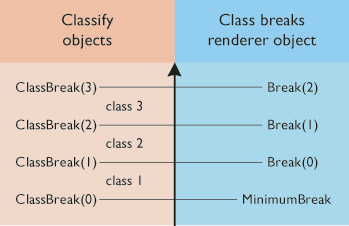
The array of class breaks (double). ClassBreaks(0) is the minimum value in the dataset, and subsequent breaks represent the upper limit of each class.
virtual object ClassBreaks { get; }Returns
Remarks
Note that the Breaks property array on the ClassBreaksRenderer has one less entry than the array returned from Classify. The first break value in the array returned from Classify is put into the ClassBreakRenderers’ MinimumBreak property. Next, copy the break values into the ClassBreaksRenderer object. You can set up the symbol property of the classes at the same time.
ClassID
The CLSID for the classification object.
virtual UID ClassID { get; }Returns
Classify(ref int)
Classifies data into the specified number of classes.
virtual void Classify(ref int numClasses)Parameters
numClassesint
Remarks
Having obtained the data values and frequencies using the SetHistogramData method, the next step is to compute some class breaks. Do this by calling the Classify method and specifying the number of classes you would like. You must supply the number of desired classes as a variable defined as a Long. Some classification algorithms will return a different number of class breaks to what you specified. The number of classes will be written back to the variable you supplied, so it is always best to recheck the number of class breaks after calling Classify.
Classify(object, object, ref int)
Classifies histogram data (array of values (doubles) and a paired array of frequencies (longs)) into the specified number of classes.
virtual void Classify(object doubleArrayValues, object longArrayFrequencies, ref int numClasses)Parameters
ClassifyMinMax(double, double, ref int)
Classifies a data range defined by a minimum and maximum value into the specified number of classes.
virtual void ClassifyMinMax(double min, double max, ref int numClasses)Parameters
IClassify_ClassBreaks
The array of class breaks (double). ClassBreaks(0) is the minimum value in the dataset, and subsequent breaks represent the upper limit of each class.
virtual object IClassify_ClassBreaks { get; }Returns
Remarks
Note that the Breaks property array on the ClassBreaksRenderer has one less entry than the array returned from Classify. The first break value in the array returned from Classify is put into the ClassBreakRenderers’ MinimumBreak property. Next, copy the break values into the ClassBreaksRenderer object. You can set up the symbol property of the classes at the same time.
IClassify_ClassID
The CLSID for the classification object.
virtual UID IClassify_ClassID { get; }Returns
IClassify_MethodName
The name of the classification method (based on choice of classification object).
virtual string IClassify_MethodName { get; }Returns
Maximum
The maximum value.
virtual double Maximum { set; }Returns
MethodName
The name of the classification method (based on choice of classification object).
virtual string MethodName { get; }Returns
Minimum
The minimum value.
virtual double Minimum { set; }Returns
SetHistogramData(object, object)
Adds data in form of a histogram (array of values (doubles) and a paired array of frequencies (longs)) to the classification.
virtual void SetHistogramData(object doubleArrayValues, object longArrayFrequencies)