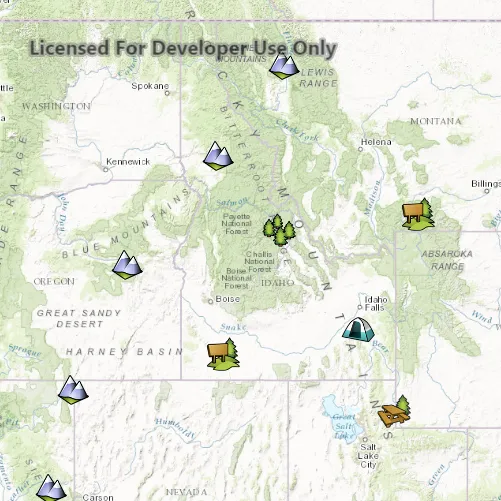
Start a local feature service and display its features in a map.
Use case
For executing offline geoprocessing tasks in your apps via an offline (local) server.
How to use the sample
A Local Server and Local Feature Service will automatically be started. Once started then a FeatureLayer will be created and added to the map.
How it works
- Create and run the Local Server.
LocalServer::instancecreates the Local Server.LocalServer::start()starts the server asynchronously.
- Wait for server to be in the
LocalServerStatus::Startedstate.LocalServer::statusChanged()fires whenever the running status of the Local Server changes.
- Create and run a local service. For example, to run a
LocalMapService:new LocalFeatureService(Url)creates a local feature service with the given URL path to the map package (mpkxfile).LocalFeatureService::start()starts the service asynchronously.- The service is added to the Local Server automatically.
- Wait for feature service to be in the
LocalServerStatus::Startedstate.LocalFeatureService::statusChanged()signal fires whenever the status of the Local Service changes.
- Create a feature layer from local feature service.
- Create a
ServiceFeatureTable(Url)from local feature service URL,LocalFeatureService::url(). - Create a
FeatureLayerusing the service feature table. - Add the feature layer to the map’s operational layers.
- Connect to the feature layer’s
LoadStatusChangedsignal. - When the feature layer’s status is
Loaded, set the map view’s extent to the layer’s full extent.
- Create a
Relevant API
- FeatureLayer
- LocalFeatureService
- LocalFeatureService::statusChanged
- LocalServer
- LocalServerStatus
Offline Data
Read more about how to set up the sample’s offline data here.
| Link | Local Location |
|---|---|
| PointsOfInterest Pro Map Package | <userhome>/ArcGIS/Runtime/Data/mpkx/PointsofInterest.mpkx |
Additional information
Local Server can be downloaded for Windows and Linux platforms. Local Server is not supported on macOS.
Tags
feature service, local, offline, server, service
Sample code
// [WriteFile Name=LocalServerFeatureLayer, Category=LocalServer]// [Legal]// Copyright 2017 Esri.//// Licensed under the Apache License, Version 2.0 (the "License");// you may not use this file except in compliance with the License.// You may obtain a copy of the License at// http://www.apache.org/licenses/LICENSE-2.0//// Unless required by applicable law or agreed to in writing, software// distributed under the License is distributed on an "AS IS" BASIS,// WITHOUT WARRANTIES OR CONDITIONS OF ANY KIND, either express or implied.// See the License for the specific language governing permissions and// limitations under the License.// [Legal]
#ifdef PCH_BUILD#include "pch.hpp"#endif // PCH_BUILD
// sample headers#include "LocalServerFeatureLayer.h"
// ArcGIS Maps SDK headers#include "Basemap.h"#include "Envelope.h"#include "FeatureLayer.h"#include "LayerListModel.h"#include "LocalFeatureService.h"#include "LocalServer.h"#include "LocalServerTypes.h"#include "Map.h"#include "MapQuickView.h"#include "MapTypes.h"#include "MapViewTypes.h"#include "ServiceFeatureTable.h"#include "Viewpoint.h"
// Qt headers#include <QDir>#include <QFile>#include <QFuture>#include <QTemporaryDir>
using namespace Esri::ArcGISRuntime;
LocalServerFeatureLayer::LocalServerFeatureLayer(QQuickItem* parent) :  QQuickItem(parent){  // Create a temporary directory for the local server if one has not already been created  if (!LocalServer::appDataPath().isEmpty() && !LocalServer::tempDataPath().isEmpty())    return;
  // create temp/data path  const QString tempPath = LocalServerFeatureLayer::shortestTempPath() + "/EsriQtTemp";
  // create the directory  m_tempDir = std::make_unique<QTemporaryDir>(tempPath);
  // set the temp & app data path for the local server  LocalServer::instance()->setTempDataPath(m_tempDir->path());  LocalServer::instance()->setAppDataPath(m_tempDir->path());}
LocalServerFeatureLayer::~LocalServerFeatureLayer() = default;
void LocalServerFeatureLayer::init(){  qmlRegisterType<MapQuickView>("Esri.Samples", 1, 0, "MapView");  qmlRegisterType<LocalServerFeatureLayer>("Esri.Samples", 1, 0, "LocalServerFeatureLayerSample");}
void LocalServerFeatureLayer::componentComplete(){  QQuickItem::componentComplete();
  // find QML MapView component  m_mapView = findChild<MapQuickView*>("mapView");  m_mapView->setWrapAroundMode(WrapAroundMode::Disabled);
  // Create a map using the topographic BaseMap  m_map = new Map(BasemapStyle::ArcGISTopographic, this);
  // Set map to map view  m_mapView->setMap(m_map);
  // Check for ArcGIS Pro map package files  const QString fileName = "PointsofInterest.mpkx";  const QString dataPath = QDir::homePath() + "/ArcGIS/Runtime/Data/mpkx/" + fileName;
  // Check to see if map package exists  if (!QFile::exists(dataPath))  {    qDebug() << "ArcGIS Pro .mpkx file not found at" << dataPath;  }
  // create a feature service  m_localFeatureService = new LocalFeatureService(dataPath, this);
  if (LocalServer::instance()->isInstallValid())  {    connectSignals();    if (LocalServer::status() == LocalServerStatus::Started)    {      qDebug() << "Local server was already running";
      // The local server can already be running if it was started in a different application.      // We start up the local feature service here because there will be no status change signal to otherwise trigger it.
      startFeatureService();    }    else if (LocalServer::status() != LocalServerStatus::Starting)    {      LocalServer::start();    }  }  else    qDebug() << "Local server install invalid";}
void LocalServerFeatureLayer::connectSignals(){  // Local server status  connect(LocalServer::instance(), &LocalServer::statusChanged, this, [this]()  {    // If the local server was not previously running, our local feature service will start here if the local server has successfully started.    if (LocalServer::status() == LocalServerStatus::Started)    {      startFeatureService();    }  });
  // local feature service status  connect(m_localFeatureService, &LocalFeatureService::statusChanged, this, [this]()  {    if (m_localFeatureService->status() == LocalServerStatus::Starting)    {      qDebug() << "Local feature service starting up";    }    else if (m_localFeatureService->status() == LocalServerStatus::Started)    {      qDebug() << "Successfully hosting local feature service at:" << m_localFeatureService->url().toString();
      // create the feature layer      ServiceFeatureTable* svt = new ServiceFeatureTable(QUrl(m_localFeatureService->url().toString() + "/0"), this);      FeatureLayer* featureLayer = new FeatureLayer(svt, this);      connect(featureLayer, &FeatureLayer::loadStatusChanged, this, [this, featureLayer](LoadStatus status)      {        if (status == LoadStatus::Loaded)        {          m_mapView->setViewpointAsync(Viewpoint(featureLayer->fullExtent()));        }      });      m_map->operationalLayers()->append(featureLayer);    }    else if (m_localFeatureService->status() == LocalServerStatus::Failed)    {      qDebug() << "Local feature service failed to start";    }  });}
void LocalServerFeatureLayer::startFeatureService() const{  if (m_localFeatureService->status() != LocalServerStatus::Started || m_localFeatureService->status() != LocalServerStatus::Starting)    m_localFeatureService->start();}
QString LocalServerFeatureLayer::shortestTempPath(){  // get tmp and home paths  const QString tmpPath = QDir::tempPath();  const QString homePath = QDir::homePath();
  // return whichever is shorter, temp or home path  if (homePath.length() > tmpPath.length())    return tmpPath;  else    return homePath;}
// [WriteFile Name=LocalServerFeatureLayer, Category=LocalServer]// [Legal]// Copyright 2017 Esri.//// Licensed under the Apache License, Version 2.0 (the "License");// you may not use this file except in compliance with the License.// You may obtain a copy of the License at// http://www.apache.org/licenses/LICENSE-2.0//// Unless required by applicable law or agreed to in writing, software// distributed under the License is distributed on an "AS IS" BASIS,// WITHOUT WARRANTIES OR CONDITIONS OF ANY KIND, either express or implied.// See the License for the specific language governing permissions and// limitations under the License.// [Legal]
#ifndef LOCAL_SERVER_FEATURELAYER_H#define LOCAL_SERVER_FEATURELAYER_H
// Qt headers#include <QQuickItem>#include <QStringListModel>
namespace Esri::ArcGISRuntime{ class Map; class MapQuickView; class LocalServer; class LocalFeatureService; class LocalService;}
class QTemporaryDir;
class LocalServerFeatureLayer : public QQuickItem{ Q_OBJECT
public: explicit LocalServerFeatureLayer(QQuickItem* parent = nullptr); ~LocalServerFeatureLayer() override;
void componentComplete() override; static void init();
private: void connectSignals(); QString shortestTempPath();
private: Esri::ArcGISRuntime::Map* m_map = nullptr; Esri::ArcGISRuntime::MapQuickView* m_mapView = nullptr; Esri::ArcGISRuntime::LocalFeatureService* m_localFeatureService = nullptr; void startFeatureService() const; std::unique_ptr<QTemporaryDir> m_tempDir;};
#endif // LOCAL_SERVER_FEATURELAYER_H// [WriteFile Name=LocalServerFeatureLayer, Category=LocalServer]// [Legal]// Copyright 2017 Esri.//// Licensed under the Apache License, Version 2.0 (the "License");// you may not use this file except in compliance with the License.// You may obtain a copy of the License at// http://www.apache.org/licenses/LICENSE-2.0//// Unless required by applicable law or agreed to in writing, software// distributed under the License is distributed on an "AS IS" BASIS,// WITHOUT WARRANTIES OR CONDITIONS OF ANY KIND, either express or implied.// See the License for the specific language governing permissions and// limitations under the License.// [Legal]
import QtQuickimport Esri.Samples
LocalServerFeatureLayerSample { id: localServerFeatureLayerSample width: 800 height: 600
// Create MapQuickView here, and create its Map etc. in C++ code MapView { anchors.fill: parent objectName: "mapView" // set focus to enable keyboard navigation focus: true
Component.onCompleted: { // Set the focus on MapView to initially enable keyboard navigation forceActiveFocus(); } }}