Learn how to create and manage an API key with ArcGIS Enterprise using API key credentials.

An API key
This tutorial shows you how to use your portal
-
Generate long-lived API keys and save them in your application.
-
Configure privileges to allow your API keys to access ArcGIS services, content, and functionality.
-
Set the expiration date and referrer URLs of an API key.
-
Manage API keys using the item page
An item page is a web page in ArcGIS Online or the developer dashboard used to access and manage the properties for an item and the content it references such as a web map, hosted layer, or file. of your API key credentials.
This tutorial focuses on creating an API key for a private application
Prerequisites
-
You need an ArcGIS Enterprise account
An ArcGIS Enterprise account is an identity for an instance of ArcGIS Enterprise. It can be used to access ArcGIS Enterprise tools, applications, and services, and to develop applications. with the correct user type and role. Please review the Product and account requirements before proceeding. -
You need to know the privileges
Privileges are a set of permissions assigned to ArcGIS accounts, developer credentials, and applications that grant access to secure resources and functionality in ArcGIS. to assign to your API key. The privileges assigned to a key allow your application to access specific ArcGIS services and resources. -
Your organization must be using ArcGIS Enterprise version 11.4 or greater. Learn more.
Steps
Sign in to your portal
You use your portal to create and manage items, including API key credentials.
- In your web browser, go to your ArcGIS Enterprise portal and sign in to your portal with your ArcGIS Enterprise account.
Create an API key credential
-
In your portal
ArcGIS portal, also known as a portal, is a website with applications and tools that can be used to create, manage, access, and share geospatial content and data. It supports security and authentication, developer credentials, content and data service management, user and group management, and site administration. A portal can be hosted in Esri's infrastructure or your own infrastructure. , click Content > My content > New item.

-
Click Developer credentials
Developer credentials are a type of item in a portal that contains parameters for authentication. There are two types of developer credentials: API key credentials and OAuth credentials. > API key credentialsAPI key credentials are an item that contains the parameters used to create and manage long-lived access tokens for API key authentication. They are a type of developer credential. and click Next.
Need troubleshooting help?
If the Developer credentials option is not visible when creating a new item, your ArcGIS Online account does not have the correct permissions. You need an ArcGIS account with a user type of Creator or higher. Learn more about user types in the ArcGIS Online documentation.
If the API key credentials option is not visible when creating developer credentials, your ArcGIS Online account does not have the correct permissions. You need an ArcGIS account with a user type of Creator or higher. Your account must also have these additional privileges:
- General privileges > Content > Generate API keys
- General privileges > Content > Assign privileges to OAuth 2.0 applications
Your organization administrator can grant you these privileges using a custom role. To learn how, go to the ArcGIS Online documentation.
Select application type
You can configure your API key credentials in this menu to align their capabilities with the type of application you are building. This menu determines the privileges that will be available for selection in the next steps.
-
In the Where will you use these credentials? menu, select Private application with selected privileges and access.

-
Click Next.
Select item privileges (optional)
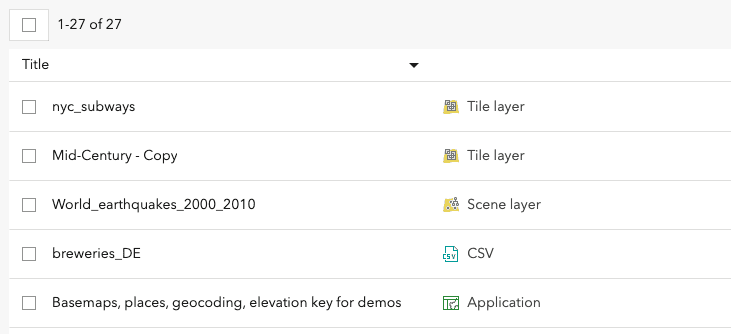
If your application will require access to specific private items, you will need to configure your developer credentials to access them. The Item access menu allows you to browse your portal's content and grant your API key access to specific items.
-
If your token does not require item access, select No item access. Then, click Next.
-
Otherwise, select Grant access to specific items.
-
Select the items you want to grant access to. You can select up to 100 items in this menu.
-
Click Next.
Select service privileges
You can configure the settings of API key credentials to configure the privileges
-
In the Create developer credentials > Privileges window, browse the available privileges.
Learn more about privileges
Browse the table below to view available privileges, privilege strings, and descriptions for ArcGIS Enterprise:
Category Label Privilege string Description Members View portal:user :view Org Users Allow application to view members of the organization. Groups Create, update, and delete portal:user :create Group Allow application to create, edit, and delete their own groups. Groups Join organizational groups portal:user :join Group Allow application to join groups within your organization. Groups View groups shared with organization portal:user :view Org Groups Allow application to view groups shared with the organization. Groups Add members from other organizations portal:user :add External Members To Group Allow application to create groups that allow members from other organizations, as well as invite external members to groups. Content Publish hosted feature layers portal:publisher :publish Features Allow application to publish hosted feature layers from shapefiles, CSVs, etc. Content Publish hosted tile layers portal:publisher :publish Tiles Allow application to publish hosted tile layers from tile packages, features, etc. Content Publish hosted scene layers portal:publisher :publish Scenes Allow application to publish hosted scene layers. Content Published hosted tiled imagery layers portal:publisher :publish Tiled Imagery Allow application to publish hosted tiled imagery layers from a single image or collection of images. Requires an ArcGIS Image for ArcGIS Online user type extension. Content Publish hosted dynamic imagery layers portal:publisher :publish Dynamic Imagery Allow application to publish hosted dynamic imagery layers from a single image or collection of images. Content View location tracks portal:user :view Tracks Allow application to view members' location tracks via shared track views when location sharing is enabled. Content Publish livestream video portal:publisher :publish Livestream Video Allow application to publish livestream videos. Content Publish real-time analytics portal:publisher :publish Real Time Analytics Allow application to publish real-time analytics to analyze and process real-time data using ArcGIS Velocity. Content Publish server-based layers portal:publisher :publish Server Services Allow application to publish server-based layers. Content Publish video portal:publisher :publish Video Allow application to publish videos. Content Register data stores portal:publisher :register Data Stores Allow application to register video stores. Content Manage feature layer webhooks portal:publisher :create Feature Webhook Allow application to manage webhooks for feature layers. Content Bulk publish from data stores portal:publisher :bulk Publish From Data Stores Allow application to bulk publish data from data stores. Content Publish big data analytics portal:publisher :publish Big Data Analytics Allow application to publish big data analytics and process historical observation data using ArcGIS Velocity. Content Publish feeds portal:publisher :publish Feeds Allow application to publish feeds. Content Publish knowledge graphs portal:publisher :publish Knowledge Graph Allow application to publish knowledge graphs. Sharing Make groups visible to organization portal:user :share Group To Org Allow application to make groups discoverable by your organization. Sharing Make groups visible to public portal:user :share Group To Public Allow application to make groups discoverable by the public. Features Edit features:user :edit Allow application to edit features in editable layers that are not public, based on the edit options enabled on the layer. Features Edit with full control features:user :full Edit Allow application to add, delete, and update features in an editable, hosted feature layer, regardless of the editing options enabled on the layer. Features Manage feature layer versions features:user :manage Versions Allow application to manage feature layer version control settings. Premium content Create notebooks premium:publisher :create Notebooks Allow application to create and edit interactive notebooks. Premium content Schedule notebooks premium:publisher :schedule Notebooks Allow application to schedule future automated runs of a notebook. Premium content Create advanced notebooks premium:publisher :create Advanced Notebooks Allow application to import and use ArcPy modules in ArcGIS Notebooks. Premium content Demographic maps premium:user :demographics Allow application to access demographic maps in ArcGIS Living Atlas. Premium content Feature report premium:user :featurereport Allow application to create feature reports in ArcGIS Survey123. Premium content Run web tools portal:user :run Web Tool Allow application to run web tools. Category Label Privilege string Description Members Update portal:admin :update Users Allow application to reset passwords, update member account information, and update member categories within your organization. Members Delete portal:admin :delete Users Allow application to delete member accounts within your organization. Members Invite portal:admin :invite Users Allow application to invite members to your organization. Members Disable portal:admin :disable Users Allow application to enable and disable member accounts within your organization. Members Change roles portal:admin :change User Roles Allow application to change the role a member account is assigned. Note, only members with the Administrator role can assign or unassign the Administrator role to other accounts. Members Manage licenses portal:admin :manage Licenses Allow application to assign licenses to members of your organization. Groups View all portal:admin :view Groups Allow application to view all groups within your organization. Groups Update portal:admin :update Groups Allow application to update groups within your organization. Groups Delete portal:admin :delete Groups Allow application to delete groups within your organization. Groups Reassign ownership portal:admin :reassign Groups Allow application to reassign groups to other members within your organization. Groups Assign members portal:admin :assign To Groups Allow application to assign your members to, update your member's group role, and remove your members from groups within your organization. Groups Link to organization-specific group portal:admin :manage Enterprise Groups Allow application to link group membership to an organization-specific group. Groups Create with leaving disallowed portal:admin :create Leaving Disallowed Group Allow application to create and own groups that do not allow members to leave (administrative groups). Content Publish web tools portal:publisher :publish Server GP Services Allow application to publish web tools. Content Geoprocessing webhook portal:admin :create GP Webhook Allow application to create geoprocessing webhooks. Content Manage servers portal:admin :manage Servers Allow application to manage servers. Content Manage webhooks portal:admin :manage Webhooks Allow application to manage webhooks. Content Create and manage administrative reports portal:admin :create Reports Allow application to create and manage administrative reports for your organization Organization settings Security and infrastructure portal:admin :manage Security Allow application to manage the organization's security and infrastructure settings. Organization settings Organization website portal:admin :manage Website Allow application to manage the organization's website settings. Organization settings Collaborations portal:admin :manage Collaborations Allow application to manage the organization's collaborations. Organization settings Member roles portal:admin :manage Roles Allow application to manage the organization's member roles. Organization settings Utility services portal:admin :manage Utility Services Allow application to manage the organization's utility service settings 
-
Select the privileges required by your application and click Next.
Need troubleshooting help?
If the Privileges window is not visible when creating API key credentials, your ArcGIS Online account does not have the correct permissions. You need an ArcGIS account with a user type of Creator or higher. Your account must also have these additional privileges:
- General privileges > Content > Generate API keys
- General privileges > Content > Assign privileges to OAuth 2.0 applications
Your organization administrator can grant you these privileges using a custom role. To learn how, go to the ArcGIS Online documentation.
If you don't see a specific privilege in the Privileges window, there are several possible reasons:
- Certain location services are only available for ArcGIS Location Platform. Check the privileges available for your product type in Security and authentication > Privileges.
- If you have an ArcGIS Location Platform account, you need to enable pay-as-you-go
Pay-as-you-go is a payment option in ArcGIS Location Platform that allows you to exceed the free usage tier and pay for additional location services and capabilities based on usage. in the Billing section of your dashboard to access some services, such as the GeoEnrichment service. - If you have an ArcGIS Online account, your account may not have the correct role to access the services you need. Contact your organization administrator.
Set the expiration date and referrers
API key credentials generate long-lived access tokens called API keys. API keys are valid for up to one year, and their expiration date is set when they are generated. You can also set referrers on an API key, which restrict the key to only be usable from authorized domains.
-
In the Create developer credentials window, click on the Expiration date field. Set the expiration date of the access token to one month from today's date.

-
Set the Referrers field to the web domains you would like to restrict the access token to. This is highly recommended for security purposes. To learn more about referrers, go to API key credentials.

-
Click Next.
Save the item
After configuring the properties of your API key credentials, save the credentials as a new item.
-
In the Create developer credentials window, set the following properties:
- Title:
My API key credentials - Folder:
Developer credentials(Create a new folder) - Tags: Add tags related to the privileges of the credentials.
- Description: Describe the application that these developer credentials will be used in.

Click Next.
- Title:
-
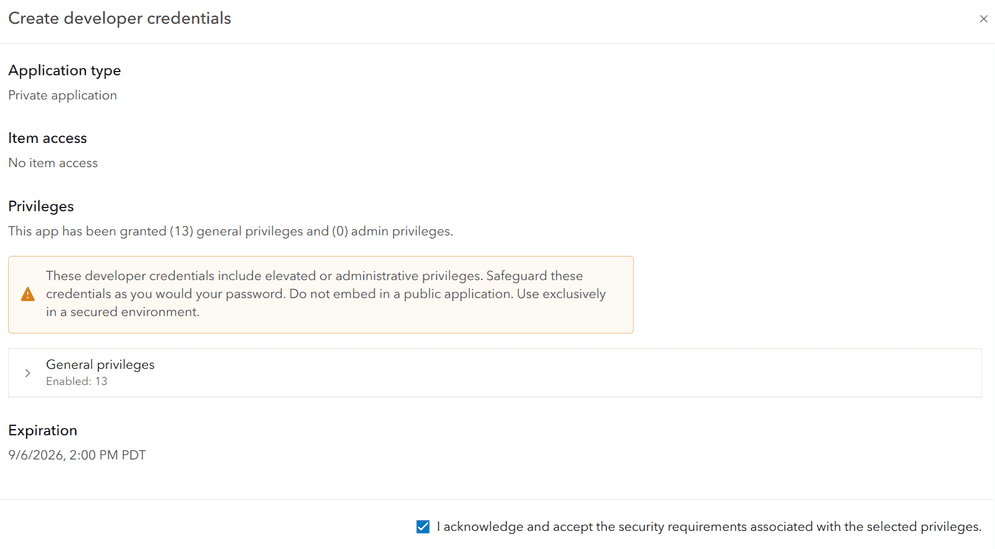
In the Summary window, review the properties, privileges, and item access you have set.
-
Click Next.
Copy the API key
-
In the Create developer credentials > Generate API key window, select Generate the API key and go to item details page. I am ready to copy and save the key.

-
Click Next.
-
Copy the API key from the window that appears and paste it into your application.

What's next?
Learn how to manage your API key credentials to generate additional keys, edit credential settings, and implement key rotation in the following tutorials:
Manage API key credentials
Manage previously created API key credentials to regenerate, edit privileges, and edit item access of API keys.