OAuth credentials are an item
Creating OAuth 2.0 credentials
Prerequisites
OAuth 2.0 credentials can be created using an ArcGIS Online account with a user type of Creator or higher. To create credentials for app authentication, the account also requires a custom role with this additional privilege
- General privileges > Content > Assign privileges to OAuth 2.0 applications
To learn more, go to the Product and account requirements.
Steps
The steps to create OAuth 2.0 credentials are explained in the Create OAuth credentials for app authentication tutorial:
Create OAuth credentials for app authentication
Both a client and client from OAuth 2.0 credentials are required to implement app authentication
Privileges
OAuth credentialsclient_id, client_secret, and redirect URIs. They are a type of developer credential.

The privileges available to OAuth credentials with an ArcGIS Online account generally include:
- ArcGIS Location Services
ArcGIS Location Services, also referred to as Location Services, are services hosted by Esri that provide geospatial functionality for developing mapping applications. They include the ArcGIS Basemap Styles service, ArcGIS Static Basemap Tiles service, ArcGIS Static Maps service, ArcGIS Places service, ArcGIS Geocoding service, ArcGIS Routing service, ArcGIS GeoEnrichment service, and ArcGIS Elevation service. An ArcGIS Location Platform or ArcGIS Online account is required to use the services. , such as the Basemap Styles serviceThe ArcGIS Basemap Styles service, also referred to as the Basemap Styles service, is a location service that provides basemap styles and data for the world. It returns styles as Mapbox styles and web maps, and data as vector tiles and/or map tiles. It supports all of the styles in the ArcGIS Basemap style and Open Basemap style family. An ArcGIS Location Platform or ArcGIS Online account is required to use the service. and Routing serviceA routing service is a service that uses network analysis and streets data to calculate the most effective path and turn-by-turn directions on a street network, optimize fleet routing and deliveries, find the closest facilities, calculate service areas, and more. It is hosted by Esri as the ArcGIS Routing service and can also be hosted in ArcGIS Enterprise. . - Portal
A portal service provides the functionality to securely create, access, and manage content, data services, users, and groups in a portal. The service can be hosted by Esri or in ArcGIS Enterprise. operations, such as managing users, items, and groups. - Spatial analysis services
Spatial analysis services are services that perform geometry and statistical analyses on feature and raster data. for performing feature and raster analysis operations.
The exact privileges available depend on the user type and role of the ArcGIS Online account that created the credentials.
Edit privileges
You can edit the privileges of your OAuth credentials to adjust the authorization level of your application.
-
Go to Settings on the item page
An item page is a web page in ArcGIS Online or the developer dashboard used to access and manage the properties for an item and the content it references such as a web map, hosted layer, or file. of your OAuth credentialsOAuth credentials are an item that contains parameters required to implement user authentication or app authentication, including a .client_id,client_secret, and redirect URIs. They are a type of developer credential. -
Under Application > Credentials, click the Edit button. In the warning that appears, click Continue. If this option is not available to your account, please refer to the Product and account requirements for app authentication.
-
Select a type of application that your key will be used in.
-
Select No item access if you do not want to grant access to any items, or select Grant access to specific items if you want to grant access to certain items in your portal. Then, click Next.
-
Select new privileges for your OAuth credentials using the privileges window. To view a list of all available privileges, go to Privileges.
-
Click Save to close the window. Then, click the Save button again under Application to update your developer credential.
Item access privileges

OAuth credentialsclient_id, client_secret, and redirect URIs. They are a type of developer credential.
The items available in this menu include all of the items owned by your account with a sharing level
Edit item access
You can edit the items that your OAuth credentials are authorized to access.
-
Go to Settings on the item page
An item page is a web page in ArcGIS Online or the developer dashboard used to access and manage the properties for an item and the content it references such as a web map, hosted layer, or file. of your OAuth credentialsOAuth credentials are an item that contains parameters required to implement user authentication or app authentication, including a .client_id,client_secret, and redirect URIs. They are a type of developer credential. -
Under Application > Credentials, click the Edit button. In the warning that appears, click Continue. If this option is not available to your account, please refer to the Product and account requirements for app authentication.
-
In the Item access window, select Grant access to specific items to grant access to specific items in your portal.
-
Select items to grant your OAuth credentials access to.
-
Click Save to close the window. Then, click the Save button again under Application to update your developer credential.
Referrers
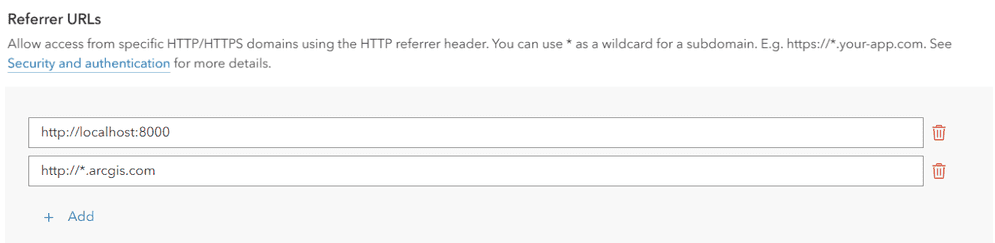
A referrer is an HTTP header field used to identify the client requesting a server resource. This functions as a security measure, allowing applications to confirm their client's identity. When OAuth credentialsclient_id, client_secret, and redirect URIs. They are a type of developer credential.referer header set, services can confirm that an incoming request's referrer matches one of the valid referrers assigned to that access token.
Specific domains can be provided or you can use wildcard characters (*) in the subdomain of your allowed referrer. For example https will allow the access token to be used on both https and https. While it is also possible to restrict access token use to specific paths (https), we do not recommend this method because browsers may remove the path due to privacy concerns.
Usage tracking
All services and content accessed with OAuth credentialsclient_id, client_secret, and redirect URIs. They are a type of developer credential.
ArcGIS Online developers use their portalclient_id, client_secret, and redirect URIs. They are a type of developer credential.
-
Go to ArcGIS.com and sign in to your portal
ArcGIS portal, also known as a portal, is a website with applications and tools that can be used to create, manage, access, and share geospatial content and data. It supports security and authentication, developer credentials, content and data service management, user and group management, and site administration. A portal can be hosted in Esri's infrastructure or your own infrastructure. with an ArcGIS Online accountAn ArcGIS Online account, also known as an ArcGIS Organization account, is an identity associated with an ArcGIS Online subscription. It can be used to access ArcGIS tools and develop applications with ArcGIS location services for an organization. . -
Click Content > My content.
-
Find the OAuth credentials
OAuth credentials are an item that contains parameters required to implement user authentication or app authentication, including a item you would like to review usage for. Go to its item pageclient_id,client_secret, and redirect URIs. They are a type of developer credential.An item page is a web page in ArcGIS Online or the developer dashboard used to access and manage the properties for an item and the content it references such as a web map, hosted layer, or file. . -
Click Settings > Application > View usage.

-
Review the usage report for the OAuth credentials
OAuth credentials are an item that contains parameters required to implement user authentication or app authentication, including a . The Credits view displays the number of credits the application has consumed. The Users view displays the number of users who have signed in to your application, if applicable.client_id,client_secret, and redirect URIs. They are a type of developer credential.
In addition to these steps, ArcGIS Online administrators can use the portal