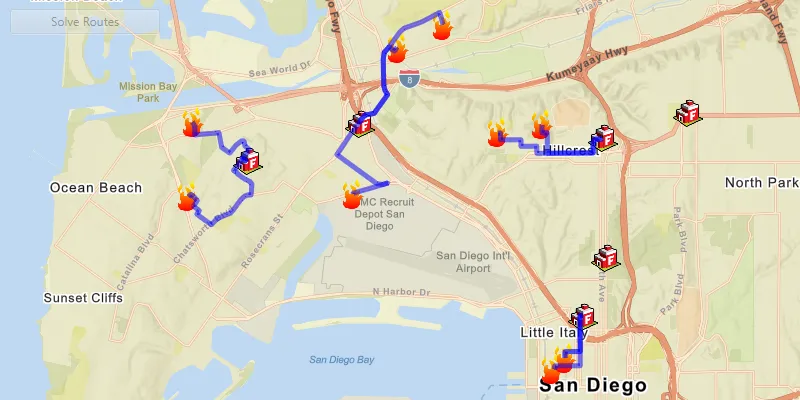
Find routes from several locations to the respective closest facility.
Use case
Quickly and accurately determining the most efficient route between a location and a facility is a frequently encountered task. For example, a city’s fire department may need to know which fire stations in the vicinity offer the quickest routes to multiple fires. Solving for the closest fire station to the fire’s location using an impedance of “travel time” would provide this information.
How to use the sample
Click the ‘Solve Routes’ button to solve and display the route from each incident (fire) to the nearest facility (fire station).
How it works
- Create a
ClosestFacilityTaskusing a URL from an online service. - Get the default set of
ClosestFacilityParametersfrom the task:closestFacilityTask.createDefaultParametersAsync().get(). - Build a list of all
Facilitys andIncidents:
- Create a
FeatureTableusingServiceFeatureTable(Uri). - Query the
FeatureTablefor allFeatures usingqueryFeaturesAsync(queryParameters). - Iterate over the result and add each
Featureto theList, instantiating the feature as aFacilityorIncident.
- Add a list of all facilities to the task parameters:
closestFacilityParameters.setFacilities(facilitiesList). - Add a list of all incidents to the task parameters:
closestFacilityParameters.setIncidents(incidentsList). - Get
ClosestFacilityResultby solving the task with the provided parameters:closestFacilityTask.solveClosestFacilityAsync(closestFacilityParameters). - Find the closest facility for each incident by iterating over the list of
Incidents. - Display the route as a
Graphicusing theclosestFacilityRoute.getRouteGeometry().
Relevant API
- ClosestFacilityParameters
- ClosestFacilityResult
- ClosestFacilityRoute
- ClosestFacilityTask
- Facility
- Graphic
- GraphicsOverlay
- Incident
Tags
facility, incident, network analysis, route, search
Sample code
ClosestFacilityStaticSample.java
/* * Copyright 2019 Esri. * * Licensed under the Apache License, Version 2.0 (the "License"); you may not * use this file except in compliance with the License. You may obtain a copy of * the License at * * http://www.apache.org/licenses/LICENSE-2.0 * * Unless required by applicable law or agreed to in writing, software * distributed under the License is distributed on an "AS IS" BASIS, WITHOUT * WARRANTIES OR CONDITIONS OF ANY KIND, either express or implied. See the * License for the specific language governing permissions and limitations under * the License. */
package com.esri.samples.closest_facility_static;
import java.util.ArrayList;import java.util.Arrays;import java.util.concurrent.ExecutionException;
import javafx.application.Application;import javafx.geometry.Insets;import javafx.geometry.Pos;import javafx.scene.Scene;import javafx.scene.control.Alert;import javafx.scene.control.Button;import javafx.scene.control.ProgressIndicator;import javafx.scene.image.Image;import javafx.scene.layout.StackPane;import javafx.scene.paint.Color;import javafx.stage.Stage;
import com.esri.arcgisruntime.ArcGISRuntimeEnvironment;import com.esri.arcgisruntime.concurrent.ListenableFuture;import com.esri.arcgisruntime.data.Feature;import com.esri.arcgisruntime.data.FeatureQueryResult;import com.esri.arcgisruntime.data.FeatureTable;import com.esri.arcgisruntime.data.QueryParameters;import com.esri.arcgisruntime.data.ServiceFeatureTable;import com.esri.arcgisruntime.geometry.Envelope;import com.esri.arcgisruntime.geometry.GeometryEngine;import com.esri.arcgisruntime.geometry.Point;import com.esri.arcgisruntime.layers.FeatureLayer;import com.esri.arcgisruntime.loadable.LoadStatus;import com.esri.arcgisruntime.mapping.ArcGISMap;import com.esri.arcgisruntime.mapping.BasemapStyle;import com.esri.arcgisruntime.mapping.view.Graphic;import com.esri.arcgisruntime.mapping.view.GraphicsOverlay;import com.esri.arcgisruntime.mapping.view.MapView;import com.esri.arcgisruntime.symbology.PictureMarkerSymbol;import com.esri.arcgisruntime.symbology.SimpleLineSymbol;import com.esri.arcgisruntime.symbology.SimpleRenderer;import com.esri.arcgisruntime.tasks.networkanalysis.ClosestFacilityParameters;import com.esri.arcgisruntime.tasks.networkanalysis.ClosestFacilityResult;import com.esri.arcgisruntime.tasks.networkanalysis.ClosestFacilityRoute;import com.esri.arcgisruntime.tasks.networkanalysis.ClosestFacilityTask;import com.esri.arcgisruntime.tasks.networkanalysis.Facility;import com.esri.arcgisruntime.tasks.networkanalysis.Incident;
public class ClosestFacilityStaticSample extends Application {
  private ClosestFacilityTask closestFacilityTask; // keep loadables in scope to avoid garbage collection  private MapView mapView;
  @Override  public void start(Stage stage) throws Exception {
    try {      // create stack pane and application scene      StackPane stackPane = new StackPane();      Scene scene = new Scene(stackPane);
      // set title, size, and add scene to stage      stage.setTitle("Closest Facility (Static) Sample");      stage.setWidth(800);      stage.setHeight(700);      stage.setScene(scene);      stage.show();
      // authentication with an API key or named user is required to access basemaps and other location services      String yourAPIKey = System.getProperty("apiKey");      ArcGISRuntimeEnvironment.setApiKey(yourAPIKey);
      // create buttons      var solveRoutesButton = new Button("Solve Routes");      solveRoutesButton.setMaxWidth(150);      solveRoutesButton.setDisable(true);
      // create a progress indicator      var progressIndicator = new ProgressIndicator();      progressIndicator.setVisible(true);
      // create a map with the streets relief basemap style      ArcGISMap map = new ArcGISMap(BasemapStyle.ARCGIS_STREETS_RELIEF);
      // create a map view and set the map to it      mapView = new MapView();      mapView.setMap(map);
      // create a graphics overlay and add it to the map      var graphicsOverlay = new GraphicsOverlay();      mapView.getGraphicsOverlays().add(graphicsOverlay);
      // create Symbols for displaying facilities      PictureMarkerSymbol facilitySymbol = new PictureMarkerSymbol(new Image("https://static.arcgis.com/images/Symbols/SafetyHealth/FireStation.png", 30, 30, true, false));      PictureMarkerSymbol incidentSymbol = new PictureMarkerSymbol(new Image("https://static.arcgis.com/images/Symbols/SafetyHealth/esriCrimeMarker_56_Gradient.png", 30, 30, true, false));
      // create a line symbol to mark the route      var simpleLineSymbol = new SimpleLineSymbol(SimpleLineSymbol.Style.SOLID, Color.web("blue", 0.4), 5.0f);
      // create a closest facility task from a network analysis service      closestFacilityTask = new ClosestFacilityTask("https://sampleserver6.arcgisonline.com/arcgis/rest/services/NetworkAnalysis/SanDiego/NAServer/ClosestFacility");
      // create a table for facilities using the feature service      FeatureTable facilitiesFeatureTable = new ServiceFeatureTable("https://services2.arcgis.com/ZQgQTuoyBrtmoGdP/ArcGIS/rest/services/San_Diego_Facilities/FeatureServer/0");      // create a feature layer from the table, apply facilities icon      FeatureLayer facilitiesFeatureLayer = new FeatureLayer(facilitiesFeatureTable);      facilitiesFeatureLayer.setRenderer(new SimpleRenderer(facilitySymbol));
      // create a table for incidents using the feature service      FeatureTable incidentsFeatureTable = new ServiceFeatureTable("https://services2.arcgis.com/ZQgQTuoyBrtmoGdP/ArcGIS/rest/services/San_Diego_Incidents/FeatureServer/0");      // create a feature layer from the table, apply incident icon      FeatureLayer incidentsFeatureLayer = new FeatureLayer(incidentsFeatureTable);      incidentsFeatureLayer.setRenderer(new SimpleRenderer(incidentSymbol));
      // add the layers to the map      map.getOperationalLayers().addAll(Arrays.asList(facilitiesFeatureLayer, incidentsFeatureLayer));
      // create the list to store the facilities      ArrayList<Facility> facilities = new ArrayList<>();
      // create the list to store the incidents      ArrayList<Incident> incidents = new ArrayList<>();
      // wait for the feature layers to load to retrieve the facilities and incidents      facilitiesFeatureLayer.addDoneLoadingListener(() -> incidentsFeatureLayer.addDoneLoadingListener(() -> {        if (facilitiesFeatureLayer.getLoadStatus() == LoadStatus.LOADED && incidentsFeatureLayer.getLoadStatus() == LoadStatus.LOADED) {
          // hide the progress indicator          progressIndicator.setVisible(false);
          // zoom to the extent of the combined feature layers          Envelope fullFeatureLayerExtent = GeometryEngine.combineExtents(facilitiesFeatureLayer.getFullExtent(), incidentsFeatureLayer.getFullExtent());          mapView.setViewpointGeometryAsync(fullFeatureLayerExtent, 90);
          // create query parameters to select all features          QueryParameters queryParameters = new QueryParameters();          queryParameters.setWhereClause("1=1");
          // retrieve a list of all facilities          ListenableFuture<FeatureQueryResult> result = facilitiesFeatureTable.queryFeaturesAsync(queryParameters);          result.addDoneListener(() -> {            try {              FeatureQueryResult facilitiesResult = result.get();
              // add the found facilities to the list              for (Feature facilityFeature : facilitiesResult) {                // since we know our feature layer only contains point features, we can cast them as Point in order to create a Facility                facilities.add(new Facility((Point) facilityFeature.getGeometry()));              }
            } catch (InterruptedException | ExecutionException e) {              new Alert(Alert.AlertType.ERROR, "Error retrieving list of facilities.").show();            }          });
          // retrieve a list of all incidents          ListenableFuture<FeatureQueryResult> incidentsQueryResult = incidentsFeatureTable.queryFeaturesAsync(queryParameters);          incidentsQueryResult.addDoneListener(() -> {            try {              FeatureQueryResult incidentsResult = incidentsQueryResult.get();
              // add the found incidents to the list              for (Feature incidentFeature : incidentsResult) {                // since we know our feature layer only contains point features, we can cast them as Point in order to create an Incident                incidents.add(new Incident((Point) incidentFeature.getGeometry()));              }
            } catch (InterruptedException | ExecutionException e) {              new Alert(Alert.AlertType.ERROR, "Error retrieving list of incidents.").show();            }          });
          // enable the 'solve routes' button          solveRoutesButton.setDisable(false);
          // resolve button press          solveRoutesButton.setOnAction(e -> {
            // disable the 'solve routes' button and show the progress indicator            solveRoutesButton.setDisable(true);            progressIndicator.setVisible(true);
            // start the routing task            closestFacilityTask.loadAsync();            closestFacilityTask.addDoneLoadingListener(() -> {              if (closestFacilityTask.getLoadStatus() == LoadStatus.LOADED) {                try {                  // create default parameters for the task and add facilities and incidents to parameters                  ClosestFacilityParameters closestFacilityParameters = closestFacilityTask.createDefaultParametersAsync().get();                  closestFacilityParameters.setFacilities(facilities);                  closestFacilityParameters.setIncidents(incidents);
                  // solve closest facilities                  try {                    // use the task to solve for the closest facility                    ListenableFuture<ClosestFacilityResult> closestFacilityTaskResult = closestFacilityTask.solveClosestFacilityAsync(closestFacilityParameters);                    closestFacilityTaskResult.addDoneListener(() -> {                      try {                        ClosestFacilityResult closestFacilityResult = closestFacilityTaskResult.get();
                        // find the closest facility for each incident                        for (int incidentIndex = 0; incidentIndex < incidents.size(); incidentIndex++) {
                          // get the index of the closest facility to incident                          Integer closestFacilityIndex = closestFacilityResult.getRankedFacilityIndexes(incidentIndex).get(0);
                          // get the route to the closest facility                          ClosestFacilityRoute closestFacilityRoute = closestFacilityResult.getRoute(closestFacilityIndex, incidentIndex);
                          // display the route on the graphics overlay                          graphicsOverlay.getGraphics().add(new Graphic(closestFacilityRoute.getRouteGeometry(), simpleLineSymbol));
                          // hide the progress indicator                          progressIndicator.setVisible(false);                        }
                      } catch (ExecutionException | InterruptedException ex) {                        new Alert(Alert.AlertType.ERROR, "Error getting the closest facility task result.").show();                      }                    });
                  } catch (Exception ex) {                    new Alert(Alert.AlertType.ERROR, "Error solving the closest facility task.").show();                  }
                } catch (InterruptedException | ExecutionException ex) {                  new Alert(Alert.AlertType.ERROR, "Error getting default route parameters.").show();                }
              } else {                new Alert(Alert.AlertType.ERROR, "Error loading route task.").show();              }            });          });        }      })      );
      // add the map view, control panel and progress indicator to the stack pane      stackPane.getChildren().addAll(mapView, solveRoutesButton, progressIndicator);      StackPane.setAlignment(solveRoutesButton, Pos.TOP_LEFT);      StackPane.setMargin(solveRoutesButton, new Insets(10, 0, 0, 10));
    } catch (Exception e) {      e.printStackTrace();    }  }
  /**   * Stops and releases all resources used in application.   */  @Override  public void stop() {
    if (mapView != null) {      mapView.dispose();    }  }
  /**   * Opens and runs application.   *   * @param args arguments passed to this application   */  public static void main(String[] args) {
    Application.launch(args);  }}