Change the appearance of a feature layer with a renderer.
Use case
A feature layer hosted on ArcGIS Online has a preset renderer and will display in your app with that renderer. However, for example, the color associated with the original renderer may be unsuitable for a company with staff or clients who are color blind, or for presentation with a different set of basemap and operational layers. In these cases, the renderer on the feature layer’s data can be set to a more suitable color.
How to use the sample
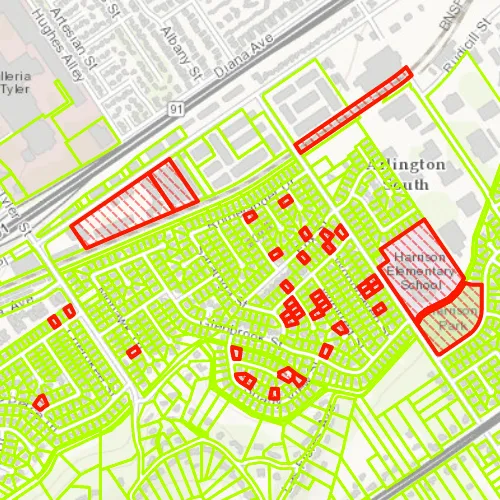
Use the button to change the renderer on the feature layer. The original renderer displays orange circles, the diameters of which are proportional to carbon storage of each tree. When the blue renderer in this sample is applied, it displays the location of the trees simply as blue points.
How it works
- Create a
ServiceFeatureTablefrom a URL. - Create a
FeatureLayerfrom the service feature table. - Create a new renderer (in this case, a
SimpleRenderer). - Change the feature layer’s renderer using
FeatureLayer::setRenderer(SimpleRenderer).
Relevant API
- FeatureLayer::setRenderer
- ServiceFeatureTable
- SimpleRenderer
About the data
This sample displays a feature layer in Warren Wilson College, North Carolina, showing carbon storage of trees on campus. The size of each circle is proportional to that particular tree’s carbon storage total.
Tags
feature layer, renderer, visualization
Sample code
// [WriteFile Name=FeatureLayerChangeRenderer, Category=Features]// [Legal]// Copyright 2016 Esri.//// Licensed under the Apache License, Version 2.0 (the "License");// you may not use this file except in compliance with the License.// You may obtain a copy of the License at// http://www.apache.org/licenses/LICENSE-2.0//// Unless required by applicable law or agreed to in writing, software// distributed under the License is distributed on an "AS IS" BASIS,// WITHOUT WARRANTIES OR CONDITIONS OF ANY KIND, either express or implied.// See the License for the specific language governing permissions and// limitations under the License.// [Legal]
#ifdef PCH_BUILD#include "pch.hpp"#endif // PCH_BUILD
// sample headers#include "FeatureLayerChangeRenderer.h"
// ArcGIS Maps SDK headers#include "Basemap.h"#include "Envelope.h"#include "FeatureLayer.h"#include "LayerListModel.h"#include "Map.h"#include "MapQuickView.h"#include "MapTypes.h"#include "MapViewTypes.h"#include "ServiceFeatureTable.h"#include "SimpleLineSymbol.h"#include "SimpleRenderer.h"#include "SpatialReference.h"#include "SymbolTypes.h"#include "Viewpoint.h"
// Qt headers#include <QColor>#include <QUrl>
using namespace Esri::ArcGISRuntime;
FeatureLayerChangeRenderer::FeatureLayerChangeRenderer(QQuickItem* parent) :  QQuickItem(parent){}
FeatureLayerChangeRenderer::~FeatureLayerChangeRenderer() = default;
void FeatureLayerChangeRenderer::init(){  qmlRegisterType<MapQuickView>("Esri.Samples", 1, 0, "MapView");  qmlRegisterType<FeatureLayerChangeRenderer>("Esri.Samples", 1, 0, "FeatureLayerChangeRendererSample");}
void FeatureLayerChangeRenderer::componentComplete(){  QQuickItem::componentComplete();
  // find QML MapView component  m_mapView = findChild<MapQuickView*>("mapView");  m_mapView->setWrapAroundMode(WrapAroundMode::Disabled);
  // Create a map using the topographic basemap  m_map = new Map(BasemapStyle::ArcGISTopographic, this);  m_map->setInitialViewpoint(Viewpoint(Envelope(-13075816.4047166, 4014771.46954516, -13073005.6797177, 4016869.78617381, SpatialReference(102100))));
  // Set map to map view  m_mapView->setMap(m_map);
  // create the feature table  ServiceFeatureTable* featureTable = new ServiceFeatureTable(QUrl("https://sampleserver6.arcgisonline.com/arcgis/rest/services/PoolPermits/FeatureServer/0"), this);  // create the feature layer using the feature table  m_featureLayer = new FeatureLayer(featureTable, this);
  connect(m_featureLayer, &FeatureLayer::loadStatusChanged, this, [this](LoadStatus loadStatus)  {    loadStatus == LoadStatus::Loaded ? m_initialized = true : m_initialized = false;    emit layerInitializedChanged();  });
  // add the feature layer to the map  m_map->operationalLayers()->append(m_featureLayer);}
bool FeatureLayerChangeRenderer::layerInitialized() const{  return m_initialized;}
void FeatureLayerChangeRenderer::changeRenderer(){  if (m_stateChanged)  {    m_featureLayer->resetRenderer();    m_stateChanged = false;  }  else  {    // create a line symbol    SimpleLineSymbol* sls = new SimpleLineSymbol(SimpleLineSymbolStyle::Solid, QColor(0, 0, 255, 204), 2.0f, this);    // create a renderer with the symbol above    SimpleRenderer* simpleRenderer = new SimpleRenderer(sls, this);    // change the renderer with the renderer created above    m_featureLayer->setRenderer(simpleRenderer);    m_stateChanged = true;  }}
// [WriteFile Name=FeatureLayerChangeRenderer, Category=Features]// [Legal]// Copyright 2016 Esri.//// Licensed under the Apache License, Version 2.0 (the "License");// you may not use this file except in compliance with the License.// You may obtain a copy of the License at// http://www.apache.org/licenses/LICENSE-2.0//// Unless required by applicable law or agreed to in writing, software// distributed under the License is distributed on an "AS IS" BASIS,// WITHOUT WARRANTIES OR CONDITIONS OF ANY KIND, either express or implied.// See the License for the specific language governing permissions and// limitations under the License.// [Legal]
#ifndef FEATURE_LAYER_CHANGE_RENDERER_H#define FEATURE_LAYER_CHANGE_RENDERER_H
// Qt headers#include <QQuickItem>
namespace Esri::ArcGISRuntime{ class Map; class MapQuickView; class FeatureLayer;}
class FeatureLayerChangeRenderer : public QQuickItem{ Q_OBJECT
Q_PROPERTY(bool layerInitialized READ layerInitialized NOTIFY layerInitializedChanged)
public: explicit FeatureLayerChangeRenderer(QQuickItem* parent = nullptr); ~FeatureLayerChangeRenderer() override;
void componentComplete() override; static void init(); Q_INVOKABLE void changeRenderer();
signals: void layerInitializedChanged();
private: bool layerInitialized() const;
private: Esri::ArcGISRuntime::Map* m_map = nullptr; Esri::ArcGISRuntime::MapQuickView* m_mapView = nullptr; Esri::ArcGISRuntime::FeatureLayer* m_featureLayer = nullptr; bool m_initialized = false; bool m_stateChanged = false;};
#endif // FEATURE_LAYER_CHANGE_RENDERER_H// [WriteFile Name=FeatureLayerChangeRenderer, Category=Features]// [Legal]// Copyright 2016 Esri.//// Licensed under the Apache License, Version 2.0 (the "License");// you may not use this file except in compliance with the License.// You may obtain a copy of the License at// http://www.apache.org/licenses/LICENSE-2.0//// Unless required by applicable law or agreed to in writing, software// distributed under the License is distributed on an "AS IS" BASIS,// WITHOUT WARRANTIES OR CONDITIONS OF ANY KIND, either express or implied.// See the License for the specific language governing permissions and// limitations under the License.// [Legal]
import QtQuickimport QtQuick.Controlsimport Esri.Samples
FeatureLayerChangeRendererSample { id: changeRendererSample width: 800 height: 600
// add a mapView component MapView { anchors.fill: parent objectName: "mapView"
Component.onCompleted: { // Set the focus on MapView to initially enable keyboard navigation forceActiveFocus(); } }
Row { anchors { bottom: parent.bottom left: parent.left right: parent.right margins: 5 bottomMargin: 25 } spacing: 5
// button to change renderer Button { text: "Change Renderer" enabled: changeRendererSample.layerInitialized onClicked: { // Call C++ invokable function to change the layer's renderer changeRendererSample.changeRenderer(); } } }}