Maps
You can use a scene
- Display a basemap layer
A basemap layer is the layer in a map or scene that displays basemap data. The data source for a basemap layer is typically a basemap service. such as streets or satellite imagery. - Access and display data layers
A data layer is a layer that references geographic data from a file or a service and is used to visualize the data in a map or scene. based on files or services, including data you have authored. - Display terrain with an elevation layer
An elevation layer is a layer that defines the ground height or the surface for a scene. . - Display real-world objects such as buildings, cars, and trees.
- Display 3D visualizations of 2D objects.
- Perform 3D analysis, such as line-of-sight, visibility, and 3D measurements.
- Provide context for temporary points, lines, polygons, or text displayed as graphics
A graphic is a visual element composed of a geometry, symbol, and attributes that is displayed on a map or scene. . - Measure distance and explore spatial relationships between geometries
A geometry is a geometric shape, such as a point, polyline, or polygon, that contains one or more coordinates and a spatial reference. . - Inspect data layers and display information from attributes
Attributes are fields and values for a single feature or non-spatial record. They are typically stored in a database or service such as a feature service. .
How a scene works
A scene
For offline
Scene
A scene contains a collection of layers
You can instantiate a new Scene object by creating a new scene and building it entirely with code. With this approach, you typically first add a basemap layer
// Set your API key during app initialization. // ArcGISEnvironment.apiKey = APIKey("<#YOUR-ACCESS-TOKEN#>") // Creates a scene with a basemap style. let scene = Scene(basemapStyle: .arcGISTopographic) // Creates an elevation source with a URL. let worldElevationServiceURL = URL(string: "https://elevation3d.arcgis.com/arcgis/rest/services/WorldElevation3D/Terrain3D/ImageServer")! // Creates and adds the elevation source to the surface. let elevationSource = ArcGISTiledElevationSource(url: worldElevationServiceURL) let surface = Surface() surface.addElevationSource(elevationSource) // Adds the surface to the scene. scene.baseSurface = surfaceYou can also instantiate a Scene that’s stored in a portal
let portalID = PortalItem.ID("579f97b2f3b94d4a8e48a5f140a6639b")! let portalItem = PortalItem(portal: .arcGISOnline(connection: .anonymous), id: portalID) let scene = Scene(item: portalItem)When the Scene first appears in the SceneView, you can focus the initial display at a specified view point with the GeoModel.initialViewpoint method. If an initial view point is not defined, the scene will initially display at a global scale.
Layer
Each layer
Scenes can also contain scene layers
The Layer class is the base class for all types of layers. The type of layer you create depends on the type of data you want to display. For example, to display feature data (point, line, or polygon geometry), for example, you can create a FeatureLayer that references an online service (such as a feature serviceArcGISVectorTiledLayer and AnnotationLayer. Similarly, 3D layers cannot be displayed in a mapArcGISSceneLayer.
        // Set your API key during app initialization.        // ArcGISEnvironment.apiKey = APIKey("<#YOUR-ACCESS-TOKEN#>")
        let scene = Scene(            basemapStyle: .arcGISTopographic        )
        let trailheadsLayer = FeatureLayer(            featureTable: ServiceFeatureTable(                url:                    URL(string: "https://services3.arcgis.com/GVgbJbqm8hXASVYi/arcgis/rest/services/Trailheads_Styled/FeatureServer/0")!            )        )        let trailsLayer = FeatureLayer(            featureTable: ServiceFeatureTable(                url:                    URL(string: "https://services3.arcgis.com/GVgbJbqm8hXASVYi/arcgis/rest/services/Trails_Styled/FeatureServer/0")!            )        )
        let openSpaceLayer = FeatureLayer(            featureTable: ServiceFeatureTable(                url:                    URL(string: "https://services3.arcgis.com/GVgbJbqm8hXASVYi/arcgis/rest/services/Parks_and_Open_Space_Styled/FeatureServer/0")!            )        )
        scene.addOperationalLayers([trailheadsLayer, trailsLayer, openSpaceLayer])
Camera
Scenes and scene views extend the concept of two dimensional viewpoints with a camera
The following properties define the camera position:
- Geographic location on the surface (longitude and latitude)
- Altitude (height, in meters, above sea level)
- Heading (angle about the z axis the camera is rotated, in degrees)
- Pitch (angle the camera is rotated up or down, in degrees)
- Roll (angle the camera is rotated side-to-side, in degrees)
let point = Point(x: -118.804, y: 34.027, z: 5330.0, spatialReference: .wgs84) let camera = Camera(location: point, heading: 355.0, pitch: 72.0, roll: 0) scene.initialViewpoint = Viewpoint(boundingGeometry: point, camera: camera)A scene view
When a camera controller other than the default GlobeCameraController is active, the scene view’s viewpoint cannot be assigned. Attempts to do so do not raise an exception, but they are ignored.
    let orbitCameraController: OrbitGeoElementCameraController = {        let plane3D = Graphic()        let orbitCameraController = OrbitGeoElementCameraController(target: plane3D, distance: 26)        orbitCameraController.cameraPitchOffset = 75.0        return orbitCameraController    }()
    var body: some View {        SceneView(scene: scene, cameraController: orbitCameraController)    }
The following camera controllers are provided:
GlobeCameraController(default)—Provides the default scene view camera behavior. Allows the user to freely move and focus the camera anywhere in the scene.OrbitGeoElementCameraController—Locks the scene view’s camera to maintain focus relative to a (possibly moving) graphic. The camera can only move relative to the target graphic.OrbitLocationCameraController—Locks the scene view’s camera to orbit a fixed location (map point). The camera can only move relative to the target map point.TransformationMatrixCameraController—Provides navigation by using aTransformationMatrixto control the camera’s location and rotation. You need to pass this object to allTransformationMatrixCameraControllerfunctions. This can be used with transformation matrices produced by Augmented Reality APIs like ARKit (iOS) and ARCore (Android).
SceneView
A scene view
After creating a scene view
Add a Scene to a SceneView control to display it. Changes you make to the scene, such as adding, removing, or reording layers, will immediately be reflected in the display. The GeoModel.initialViewpoint method will set the area shown when the scene loads.
var body: some View { SceneView(scene: scene, cameraController: orbitCameraController) }A scene view
- Adjust light, atmosphere, and space effects.
- Display image overlays on the scene surface.
- Lock the camera to a location or geoelement
A geoelement refers to any geographic element in a map or map view that can be identified by its location to return attribute information. . - Add analysis overlays to visualize analysis results.
- Identify and select features using a mouse or tap location.
- Export an image of the current display.
- Apply a time extent to filter the display of features.
Examples
Display a scene with elevation
This example uses a Scene and SceneView to display the topographic basemap layerCamera is created to define the initial view of the scene.
Steps
- Create a
Sceneand add a basemap layerA basemap layer is the layer in a map or scene that displays basemap data. The data source for a basemap layer is typically a basemap service. . - Use an elevation service with
Scene.baseSurfaceto define a base surface. - Create a
SceneViewand set the cameraA camera defines the rendering viewpoint of a 3D scene in a scene view. position.
5 collapsed lines
import SwiftUIimport ArcGIS
struct SceneElevationView: View {
// Set your API key during app initialization. // ArcGISEnvironment.apiKey = APIKey("<#YOUR-ACCESS-TOKEN#>") @State private var scene: ArcGIS.Scene = { // Creates a scene with a basemap style. let scene = Scene(basemapStyle: .arcGISTopographic) // Creates an elevation source with a URL. let worldElevationServiceURL = URL(string: "https://elevation3d.arcgis.com/arcgis/rest/services/WorldElevation3D/Terrain3D/ImageServer")! // Creates and adds the elevation source to the surface. let elevationSource = ArcGISTiledElevationSource(url: worldElevationServiceURL) let surface = Surface() surface.addElevationSource(elevationSource) // Adds the surface to the scene. scene.baseSurface = surface // Creates an initial viewpoint with a point and camera. let point = Point(x: -118.804, y: 34.027, z: 5330.0, spatialReference: .wgs84) let camera = Camera(location: point, heading: 355.0, pitch: 72.0, roll: 0) scene.initialViewpoint = Viewpoint(boundingGeometry: point, camera: camera) return scene }()
var body: some View { // Displays the model's scene. SceneView(scene: scene) }2 collapsed lines
}Display a scene from a mobile scene package
This example displays a scene
Steps
- Create a
MobileScenePackageusing the path to a local .mspk file. - Call
MobileScenePackage.load()to load the package. - When the package loads, get the first scene from the package using
MobileScenePackage.scenes. - Display the scene in a
SceneView.
5 collapsed lines
import SwiftUIimport ArcGIS
struct MobileSceneView: View {
// Set your API key during app initialization. // ArcGISEnvironment.apiKey = APIKey("<#YOUR-ACCESS-TOKEN#>") @State private var scene = Scene()
func loadMobileScenePackage() async throws { // Creates a mobile scene package with a local file. let fileURL = Bundle.main.url(forResource: "Philadelphia", withExtension: "mspk")! let scenePackage = MobileScenePackage(fileURL: fileURL) try await scenePackage.load() // Gets the first map in the mobile map package. guard let scene = scenePackage.scenes.first else { return } self.scene = scene }
var body: some View { SceneView(scene: scene) .task { do { try await loadMobileScenePackage() } catch { // Prints an error message if the map fails to load. print("Error loading mobile map scene package.") } } }2 collapsed lines
}Tutorials


Samples
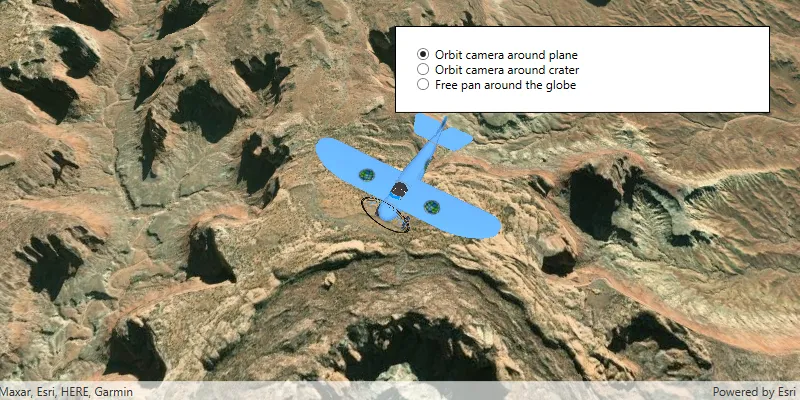
Change camera controller

Show realistic light and shadows

Animate images with image overlay

Display a web scene from a portal item

Display scene from a mobile scene package
