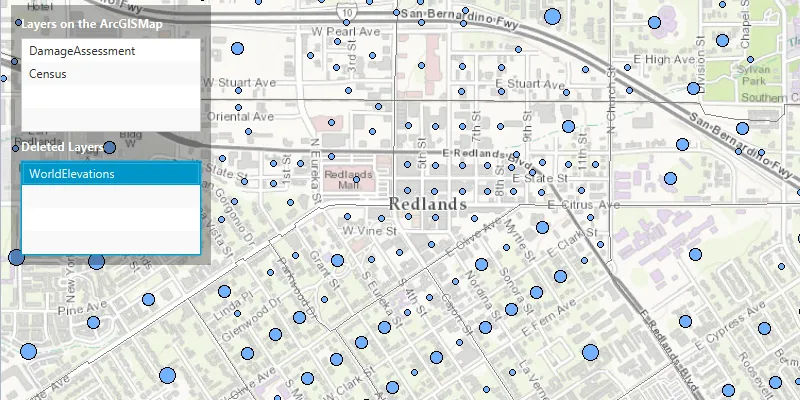
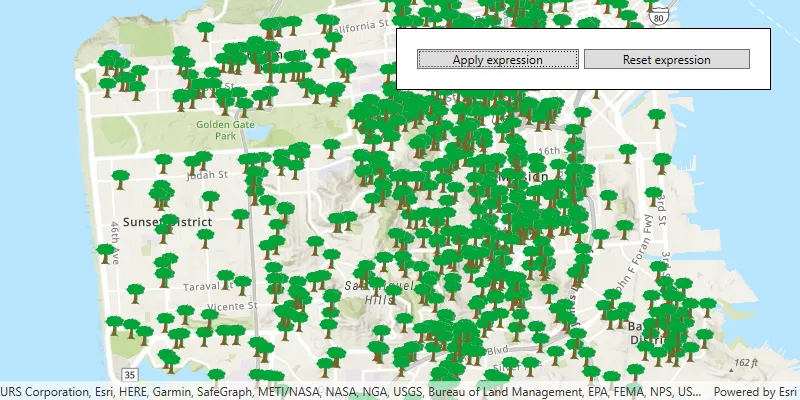
Maps A map is a collection of layers that are displayed in 2D. It is typically composed of a basemap layer and data layers. Learn more and scenes A scene is a collection of layers that are displayed in 3D. It is typically composed of a basemap layer, data layers, and 3D data. Learn more use a collection of layers A layer is a reference to a collection of geographic data that is used to access and display data. The data for layers are typically provided by the basemap layer service and data services. Learn more to display geographic data from a variety of sources and formats. These can include several basemap layers A basemap layer is the layer in a map or scene that displays basemap data. The data source for a basemap layer is typically a basemap service. Learn more and data layers A data layer is a layer that references geographic data from a file or a service and is used to visualize the data in a map or scene. Learn more from online or local sources.

Each layer A layer is a reference to a collection of geographic data that is used to access and display data. The data for layers are typically provided by the basemap layer service and data services. Learn more in a map references geographic data, either from an online service or from a local dataset. There are a variety of layers that can be added to a map, each designed to display a particular type of data. Some layers display images, such as satellite photos or aerial photography, others are composed of a collection of features A feature is a single record, also known as a row, that represents a real-world entity. It typically contains a geometry (point, multipoint, polyline, or polygon) and attributes but it can also contain just attributes. Learn more to represent real-world entities using point, line, or polygon geometries A geometry is a geometric shape, such as a point, polyline, or polygon, that contains one or more coordinates and a spatial reference. Learn more . In addition to geometry, features have attributes Attributes are fields and values for a single feature or non-spatial record. They are typically stored in a database or service such as a feature service. Learn more that provide details about the entity it represents.

Basemap layers

A basemap layer A basemap layer is the layer in a map or scene that displays basemap data. The data source for a basemap layer is typically a basemap service. Learn more is a layer A layer is a reference to a collection of geographic data that is used to access and display data. The data for layers are typically provided by the basemap layer service and data services. Learn more that provides the overall visual context for a map A map is a collection of layers that are displayed in 2D. It is typically composed of a basemap layer and data layers. Learn more or scene A scene is a collection of layers that are displayed in 3D. It is typically composed of a basemap layer, data layers, and 3D data. Learn more . It typically contains geographic features such as continents, lakes, administrative boundaries, streets, cities, and place names. These features are represented with different styles provided by the basemap styles service The ArcGIS Basemap Styles service, also referred to as the Basemap Styles service, is a location service that provides basemap styles and data for the world. It returns styles as Mapbox styles and web maps, and data as vector tiles and/or map tiles. It supports all of the styles in the ArcGIS Basemap style and Open Basemap style family. An ArcGIS Location Platform or ArcGIS Online account is required to use the service. Learn more such as streets, topographic, and imagery. The style you choose depends on the type of application and the visualization you would like to create.

A basemap layer provides the visual foundation for a mapping application. It typically contains data with global coverage and is the first layer added to a map or scene. The main data source for a basemap layer is the basemap styles service The ArcGIS Basemap Styles service, also referred to as the Basemap Styles service, is a location service that provides basemap styles and data for the world. It returns styles as Mapbox styles and web maps, and data as vector tiles and/or map tiles. It supports all of the styles in the ArcGIS Basemap style and Open Basemap style family. An ArcGIS Location Platform or ArcGIS Online account is required to use the service. Learn more . When a view displays a map, a basemap layer is the first layer to draw, followed by data layers A data layer is a layer that references geographic data from a file or a service and is used to visualize the data in a map or scene. Learn more , and then graphics A graphic is a visual element composed of a geometry, symbol, and attributes that is displayed on a map or scene. Learn more .

The basemap styles service The ArcGIS Basemap Styles service, also referred to as the Basemap Styles service, is a location service that provides basemap styles and data for the world. It returns styles as Mapbox styles and web maps, and data as vector tiles and/or map tiles. It supports all of the styles in the ArcGIS Basemap style and Open Basemap style family. An ArcGIS Location Platform or ArcGIS Online account is required to use the service. Learn more provides a number of vector tile and image tile basemap layers that you can use to build different types of mapping applications. Each of the basemap styles is defined in an enumeration. For example, you can use the Navigation style to create an application that supports driving directions, or you can use Imagery to create an application that displays a real-world view of the earth.

Add a vector tile basemap
// Authenticate with an API key access token or user authentication is required to access basemaps
// and other location services.
ArcGISRuntimeEnvironment.setApiKey("YOUR_ACCESS_TOKEN");
// Create a map and initialize with a vector tile basemap.
ArcGISMap vectorBasemap = new ArcGISMap(BasemapStyle.ARCGIS_NAVIGATION);
//ArcGISMap vectorBasemap = new ArcGISMap(BasemapStyle.ARCGIS_TOPOGRAPHIC);
//ArcGISMap vectorBasemap = new ArcGISMap(BasemapStyle.ARCGIS_LIGHT_GRAY);
Add an image tile basemap
// Create a map and initialize with an image tile basemap.
ArcGISMap imageBasemap = new ArcGISMap(BasemapStyle.ARCGIS_IMAGERY_STANDARD);
// ArcGISMap imageBasemap = new ArcGISMap(BasemapStyle.ARCGIS_HILLSHADE_LIGHT);
// ArcGISMap imageBasemap = new ArcGISMap(BasemapStyle.ARCGIS_HILLSHADE_DARK);

Data layers

A data layer A data layer is a layer that references geographic data from a file or a service and is used to visualize the data in a map or scene. Learn more , also known as an operational layer, is a layer A layer is a reference to a collection of geographic data that is used to access and display data. The data for layers are typically provided by the basemap layer service and data services. Learn more that can access geographic data from a data source A data source is a service or file containing geographic data that is accessed by a data layer. Learn more . You use a data layer to display geographic data on top of a basemap layer A basemap layer is the layer in a map or scene that displays basemap data. The data source for a basemap layer is typically a basemap service. Learn more in a map A map is a collection of layers that are displayed in 2D. It is typically composed of a basemap layer and data layers. Learn more or scene A scene is a collection of layers that are displayed in 3D. It is typically composed of a basemap layer, data layers, and 3D data. Learn more . The data source for the layer can be a data service Data services, also known as hosted data services, are services created dynamically to store and provide access to your data in ArcGIS. Examples are feature services, vector tile services, map tile services, image services, and scene services. Learn more or a file such as a shapefile A shapefile is a vector data storage format that contains geometry and attribute data for geographic features. It can also include spatial and non-spatial indexes. Learn more or GeoPackage A geopackage is an OGC spatial data storage format that can contain multiple datasets of geographic features, non-spatial tabular data, and raster data. Learn more .

A data layer A data layer is a layer that references geographic data from a file or a service and is used to visualize the data in a map or scene. Learn more provides access to geographic data that is displayed in a map or scene. Each layer references a file or service data source A data source is a service or file containing geographic data that is accessed by a data layer. Learn more . The data source contains either as vector data (points, lines, polygons and attributes) or raster data (images). Different types of layers can access and display different types of data.

The data for a data layer A data layer is a layer that references geographic data from a file or a service and is used to visualize the data in a map or scene. Learn more is typically stored in ArcGIS as a data service Data services, also known as hosted data services, are services created dynamically to store and provide access to your data in ArcGIS. Examples are feature services, vector tile services, map tile services, image services, and scene services. Learn more . You can use feature services A feature service is a data service that provides access to spatial and non-spatial data in feature layers, feature layer views, and tables. Learn more , map tile services A map tile service, formerly known as image tile service, is a data service that provides access to static, pre-rendered mao tiles. The tiles are typical in PNG format. Map tiles are typically retrieved by specifying a specific level, row, and column value. Learn more , and vector tile services A vector tile service is a data service that provides access to vector tile data and a style definition. Learn more to host your data. Learn more in Data hosting.

A data layer can also be created from a dataset stored on the device A device is nearly any kind of computer, including desktops, laptops, mobile phones, and tablets. Learn more . For example, data stored in a shapefile A shapefile is a vector data storage format that contains geometry and attribute data for geographic features. It can also include spatial and non-spatial indexes. Learn more , mobile map package A mobile map package (MMPK) is a standalone file that contains one or more map definitions, including the basemap layers, data layers, layer styles, and pop-up styles for use in offline applications built with ArcGIS Maps SDKs for Native Apps. Learn more , or geodatabase A geodatabase is a spatial data storage format that can contain multiple datasets of geographic features and non-spatial tabular data, as well as attachments, field domain definitions, and relationships between layers/tables. Learn more . Learn more about using offline data in Offline maps, scenes, and data.

To add a data layer A data layer is a layer that references geographic data from a file or a service and is used to visualize the data in a map or scene. Learn more to a map or scene, you typically add imagery or tile layers first, and then polygons, lines, and points layers last. A map or scene controls the order of the layers, and the map or scene view combines the layers to create the final display.

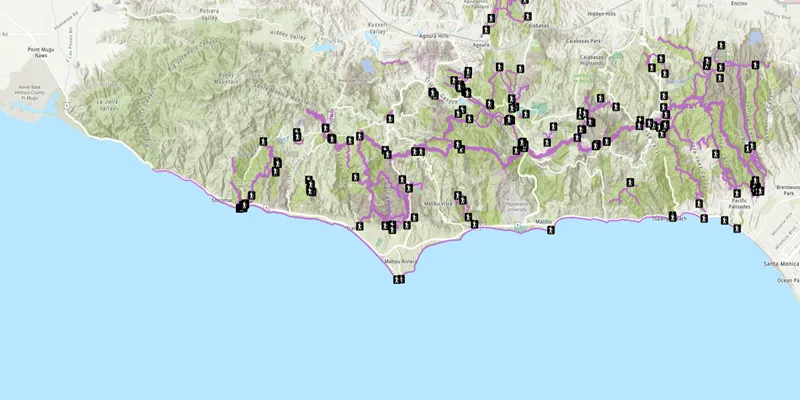
Add data layers to a map
// Create a map with the standard imagery basemap style.
ArcGISMap map = new ArcGISMap(BasemapStyle.ARCGIS_IMAGERY_STANDARD);
// Create a new trail heads feature layer from its URL.
FeatureLayer trailheadsLayer = new FeatureLayer(new ServiceFeatureTable(trailheadsURL));
// Create a new trails feature layer from its URL.
FeatureLayer trailsLayer = new FeatureLayer(new ServiceFeatureTable(trailsURL));
// Create a new open spaces feature layer from its URL.
FeatureLayer openSpacesLayer = new FeatureLayer(new ServiceFeatureTable(parksOpenSpace));
// Add all feature layers to the map.
map.getOperationalLayers().addAll(Arrays.asList(openSpacesLayer, trailsLayer, trailheadsLayer));

Use API key access tokens

An API key access token An access token is an authorization string that provides access to secure ArcGIS content, data, and services. Its capabilities are determined by the privileges it supports. It is obtained by implementing API key authentication, User authentication, or App authentication. Learn more can be used to authorize access to ArcGIS services A service, also known as an ArcGIS service, is software that supports an ArcGIS REST API and provides geospatial functionality or data. A service can be hosted by Esri or in ArcGIS Enterprise. Learn more and portal items from your app, as well as to monitor access to those services. You can use a single access token An access token is an authorization string that provides access to secure ArcGIS content, data, and services. Its capabilities are determined by the privileges it supports. It is obtained by implementing API key authentication, User authentication, or App authentication. Learn more for all requests made by your app, or assign individual access tokens An access token is an authorization string that provides access to secure ArcGIS content, data, and services. Its capabilities are determined by the privileges it supports. It is obtained by implementing API key authentication, User authentication, or App authentication. Learn more for any classes that implements ApiKeyResource.

Learn more about API key authentication

Tutorials

Samples

Services

Next steps