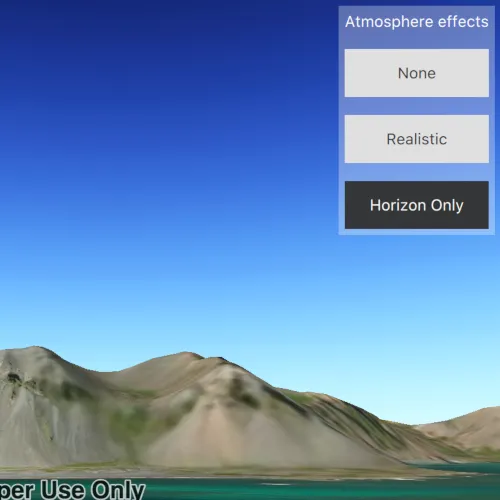
Changes the appearance of the atmosphere in a scene.
How to use the sample
Select one of the three available atmosphere effects. The sky will change to display the selected atmosphere effect.
How it works
- Create a
Sceneand display it in aSceneQuickView. - Change the atmosphere effect with
SceneQuickView::setAtmosphereEffect.
Relevant API
- Scene
- AtmosphereEffect
- SceneView
Additional Information
There are three atmosphere effect options:
- None - No atmosphere effect. The sky is rendered black with a starfield consisting of randomly placed white dots.
- Realistic - Atmosphere effect applied to both the sky and the surface as viewed from above.
- Horizon only - Atmosphere effect applied to the sky (horizon) only. This is the default.
Tags
atmosphere, horizon, sky
Sample code
// [WriteFile Name=ChangeAtmosphereEffect, Category=Scenes]// [Legal]// Copyright 2018 Esri.//// Licensed under the Apache License, Version 2.0 (the "License");// you may not use this file except in compliance with the License.// You may obtain a copy of the License at// http://www.apache.org/licenses/LICENSE-2.0//// Unless required by applicable law or agreed to in writing, software// distributed under the License is distributed on an "AS IS" BASIS,// WITHOUT WARRANTIES OR CONDITIONS OF ANY KIND, either express or implied.// See the License for the specific language governing permissions and// limitations under the License.// [Legal]
#ifdef PCH_BUILD#include "pch.hpp"#endif // PCH_BUILD
// sample headers#include "ChangeAtmosphereEffect.h"
// ArcGIS Maps SDK headers#include "ArcGISTiledElevationSource.h"#include "Camera.h"#include "ElevationSourceListModel.h"#include "MapTypes.h"#include "Scene.h"#include "SceneQuickView.h"#include "Surface.h"
// Qt headers#include <QFuture>
using namespace Esri::ArcGISRuntime;
ChangeAtmosphereEffect::ChangeAtmosphereEffect(QObject* parent /* = nullptr */):  QObject(parent),  m_scene(new Scene(BasemapStyle::ArcGISImageryStandard, this)){  // create a new elevation source from %{ElevationOption} rest service  ArcGISTiledElevationSource* elevationSource = new ArcGISTiledElevationSource(        QUrl("https://elevation3d.arcgis.com/arcgis/rest/services/WorldElevation3D/Terrain3D/ImageServer"), this);
  // add the elevation source to the scene to display elevation  m_scene->baseSurface()->elevationSources()->append(elevationSource);
}
ChangeAtmosphereEffect::~ChangeAtmosphereEffect() = default;
void ChangeAtmosphereEffect::init(){  // Register classes for QML  qmlRegisterType<SceneQuickView>("Esri.Samples", 1, 0, "SceneView");  qmlRegisterType<ChangeAtmosphereEffect>("Esri.Samples", 1, 0, "ChangeAtmosphereEffectSample");}SceneQuickView* ChangeAtmosphereEffect::sceneView() const{  return m_sceneView;}
// Set the view (created in QML)void ChangeAtmosphereEffect::setSceneView(SceneQuickView* sceneView){  if (!sceneView || sceneView == m_sceneView)  {    return;  }
  m_sceneView = sceneView;  m_sceneView->setArcGISScene(m_scene);
  Camera camera(64.416919, -14.483728, 100, 318, 105, 0);  sceneView->setViewpointCameraAsync(camera, 0);
  emit sceneViewChanged();}
void ChangeAtmosphereEffect::setAtmosphereEffect(AtmosphereEnum atmosphereEffect){  if (m_sceneView)  {    m_sceneView->setAtmosphereEffect(static_cast<AtmosphereEffect>(atmosphereEffect));    emit atmosphereEffectChanged();  }}
ChangeAtmosphereEffect::AtmosphereEnum ChangeAtmosphereEffect::atmosphereEffect() const{  if (m_sceneView)    return static_cast<AtmosphereEnum>(m_sceneView->atmosphereEffect());  return static_cast<AtmosphereEnum>(AtmosphereEffect::None);}
// [WriteFile Name=ChangeAtmosphereEffect, Category=Scenes]// [Legal]// Copyright 2018 Esri.//// Licensed under the Apache License, Version 2.0 (the "License");// you may not use this file except in compliance with the License.// You may obtain a copy of the License at// http://www.apache.org/licenses/LICENSE-2.0//// Unless required by applicable law or agreed to in writing, software// distributed under the License is distributed on an "AS IS" BASIS,// WITHOUT WARRANTIES OR CONDITIONS OF ANY KIND, either express or implied.// See the License for the specific language governing permissions and// limitations under the License.// [Legal]
#ifndef CHANGEATMOSPHEREEFFECT_H#define CHANGEATMOSPHEREEFFECT_H
// ArcGIS Maps SDK headers#include "SceneViewTypes.h"
// Qt headers#include <QObject>
namespace Esri::ArcGISRuntime{class Scene;class SceneQuickView;}
Q_MOC_INCLUDE("SceneQuickView.h")
class ChangeAtmosphereEffect : public QObject{ Q_OBJECT Q_PROPERTY(AtmosphereEnum atmosphereEffect READ atmosphereEffect WRITE setAtmosphereEffect NOTIFY atmosphereEffectChanged) Q_PROPERTY(Esri::ArcGISRuntime::SceneQuickView* sceneView READ sceneView WRITE setSceneView NOTIFY sceneViewChanged)public: enum AtmosphereEnum { None = static_cast<int>(Esri::ArcGISRuntime::AtmosphereEffect::None), HorizonOnly = static_cast<int>(Esri::ArcGISRuntime::AtmosphereEffect::HorizonOnly), Realistic = static_cast<int>(Esri::ArcGISRuntime::AtmosphereEffect::Realistic) }; Q_ENUM(AtmosphereEnum)
explicit ChangeAtmosphereEffect(QObject* parent = nullptr); ~ChangeAtmosphereEffect() override;
static void init();
signals: void sceneViewChanged(); void atmosphereEffectChanged();
private: Esri::ArcGISRuntime::SceneQuickView* sceneView() const; void setSceneView(Esri::ArcGISRuntime::SceneQuickView* sceneView);
void setAtmosphereEffect(AtmosphereEnum atmosphereEffect); AtmosphereEnum atmosphereEffect() const;
Esri::ArcGISRuntime::Scene* m_scene = nullptr; Esri::ArcGISRuntime::SceneQuickView* m_sceneView = nullptr;};
#endif // CHANGEATMOSPHEREEFFECT_H// [WriteFile Name=ChangeAtmosphereEffect, Category=Scenes]// [Legal]// Copyright 2018 Esri.//// Licensed under the Apache License, Version 2.0 (the "License");// you may not use this file except in compliance with the License.// You may obtain a copy of the License at// http://www.apache.org/licenses/LICENSE-2.0//// Unless required by applicable law or agreed to in writing, software// distributed under the License is distributed on an "AS IS" BASIS,// WITHOUT WARRANTIES OR CONDITIONS OF ANY KIND, either express or implied.// See the License for the specific language governing permissions and// limitations under the License.// [Legal]
import QtQuickimport QtQuick.Controlsimport QtQuick.Layoutsimport Esri.Samples
Item { states: [ State { when: noAtmosphereButton.checked PropertyChanges { target: sample atmosphereEffect: ChangeAtmosphereEffectSample.None } }, State { when: realisticAtmosphereButton.checked PropertyChanges { target: sample atmosphereEffect: ChangeAtmosphereEffectSample.Realistic } }, State { when: horizonAtmosphereButton.checked PropertyChanges { target: sample atmosphereEffect: ChangeAtmosphereEffectSample.HorizonOnly } } ]
SceneView { id: view anchors.fill: parent
Component.onCompleted: { // Set the focus on SceneView to initially enable keyboard navigation forceActiveFocus(); } }
// Declare the C++ instance which creates the scene etc. and supply the view ChangeAtmosphereEffectSample { id: sample sceneView: view }
Rectangle { anchors { top: parent.top right: parent.right margins: 5 }
color: Qt.rgba(1, 1, 1, 0.3); width: childrenRect.width height: childrenRect.height ColumnLayout { id: layout
Text { Layout.margins: 5 color: "white" text: "Atmosphere effects" }
Button { id: noAtmosphereButton Layout.margins: 5 Layout.fillWidth: true text: "None" checkable: true }
Button { id: realisticAtmosphereButton Layout.margins: 5 Layout.fillWidth: true text: "Realistic" checkable: true }
Button { id: horizonAtmosphereButton Layout.margins: 5 Layout.fillWidth: true text: "Horizon Only" checkable: true checked: true } }
ButtonGroup { buttons: [noAtmosphereButton, realisticAtmosphereButton, horizonAtmosphereButton] } }}