Extrude graphics based on an attribute value.
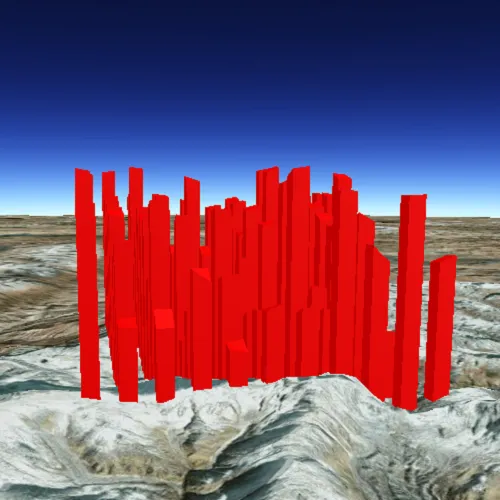
Use case
Graphics representing features can be vertically extruded to represent properties of the data that might otherwise go unseen. Extrusion can add visual prominence to data beyond what may be offered by varying the color, size, or shape of symbol alone. For example, graphics representing wind turbines in a wind farm application can be extruded by a real-world “height” attribute so that they can be visualized in a landscape. Likewise, census data can be extruded by a thematic “population” attribute to visually convey population levels across a country.
How to use the sample
Run the sample. Note that the graphics are extruded to the level set in their height property.
How it works
- Create a
GraphicsOverlayandSimpleRenderer. - Get the renderer’s
ScenePropertiesusingrenderer::sceneProperties(). - Set the extrusion mode for the renderer with
props::setExtrusionMode(ExtrusionMode::BaseHeight). - Specify the attribute name of the graphic that the extrusion mode will use:
props::setExtrusionExpression("[height]"). - Set the renderer on the graphics overlay using
graphicsOverlay::setRenderer(renderer). - Create graphics with the attribute set:
graphic::attributes()::insertAttribute("height", z).
Relevant API
- RendererSceneProperties
- ExtrusionMode
- SceneProperties::setExtrusionExpression()
- SimpleRenderer
About the data
Data is hard coded in this sample as a demonstration of how to create and set an attribute to a graphic. To extrude graphics based on pre-existing attributes (e.g. from a feature layer) see the FeatureLayerExtrusion sample.
Tags
3D, extrude, extrusion, height, scene, visualization
Sample code
// [WriteFile Name=ExtrudeGraphics, Category=Scenes]// [Legal]// Copyright 2016 Esri.//// Licensed under the Apache License, Version 2.0 (the "License");// you may not use this file except in compliance with the License.// You may obtain a copy of the License at// http://www.apache.org/licenses/LICENSE-2.0//// Unless required by applicable law or agreed to in writing, software// distributed under the License is distributed on an "AS IS" BASIS,// WITHOUT WARRANTIES OR CONDITIONS OF ANY KIND, either express or implied.// See the License for the specific language governing permissions and// limitations under the License.// [Legal]
#ifdef PCH_BUILD#include "pch.hpp"#endif // PCH_BUILD
// sample headers#include "ExtrudeGraphics.h"
// ArcGIS Maps SDK headers#include "ArcGISTiledElevationSource.h"#include "AttributeListModel.h"#include "Basemap.h"#include "Camera.h"#include "ElevationSourceListModel.h"#include "Graphic.h"#include "GraphicListModel.h"#include "GraphicsOverlay.h"#include "GraphicsOverlayListModel.h"#include "MapTypes.h"#include "Point.h"#include "Polygon.h"#include "PolygonBuilder.h"#include "RendererSceneProperties.h"#include "Scene.h"#include "SceneQuickView.h"#include "SceneViewTypes.h"#include "SimpleFillSymbol.h"#include "SimpleRenderer.h"#include "SpatialReference.h"#include "Surface.h"#include "SymbolTypes.h"
// STL headers#include <cmath>#include <ctime>
using namespace Esri::ArcGISRuntime;
ExtrudeGraphics::ExtrudeGraphics(QQuickItem* parent) :  QQuickItem(parent){  srand(time(nullptr));}
ExtrudeGraphics::~ExtrudeGraphics() = default;
void ExtrudeGraphics::init(){  qmlRegisterType<SceneQuickView>("Esri.Samples", 1, 0, "SceneView");  qmlRegisterType<ExtrudeGraphics>("Esri.Samples", 1, 0, "ExtrudeGraphicsSample");}
void ExtrudeGraphics::componentComplete(){  QQuickItem::componentComplete();
  // find QML SceneView component  m_sceneView = findChild<SceneQuickView*>("sceneView");
  // create a new basemap instance  Basemap* basemap = new Basemap(BasemapStyle::ArcGISImageryStandard, this);  // create a new scene instance  m_scene = new Scene(basemap, this);  // set scene on the scene view  m_sceneView->setArcGISScene(m_scene);
  // create a new elevation source  ArcGISTiledElevationSource* elevationSource = new ArcGISTiledElevationSource(m_elevationSourceUrl, this);  // add the elevation source to the scene to display elevation  m_scene->baseSurface()->elevationSources()->append(elevationSource);
  // create a camera  const double latitude = 28.4;  const double longitude = 83.9;  const double altitude = 10010.0;  const double heading = 10.0;  const double pitch = 80.0;  const double roll = 0.0;  Camera camera(latitude, longitude, altitude, heading, pitch, roll);  // set the viewpoint  m_sceneView->setViewpointCameraAndWait(camera);
  // graphics location  double lon = camera.location().x() - 0.03;  double lat = camera.location().y() + 0.2;
  GraphicsOverlay* graphicsOverlay = new GraphicsOverlay(this);
  // set renderer with extrusion property  SimpleRenderer* renderer = new SimpleRenderer(this);  RendererSceneProperties props = renderer->sceneProperties();  props.setExtrusionMode(ExtrusionMode::BaseHeight);  props.setExtrusionExpression("[height]");  renderer->setSceneProperties(props);  SimpleFillSymbol* sfs = new SimpleFillSymbol(SimpleFillSymbolStyle::Solid, QColor("red"), this);  renderer->setSymbol(sfs);  graphicsOverlay->setRenderer(renderer);
  // setup graphic locations  QList<Point> pointsList;  for (int i = 0; i <= 100; i++)  {    Point point(i / 10 * (m_size * 2) + lon, i % 10 * (m_size * 2) + lat, m_sceneView->spatialReference());    pointsList.append(point);  }
  for (const Point& point : pointsList)  {    // create a random z value    const int randNum = rand() % 6 + 1;    const double z = m_maxZ * randNum;
    // create a list of points    const QList<Point> points { Point(point.x(), point.y(), z)                              , Point(point.x() + m_size, point.y(), z)                              , Point(point.x() + m_size, point.y() + m_size, z)                              , Point(point.x(), point.y() + m_size, z)                              };
    // create a new graphic    Graphic* graphic = new Graphic(createPolygonFromPoints(points), this);    // add a height attribute to the graphic using the attribute list model    // the extrusion will be applied to this attribute. See the expression above    graphic->attributes()->insertAttribute("height", z);    // add the graphic to the graphic overlay    graphicsOverlay->graphics()->append(graphic);  }
  m_sceneView->graphicsOverlays()->append(graphicsOverlay);}
// helper to create polygon from pointsPolygon ExtrudeGraphics::createPolygonFromPoints(const QList<Point>& points){  Polygon polygon;  if (points.length() == 0)    return polygon;
  // create a polygon builder  PolygonBuilder* pb = new PolygonBuilder(m_sceneView->spatialReference(), this);  for (const Point& point : points)  {    // add each point to the builder object    pb->addPoint(point);  }  return polygon = pb->toPolygon();}
// [WriteFile Name=ExtrudeGraphics, Category=Scenes]// [Legal]// Copyright 2016 Esri.//// Licensed under the Apache License, Version 2.0 (the "License");// you may not use this file except in compliance with the License.// You may obtain a copy of the License at// http://www.apache.org/licenses/LICENSE-2.0//// Unless required by applicable law or agreed to in writing, software// distributed under the License is distributed on an "AS IS" BASIS,// WITHOUT WARRANTIES OR CONDITIONS OF ANY KIND, either express or implied.// See the License for the specific language governing permissions and// limitations under the License.// [Legal]
#ifndef EXTRUDE_GRAPHICS_H#define EXTRUDE_GRAPHICS_H
// Qt headers#include <QQuickItem>#include <QUrl>
namespace Esri::ArcGISRuntime{ class Scene; class SceneQuickView; class Point; class Polygon;}
class ExtrudeGraphics : public QQuickItem{ Q_OBJECT
public: explicit ExtrudeGraphics(QQuickItem* parent = nullptr); ~ExtrudeGraphics() override;
void componentComplete() override; static void init();
private: Esri::ArcGISRuntime::Polygon createPolygonFromPoints(const QList<Esri::ArcGISRuntime::Point>&);
Esri::ArcGISRuntime::Scene* m_scene = nullptr; Esri::ArcGISRuntime::SceneQuickView* m_sceneView = nullptr; QUrl m_elevationSourceUrl = QUrl("https://elevation3d.arcgis.com/arcgis/rest/services/WorldElevation3D/Terrain3D/ImageServer"); int m_maxZ = 1000; double m_size = 0.01;};
#endif // EXTRUDE_GRAPHICS_H// [WriteFile Name=ExtrudeGraphics, Category=Scenes]// [Legal]// Copyright 2016 Esri.//// Licensed under the Apache License, Version 2.0 (the "License");// you may not use this file except in compliance with the License.// You may obtain a copy of the License at// http://www.apache.org/licenses/LICENSE-2.0//// Unless required by applicable law or agreed to in writing, software// distributed under the License is distributed on an "AS IS" BASIS,// WITHOUT WARRANTIES OR CONDITIONS OF ANY KIND, either express or implied.// See the License for the specific language governing permissions and// limitations under the License.// [Legal]
import QtQuickimport QtQuick.Controlsimport Esri.Samples
ExtrudeGraphicsSample { width: 800 height: 600
// add a mapView component SceneView { anchors.fill: parent objectName: "sceneView"
Component.onCompleted: { // Set the focus on SceneView to initially enable keyboard navigation forceActiveFocus(); } }}