Create a feature collection layer from a portal item.
Use case
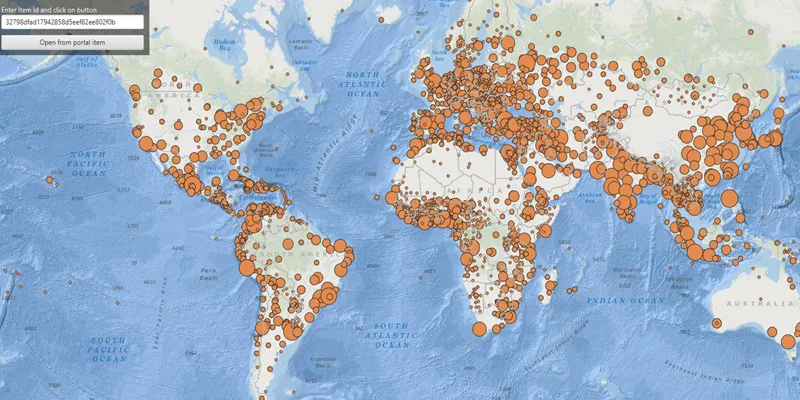
Feature collection layers are often used to hold features with mixed geometry or unstructured data. You can display feature collections stored in a Portal, which are often used for showing content from a CSV or map notes.
How to use the sample
The feature collection is loaded from the Portal item when the sample starts. Enter the ID of a Portal item that holds a feature collection into the text field, and click on the button to see result.
How it works
- Create a
Portal. - Create the
PortalItem, referring to the portal and an item ID. - Verify that the item represents a feature collection.
- Create a
FeatureCollectionfrom the item. - Create a
FeatureCollectionLayer, referring to the feature collection. - Add the feature collection layer to the map’s operational layers collection.
Relevant API
- FeatureCollection
- FeatureCollectionLayer
- Feature
- Portal
- PortalItem
About the data
The sample uses a sample layer depicting world populations.
Tags
collection, feature collection, feature collection layer, id, item, map notes, portal
Sample code
FeatureCollectionLayerFromPortalSample.java
/* * Copyright 2020 Esri. * * Licensed under the Apache License, Version 2.0 (the "License"); you may not * use this file except in compliance with the License. You may obtain a copy of * the License at * * http://www.apache.org/licenses/LICENSE-2.0 * * Unless required by applicable law or agreed to in writing, software * distributed under the License is distributed on an "AS IS" BASIS, WITHOUT * WARRANTIES OR CONDITIONS OF ANY KIND, either express or implied. See the * License for the specific language governing permissions and limitations under * the License. */
package com.esri.samples.feature_collection_layer_from_portal;
import javafx.geometry.Insets;import javafx.geometry.Pos;import javafx.scene.Scene;import javafx.scene.control.Alert;import javafx.scene.control.Button;import javafx.scene.control.TextField;import javafx.application.Application;import javafx.scene.layout.StackPane;import javafx.stage.Stage;
import com.esri.arcgisruntime.ArcGISRuntimeEnvironment;import com.esri.arcgisruntime.data.FeatureCollection;import com.esri.arcgisruntime.layers.FeatureCollectionLayer;import com.esri.arcgisruntime.loadable.LoadStatus;import com.esri.arcgisruntime.mapping.ArcGISMap;import com.esri.arcgisruntime.mapping.BasemapStyle;import com.esri.arcgisruntime.mapping.view.MapView;import com.esri.arcgisruntime.portal.Portal;import com.esri.arcgisruntime.portal.PortalItem;
public class FeatureCollectionLayerFromPortalSample extends Application {
  private ArcGISMap map;  private MapView mapView;  private Portal portal;  private TextField inputTextField;  private PortalItem portalItem; // keep loadable in scope to avoid garbage collection
  @Override  public void start(Stage stage) {    // set up the application scene    try {      // create stack pane and application scene      StackPane stackPane = new StackPane();      Scene scene = new Scene(stackPane);
      // set title, size, and add scene to stage      stage.setTitle("Feature Collection Layer From Portal");      stage.setWidth(800);      stage.setHeight(700);      stage.setScene(scene);      stage.show();
      // authentication with an API key or named user is required to access basemaps and other location services      String yourAPIKey = System.getProperty("apiKey");      ArcGISRuntimeEnvironment.setApiKey(yourAPIKey);
      // create a map with the oceans basemap style      map = new ArcGISMap(BasemapStyle.ARCGIS_OCEANS);
      // create a map view and set the map to it      mapView = new MapView();      mapView.setMap(map);
      // create portal      portal = new Portal("https://www.arcgis.com/");
      // create text field to input user's own portal item ID      inputTextField = new TextField("32798dfad17942858d5eef82ee802f0b");      inputTextField.setMaxWidth(250);
      // fetch the default feature collection layer from the portal      fetchFeatureCollectionFromPortal();
      // create button to perform action      Button fetchFromPortalButton = new Button("Open from portal item");      fetchFromPortalButton.setMaxWidth(250);
      // verify the input and fetch the portal item      fetchFromPortalButton.setOnAction(e -> fetchFeatureCollectionFromPortal());
      // add the map view and control panel to stack pane      stackPane.getChildren().addAll(mapView, inputTextField, fetchFromPortalButton);      StackPane.setAlignment(inputTextField, Pos.TOP_LEFT);      StackPane.setMargin(inputTextField, new Insets(10, 0, 0, 10));      StackPane.setAlignment(fetchFromPortalButton, Pos.TOP_LEFT);      StackPane.setMargin(fetchFromPortalButton, new Insets(40, 0, 0, 10));
    } catch (Exception e) {      // on any error, display the stack trace      e.printStackTrace();    }  }
  /**   * Fetch feature collection from portal and load as feature layer.   */  private void fetchFeatureCollectionFromPortal() {
    if (!inputTextField.getText().isEmpty()) {      // crate portal item      portalItem = new PortalItem(portal, inputTextField.getText());      portalItem.loadAsync();
      portalItem.addDoneLoadingListener(() -> {
        if (portalItem.getLoadStatus() == LoadStatus.LOADED) {
          if (portalItem.getType() == PortalItem.Type.FEATURE_COLLECTION) {
            // create feature collection and add to the map as a layer            FeatureCollection  featureCollection = new FeatureCollection(portalItem);            FeatureCollectionLayer featureCollectionLayer = new FeatureCollectionLayer(featureCollection);
            // add feature collection layer to the map            map.getOperationalLayers().clear();            map.getOperationalLayers().add(featureCollectionLayer);
          } else {            new Alert(Alert.AlertType.ERROR, "Portal item is not a feature collection").show();          }        } else {          new Alert(Alert.AlertType.ERROR, "Portal item failed to load").show();        }      });    } else {      new Alert(Alert.AlertType.ERROR, "Portal Item ID is empty").show();    }
  }  /**   * Stops and releases all resources used in application.   */  @Override  public void stop() {
    if (mapView != null) {      mapView.dispose();    }  }
  /**   * Opens and runs application.   *   * @param args arguments passed to this application   */  public static void main(String[] args) {
    Application.launch(args);  }}