import DirectLineMeasurement3D from "@arcgis/core/widgets/DirectLineMeasurement3D.js";const DirectLineMeasurement3D = await $arcgis.import("@arcgis/core/widgets/DirectLineMeasurement3D.js");- Inheritance:
- DirectLineMeasurement3D→
Widget<DirectLineMeasurement3DProperties>→ Accessor
- Since
- ArcGIS Maps SDK for JavaScript 4.6
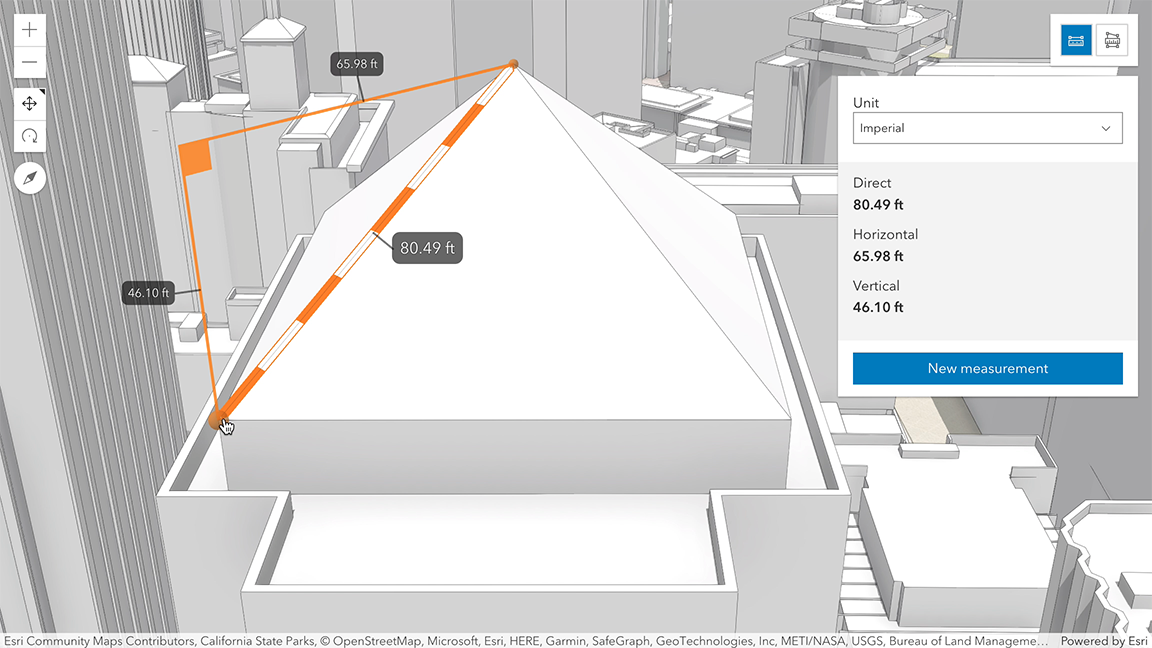
The DirectLineMeasurement3D widget calculates and displays the 3D distance between two points. This widget can be used in a SceneView to measure the vertical, horizontal, and direct distance between two points.
How distances are computed depends on the scene's spatial reference.
In geographic coordinate systems (GCS) and in Web Mercator:
- Direct distance is computed in a Euclidean manner, in an ECEF coordinate system (or equivalent on other planets);
- Horizontal distance is computed geodetically, taking into consideration the curvature of the planet;
- Vertical distance is computed as an elevation difference.
In projected coordinate systems (PCS), apart from Web Mercator, all three distances (direct, horizontal, and vertical) are computed in a Euclidean manner (in their respective PCS).
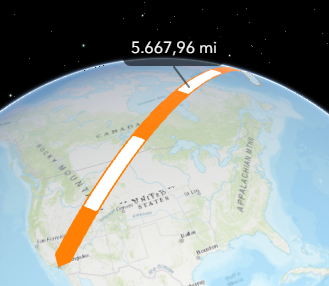
DirectLineMeasurement3D widget visualizes and labels the direct, horizontal, and vertical distances and displays the same values in the UI panel. When the distance between the points is greater than 100 kilometers, the measurement visualization is simplified, and only the horizontal and vertical distances are calculated. The direct distance option becomes unavailable.
When the widget is active, a horizontal "laser" line is drawn which indicates the height at the current mouse position. This line can help in analyzing the heights of objects relative to each other and the terrain. A second laser line shows the intersection of the scene with the vertical plane that passes through the checkered line.
This widget is designed to work with 3D SceneViews. For measurements with 2D MapViews, use DistanceMeasurement2D.
Things to consider:
Snapping is enabled by default. This can be temporarily disabled by holding the CTRL key.
Layer types currently supported for snapping are: FeatureLayer, GraphicsLayer (except Mesh geometries),
GeoJSONLayer, WFSLayer, CSVLayer,
3D Object SceneLayer, and BuildingSceneLayer.
Example
let measurementWidget = new DirectLineMeasurement3D({  view: view});
view.ui.add(measurementWidget, "top-right");
Constructors
Constructor
Parameters
| Parameter | Type | Description | Required |
|---|---|---|---|
| properties | | |
Example
// typical usagelet measurementWidget = new DirectLineMeasurement3D({ view: view});Properties
| Property | Type | Class |
|---|---|---|
| | ||
container inherited | HTMLElement | null | undefined | |
declaredClass readonly inherited | ||
destroyed readonly inherited | ||
Icon["icon"] | | |
id inherited | ||
| | ||
| | ||
| | ||
| | ||
| | ||
visible inherited |
analysis
- Since
- ArcGIS Maps SDK for JavaScript 4.23
The direct line measurement analysis object being created or modified by the widget. This property is an alias for DirectLineMeasurement3DViewModel.analysis.
If no analysis is provided, the widget automatically creates its own analysis and adds it to the view. In this case, the analysis will also be automatically removed from the view when the widget is destroyed.
Example
// Construct a direct line measurement analysis object outside of the widgetconst analysis = new DirectLineMeasurementAnalysis({  startPoint: {    type: "point", // autocasts as new Point()    x: 7.67,    y: 45.981,    z: 3435.765  },  endPoint: {    type: "point",    x: 7.659,    y: 45.976,    z: 4437  }});
// Ensure that the analysis is added to the viewview.analyses.add(analysis);
// Frame the analysis in the viewview.goTo(analysis.extent);
// Pass the analysis object as a constructor parameter to modify it using the widgetconst viewModel = new DirectLineMeasurement3D({  analysis: analysis,  view: view});
container
- Type
- HTMLElement | null | undefined
The ID or node representing the DOM element containing the widget. This property can only be set once. The following examples are all valid use case when working with widgets.
Examples
// Create the HTML div element programmatically at runtime and set to the widget's containerconst basemapGallery = new BasemapGallery({  view: view,  container: document.createElement("div")});
// Add the widget to the top-right corner of the viewview.ui.add(basemapGallery, {  position: "top-right"});
// Specify an already-defined HTML div element in the widget's container
const basemapGallery = new BasemapGallery({ view: view, container: basemapGalleryDiv});
// Add the widget to the top-right corner of the viewview.ui.add(basemapGallery, { position: "top-right"});
// HTML markup<body> <div id="viewDiv"></div> <div id="basemapGalleryDiv"></div></body>// Specify the widget while adding to the view's UIconst basemapGallery = new BasemapGallery({ view: view});
// Add the widget to the top-right corner of the viewview.ui.add(basemapGallery, { position: "top-right"}); icon
- Type
- Icon["icon"]
- Since
- ArcGIS Maps SDK for JavaScript 4.27
Icon which represents the widget. It is typically used when the widget is controlled by another one (e.g. in the Expand widget).
- Default value
- "measure-line"
unit
- Type
- SystemOrLengthUnit
- Since
- ArcGIS Maps SDK for JavaScript 4.8
Unit system (imperial, metric) or specific unit used for displaying the distance values. Possible values are listed in unitOptions.
unitOptions
- Type
- SystemOrLengthUnit[]
- Since
- ArcGIS Maps SDK for JavaScript 4.7
List of unit systems (imperial, metric) and specific units for displaying the distance values.
By default, the following units are included: metric, imperial, inches, feet, us-feet, yards, miles, nautical-miles, meters, kilometers.
Possible unit values can only be a subset of this list.
viewModel
- Since
- ArcGIS Maps SDK for JavaScript 4.7
The view model for this widget. This is a class that contains all the logic (properties and methods) that controls this widget's behavior. See the DirectLineMeasurement3DViewModel class to access all properties and methods on the widget.
visible
- Type
- boolean
Indicates whether the widget is visible.
If false, the widget will no longer be rendered in the web document. This may affect the layout of other elements or widgets in the document. For example, if this widget is
the first of three widgets associated to the upper right hand corner of the DefaultUI, then the other widgets will reposition when this widget is made invisible.
For more information, refer to the css display value of "none".
- Default value
- true
Example
// Hides the widget in the viewwidget.visible = false;Methods
| Method | Signature | Class |
|---|---|---|
classes inherited | classes(...classNames: ((string | null | undefined) | ((string[] | Record<string, boolean>) | null | undefined) | false | null | undefined)[]): string | |
destroy inherited | destroy(): void | |
emit inherited | emit<Type extends EventNames<this>>(type: Type, event?: this["@eventTypes"][Type]): boolean | |
hasEventListener inherited | hasEventListener<Type extends EventNames<this>>(type: Type): boolean | |
isFulfilled inherited | isFulfilled(): boolean | |
isRejected inherited | isRejected(): boolean | |
isResolved inherited | isResolved(): boolean | |
on inherited | on<Type extends EventNames<this>>(type: Type, listener: EventedCallback<this["@eventTypes"][Type]>): ResourceHandle | |
postInitialize inherited | postInitialize(): void | |
render inherited | render(): any | null | |
renderNow inherited | renderNow(): void | |
scheduleRender inherited | scheduleRender(): void | |
when inherited | when<TResult1 = this, TResult2 = never>(onFulfilled?: OnFulfilledCallback<this, TResult1> | null | undefined, onRejected?: OnRejectedCallback<TResult2> | null | undefined): Promise<TResult1 | TResult2> |
classes
- Signature
-
classes (...classNames: ((string | null | undefined) | ((string[] | Record<string, boolean>) | null | undefined) | false | null | undefined)[]): string
- Since
- ArcGIS Maps SDK for JavaScript 4.7
A utility method used for building the value for a widget's class property.
This aids in simplifying css class setup.
Parameters
- Returns
- string
The computed class name.
Example
// .tsx syntax showing how to set css classes while rendering the widget
render() {  const dynamicClasses = {    [css.flip]: this.flip,    [css.primary]: this.primary  };
return ( <div class={classes(css.root, css.mixin, dynamicClasses)} /> );} emit
- Signature
-
emit <Type extends EventNames<this>>(type: Type, event?: this["@eventTypes"][Type]): boolean
- Type parameters
- <Type extends EventNames<this>>
Emits an event on the instance. This method should only be used when creating subclasses of this class.
hasEventListener
- Signature
-
hasEventListener <Type extends EventNames<this>>(type: Type): boolean
- Type parameters
- <Type extends EventNames<this>>
Indicates whether there is an event listener on the instance that matches the provided event name.
Parameters
| Parameter | Type | Description | Required |
|---|---|---|---|
| type | Type | The name of the event. | |
- Returns
- boolean
Returns true if the class supports the input event.
isFulfilled
- Signature
-
isFulfilled (): boolean
isFulfilled() may be used to verify if creating an instance of the class is fulfilled (either resolved or rejected).
If it is fulfilled, true will be returned.
- Returns
- boolean
Indicates whether creating an instance of the class has been fulfilled (either resolved or rejected).
isRejected
- Signature
-
isRejected (): boolean
isRejected() may be used to verify if creating an instance of the class is rejected.
If it is rejected, true will be returned.
- Returns
- boolean
Indicates whether creating an instance of the class has been rejected.
isResolved
- Signature
-
isResolved (): boolean
isResolved() may be used to verify if creating an instance of the class is resolved.
If it is resolved, true will be returned.
- Returns
- boolean
Indicates whether creating an instance of the class has been resolved.
on
- Signature
-
on <Type extends EventNames<this>>(type: Type, listener: EventedCallback<this["@eventTypes"][Type]>): ResourceHandle
- Type parameters
- <Type extends EventNames<this>>
Registers an event handler on the instance. Call this method to hook an event with a listener.
Parameters
| Parameter | Type | Description | Required |
|---|---|---|---|
| type | Type | An event or an array of events to listen for. | |
| listener | EventedCallback<this["@eventTypes"][Type]> | The function to call when the event fires. | |
- Returns
- ResourceHandle
Returns an event handler with a
remove()method that should be called to stop listening for the event(s).Property Type Description remove Function When called, removes the listener from the event.
Example
view.on("click", function(event){ // event is the event handle returned after the event fires. console.log(event.mapPoint);}); when
- Signature
-
when <TResult1 = this, TResult2 = never>(onFulfilled?: OnFulfilledCallback<this, TResult1> | null | undefined, onRejected?: OnRejectedCallback<TResult2> | null | undefined): Promise<TResult1 | TResult2>
when() may be leveraged once an instance of the class is created. This method takes two input parameters: an onFulfilled function and an onRejected function.
The onFulfilled executes when the instance of the class loads. The
onRejected executes if the instance of the class fails to load.
Parameters
| Parameter | Type | Description | Required |
|---|---|---|---|
| onFulfilled | OnFulfilledCallback<this, TResult1> | null | undefined | The function to call when the promise resolves. | |
| onRejected | The function to execute when the promise fails. | |
- Returns
- Promise<TResult1 | TResult2>
Returns a new promise for the result of
onFulfilledthat may be used to chain additional functions.
Example
// Although this example uses MapView, any class instance that is a promise may use when() in the same waylet view = new MapView();view.when(function(){ // This function will execute once the promise is resolved}, function(error){ // This function will execute if the promise is rejected due to an error});