import SimpleRenderer from "@arcgis/core/renderers/SimpleRenderer.js";const SimpleRenderer = await $arcgis.import("@arcgis/core/renderers/SimpleRenderer.js");- Since
- ArcGIS Maps SDK for JavaScript 4.0
SimpleRenderer renders all features in a Layer with one Symbol. This renderer may be used to simply visualize the location of geographic features. For example, layers representing political boundaries, cities, buildings, rivers, etc. that are typically used for providing geographic context in an application may be defined with a single symbol per layer.
Supported layers
SimpleRenderer may only be used to create visualizations for the following layer types: FeatureLayer, SceneLayer, MapImageLayer, CSVLayer, GeoJSONLayer, OGCFeatureLayer, WFSLayer, and StreamLayer
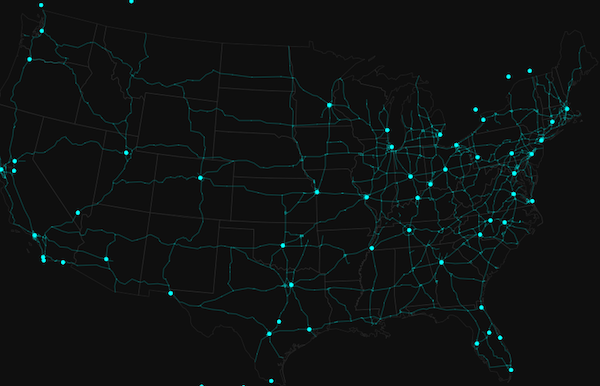
The example in the screenshot below contains three layers: one of state boundaries, another of highways, and another of cities. Each gives geographic context to the map.
SimpleRenderer can also be used to thematically visualize numeric data attributes. This is accomplished with visual variables. Visual variables define the parameters for data-driven visualizations of numeric data. They allow you to easily map continuous ramps of color, size, and/or opacity to minimum and maximum data values of one of the layer's numeric attribute fields.
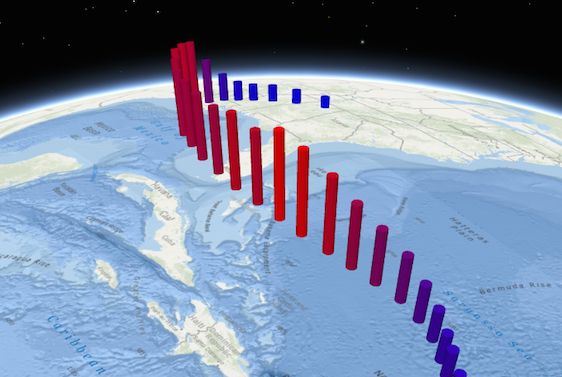
The example below adds size and color visual variables in a 3D SceneView to thematically visualize a hurricane's windspeed in various locations along its path.
To read more about visual variables, see the visualVariables property.
Examples
// Set a basic symbol on a layer to visualize all features the same waylet citiesRenderer = { type: "simple", // autocasts as new SimpleRenderer() symbol: { type: "simple-marker", // autocasts as new SimpleMarkerSymbol() size: 6, color: "black", outline: { // autocasts as new SimpleLineSymbol() width: 0.5, color: "white" } }};let citiesLayer = new FeatureLayer({ url: "http://url.to.service", renderer: citiesRenderer});// Set a continuous color ramp on the renderer with visual variableslet citiesRenderer = { type: "simple", // autocasts as new SimpleRenderer() symbol: { type: "simple-fill" }, // autocasts as new SimpleFillSymbol() visualVariables: [{ type: "color", field: "POPULATION", normalizationField: "SQ_KM", // features with 30 ppl/sq km or below are assigned the first color stops: [{ value: 100, color: "#fffcd4" }, { value: 500, color: "#0d2644" }] }]};let citiesLayer = new FeatureLayer({ url: "http://url.to.service", renderer: citiesRenderer});Constructors
Constructor
Parameters
| Parameter | Type | Description | Required |
|---|---|---|---|
| properties | | |
Properties
| Property | Type | Class |
|---|---|---|
authoringInfo inherited | ||
declaredClass readonly inherited | ||
| | ||
SymbolUnion | null | undefined | | |
type readonly | "simple" | |
visualVariables inherited | VisualVariable[] | null | undefined |
authoringInfo
- Type
- AuthoringInfo | null | undefined
Authoring metadata only included in renderers generated from one of the Smart Mapping creator methods, such as sizeRendererCreator.createContinuousRenderer() or colorRendererCreator.createContinuousRenderer(). This includes information from UI elements such as sliders and selected classification methods and themes. This allows the authoring clients to save specific overridable settings so that next time it is accessed via the UI, their selections can be remembered.
label
The label for the renderer. This describes what features with the given symbol represent in the real world. This will display next to the layer's symbol inside the Legend.
This text is not displayed in the Legend when
visualVariables are used. When the renderer contains
visualVariables, you should set the title property in
legendOptions on each visual variable to describe the visualization.
symbol
- Type
- SymbolUnion | null | undefined
The symbol used by the renderer to visualize all features in the layer.
Example
let renderer = { type: "simple", // autocasts as new SimpleRenderer() symbol: { type: "simple-fill", // autocasts as new SimpleFillSymbol() color: [ 255, 128, 0, 0.5 ], outline: { // autocasts as new SimpleLineSymbol() width: 1, color: "white" } }}; visualVariables
- Type
- VisualVariable[] | null | undefined
An array of VisualVariable objects. Each object must indicate the type of visual variable to apply (e.g. ColorVisualVariable, SizeVisualVariable, OpacityVisualVariable, RotationVisualVariable), the numeric field or expression from which to drive the visualization, and the visual values to map to the data. The following list identifies each visual variable type and provides a link to the specification table of each.
| Type | Object Specification | Legend Example |
|---|---|---|
| color | ColorVisualVariable |  |
| size | SizeVisualVariable | 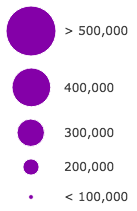 |
| opacity | OpacityVisualVariable |  |
| rotation | RotationVisualVariable | - |
Visual variables are primarily be used in two ways.
1. Thematic mapping
In most cases, visual variables are used to create visualizations based on a thematic attribute (e.g. population, education, rank, money, magnitude, etc.) in either 2D or 3D.
renderer.visualVariables = [{ type: "size", field: "POP_POVERTY", normalizationField: "TOTPOP_CY", legendOptions: { title: "% population in poverty by county" }, stops: [ { value: 0.15, size: 4, label: "<15%" }, { value: 0.25, size: 12, label: "25%" }, { value: 0.35, size: 24, label: ">35%" } ]}];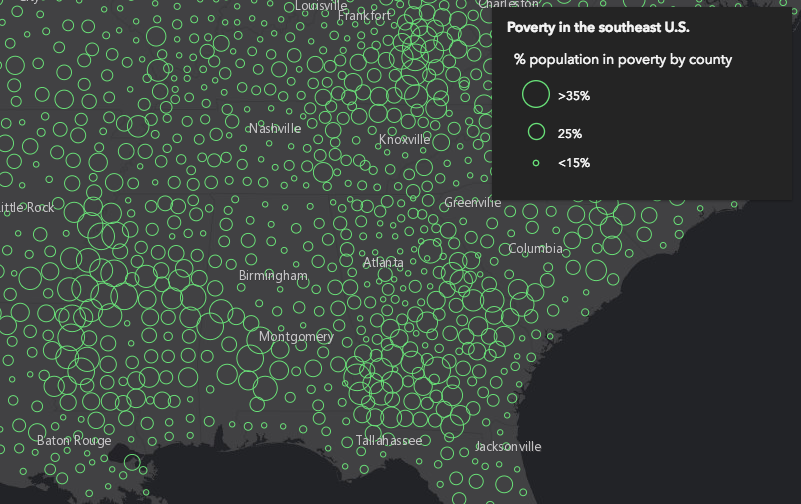
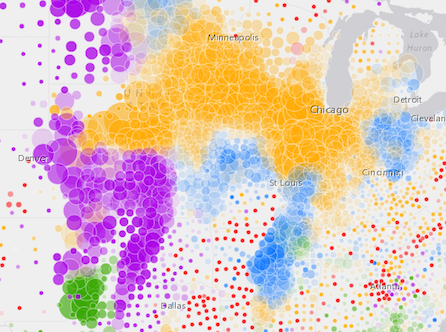
You can take the visualization a step further and use multiple visual variables in the same renderer. The sample below uses three visual variables (size, color, and opacity).
2. Mapping real-world sizes
The size visual variable can be used to visualize the true sizes of features (e.g. tree canopy, road width, building height, etc.) based on their size in the real world. This can be particularly powerful when working in a 3D SceneView. The image below shows a layer of trees that uses visual variables to size each feature to the true dimensions of each tree based on data stored in multiple attribute fields.
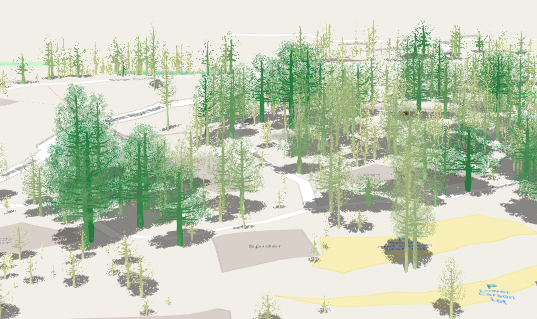
See the Thematic visualization with realistic 3D symbols for an example of using multiple visual variables to visualize your data.
Known Limitations
Color and opacity visual variables must not have more than 8 stops and size visual variables must not have more than 6 stops. This does not apply to variables driven by view scale.
For apps where users can interactively change the field or valueExpression of a visual variable, we suggest
you include all potential fields referenced by visual variables in the FeatureLayer.outFields
of the layer. This ensures the best user experience when switching or updating fields in renderers.
- See also
Methods
fromJSON
- Signature
-
fromJSON (json: any): any
Creates a new instance of this class and initializes it with values from a JSON object
generated from an ArcGIS product. The object passed into the input json
parameter often comes from a response to a query operation in the REST API or a
toJSON()
method from another ArcGIS product. See the Using fromJSON()
topic in the Guide for details and examples of when and how to use this function.
Parameters
| Parameter | Type | Description | Required |
|---|---|---|---|
| json | A JSON representation of the instance in the ArcGIS format. See the ArcGIS REST API documentation for examples of the structure of various input JSON objects. | |
- Returns
- any
Returns a new instance of this class.
clone
- Signature
-
clone (): SimpleRenderer
Creates a deep clone of the renderer.
- Returns
- SimpleRenderer
A deep clone of the object that invoked this method.
Example
// Creates a deep clone of the first layer's rendererlet renderer = view.map.layers.at(0).renderer.clone(); toJSON
- Signature
-
toJSON (): any
Converts an instance of this class to its ArcGIS portal JSON representation. See the Using fromJSON() guide topic for more information.
- Returns
- any
The ArcGIS portal JSON representation of an instance of this class.