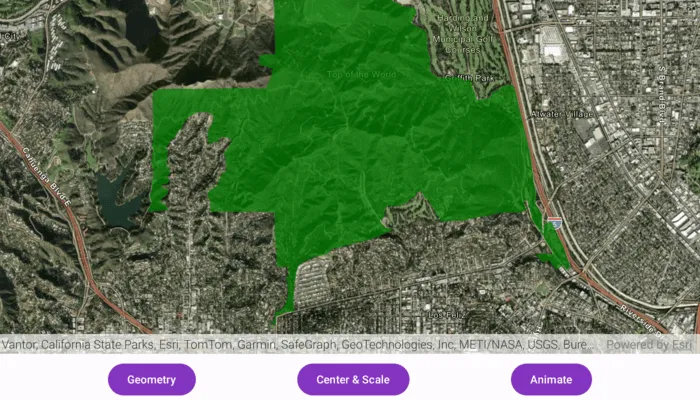
Set the map view to a new viewpoint.
Use case
Navigate programmatically to a specific location on the map, allowing you to zoom in on a particular point.
How to use the sample
The map view has several methods for setting its current viewpoint. Select a viewpoint from the UI to see the viewpoint changed using that method.
How it works
- Create a new
ArcGISMapobject and pass it to theMapViewcomposable’sarcGISMapparameter. - Change the map’s
Viewpointby calling one of the available methods viaMapViewProxy:- Use
MapViewProxy.setViewpointAnimted()to pan to a viewpoint over a specifiedDuration. - Use
MapViewProxy.setViewpointCenter()to center the viewpoint on aPoint. - Use
MapViewProxy.setViewpointGeometry()to set a viewpoint on a givenGeometry
- Use
Relevant API
- ArcGISMap
- Geometry
- MapViewProxy
- Point
- Viewpoint
Additional information
See the various “setViewpoint” methods on MapViewProxy and SceneViewProxy here.
Tags
animate, center, extent, pan, rotate, scale, view, zoom
Sample code
/* Copyright 2026 Esri * * Licensed under the Apache License, Version 2.0 (the "License"); * you may not use this file except in compliance with the License. * You may obtain a copy of the License at * *    http://www.apache.org/licenses/LICENSE-2.0 * * Unless required by applicable law or agreed to in writing, software * distributed under the License is distributed on an "AS IS" BASIS, * WITHOUT WARRANTIES OR CONDITIONS OF ANY KIND, either express or implied. * See the License for the specific language governing permissions and * limitations under the License. * */
package com.esri.arcgismaps.sample.changeviewpoint.components
import android.app.Applicationimport androidx.compose.runtime.getValueimport androidx.compose.runtime.mutableStateOfimport androidx.compose.runtime.setValueimport androidx.lifecycle.AndroidViewModelimport androidx.lifecycle.viewModelScopeimport com.arcgismaps.Colorimport com.arcgismaps.geometry.Geometryimport com.arcgismaps.geometry.Pointimport com.arcgismaps.geometry.Polygonimport com.arcgismaps.geometry.SpatialReferenceimport com.arcgismaps.mapping.ArcGISMapimport com.arcgismaps.mapping.BasemapStyleimport com.arcgismaps.mapping.Viewpointimport com.arcgismaps.mapping.symbology.SimpleFillSymbolimport com.arcgismaps.mapping.symbology.SimpleFillSymbolStyleimport com.arcgismaps.mapping.view.Graphicimport com.arcgismaps.mapping.view.GraphicsOverlayimport com.arcgismaps.toolkit.geoviewcompose.MapViewProxyimport com.esri.arcgismaps.sample.changeviewpoint.Rimport com.esri.arcgismaps.sample.sampleslib.components.MessageDialogViewModelimport kotlinx.coroutines.launchimport kotlin.time.Duration.Companion.seconds
class ChangeViewpointViewModel(app: Application) : AndroidViewModel(app) {
    //Create a viewpoint for London, England with a center point and scale    private val londonViewpoint = Viewpoint(        center = Point(            x = 0.1275,            y = 51.5072,            spatialReference = SpatialReference.wgs84()        ),        scale = 4e4    )
    // Create an ArcGISMap with a basemap style and set the initial viewpoint    val arcGISMap = ArcGISMap(BasemapStyle.ArcGISImagery).apply {        initialViewpoint = londonViewpoint    }
    // Create a graphics overlay to display the polygon geometry graphic    val graphicsOverlay = GraphicsOverlay()
    // Create a MapviewProxy to interact viewpoint changes with the MapView    val mapViewProxy = MapViewProxy()
    // Track the current visible area for animated viewpoint    private var currentVisibleArea: Polygon? by mutableStateOf(null)
    // Track the current map scale for animated viewpoint    private var currentMapScale: Double? by mutableStateOf(null)
    // Create a message dialog view model for handling error messages    val messageDialogVM = MessageDialogViewModel()
    init {        // Create the geometry from JSON and the simple fill symbol for the graphic        val griffithParkPolygon = Geometry.fromJsonOrNull(            json = app.resources.openRawResource(R.raw.griffith_park_geometry)                .bufferedReader()                .use { it.readText() }        ) as? Polygon
        if (griffithParkPolygon != null) {            val fillSymbol = SimpleFillSymbol(                style = SimpleFillSymbolStyle.Solid,                color = Color.fromRgba(r = 0, g = 128, b = 0, a = 179)            )
            // Create the graphic using the geometry and symbol, and add it to the graphics overlay            val griffithParkGraphic = Graphic(                geometry = griffithParkPolygon,                symbol = fillSymbol            )            graphicsOverlay.graphics.add(griffithParkGraphic)        } else {            messageDialogVM.showMessageDialog("Failed to create geometry from JSON file.")        }
        viewModelScope.launch {            arcGISMap.load().onFailure { messageDialogVM.showMessageDialog(it) }        }    }
    /**     * Track the current visible area for animated viewpoint.     */    fun onVisibleAreaChanged(newVisibleArea: Polygon) {        currentVisibleArea = newVisibleArea    }
    /**     * Track current map scale for animated viewpoint.     */    fun onMapScaleChanged(scale: Double) {        currentMapScale = scale    }
    /**     * Sets the viewpoint using a bounding geometry from the [graphicsOverlay].     */    fun onGeometrySelected() {        val polygon = graphicsOverlay.graphics.firstOrNull()?.geometry ?: return
        viewModelScope.launch {            mapViewProxy.setViewpointGeometry(                boundingGeometry = polygon,                paddingInDips = 50.0            )        }    }
    /**     * Sets the viewpoint using center point and scale from the [londonViewpoint].     */    fun onCenterSelected() {        val center = londonViewpoint.targetGeometry.extent.center        val scale = londonViewpoint.targetScale        viewModelScope.launch {            mapViewProxy.setViewpointCenter(                center = center,                scale = scale            )        }    }
    /**     * Animates the viewpoint to zoom in and out over duration, using current visible area and map scale     */    fun onAnimateSelected() {        val center = currentVisibleArea?.extent?.center ?: return        val scale = currentMapScale ?: return
        viewModelScope.launch {            // Zoom in to the current visible area by half the current scale            val isAnimationComplete = mapViewProxy.setViewpointAnimated(                viewpoint = Viewpoint(center = center, scale = scale / 2),                duration = 5.seconds            ).getOrElse {                messageDialogVM.showMessageDialog(it)                false            }            // Once complete, zoom back out to the original scale            if (isAnimationComplete) {                mapViewProxy.setViewpointAnimated(                    viewpoint = Viewpoint(center = center, scale = scale),                    duration = 5.seconds                )            }        }    }}
/* Copyright 2026 Esri * * Licensed under the Apache License, Version 2.0 (the "License"); * you may not use this file except in compliance with the License. * You may obtain a copy of the License at * * http://www.apache.org/licenses/LICENSE-2.0 * * Unless required by applicable law or agreed to in writing, software * distributed under the License is distributed on an "AS IS" BASIS, * WITHOUT WARRANTIES OR CONDITIONS OF ANY KIND, either express or implied. * See the License for the specific language governing permissions and * limitations under the License. * */
package com.esri.arcgismaps.sample.changeviewpoint
import android.os.Bundleimport androidx.activity.ComponentActivityimport androidx.activity.compose.setContentimport androidx.activity.enableEdgeToEdgeimport androidx.compose.material3.MaterialThemeimport androidx.compose.material3.Surfaceimport androidx.compose.runtime.Composableimport androidx.compose.ui.tooling.preview.Previewimport com.esri.arcgismaps.sample.sampleslib.theme.SampleAppThemeimport com.esri.arcgismaps.sample.changeviewpoint.screens.ChangeViewpointScreenclass MainActivity : ComponentActivity() {
override fun onCreate(savedInstanceState: Bundle?) { super.onCreate(savedInstanceState) enableEdgeToEdge() setContent { SampleAppTheme { ChangeViewpointApp() } } }
@Composable private fun ChangeViewpointApp() { Surface(color = MaterialTheme.colorScheme.background) { ChangeViewpointScreen( sampleName = getString(R.string.change_viewpoint_app_name) ) } }}
@Preview(showBackground = true)@Composablefun ChangeViewpointScreenPreview() { SampleAppTheme { ChangeViewpointScreen( sampleName = "Change Viewpoint" ) }}/* Copyright 2026 Esri * * Licensed under the Apache License, Version 2.0 (the "License"); * you may not use this file except in compliance with the License. * You may obtain a copy of the License at * * http://www.apache.org/licenses/LICENSE-2.0 * * Unless required by applicable law or agreed to in writing, software * distributed under the License is distributed on an "AS IS" BASIS, * WITHOUT WARRANTIES OR CONDITIONS OF ANY KIND, either express or implied. * See the License for the specific language governing permissions and * limitations under the License. * */
package com.esri.arcgismaps.sample.changeviewpoint.screens
import androidx.compose.foundation.layout.Arrangementimport androidx.compose.foundation.layout.Columnimport androidx.compose.foundation.layout.Rowimport androidx.compose.foundation.layout.fillMaxSizeimport androidx.compose.foundation.layout.fillMaxWidthimport androidx.compose.foundation.layout.paddingimport androidx.compose.material3.Buttonimport androidx.compose.material3.Scaffoldimport androidx.compose.material3.Textimport androidx.compose.runtime.Composableimport androidx.compose.ui.Modifierimport androidx.compose.ui.res.stringResourceimport androidx.compose.ui.unit.dpimport androidx.lifecycle.viewmodel.compose.viewModelimport com.arcgismaps.toolkit.geoviewcompose.MapViewimport com.esri.arcgismaps.sample.changeviewpoint.Rimport com.esri.arcgismaps.sample.changeviewpoint.components.ChangeViewpointViewModelimport com.esri.arcgismaps.sample.sampleslib.components.MessageDialogimport com.esri.arcgismaps.sample.sampleslib.components.SampleTopAppBar
/** * Main screen layout for the sample app */@Composablefun ChangeViewpointScreen(sampleName: String) { val mapViewModel: ChangeViewpointViewModel = viewModel()
Scaffold(topBar = { SampleTopAppBar(title = sampleName) }) { paddingValues -> Column( modifier = Modifier .fillMaxSize() .padding(paddingValues), ) { MapView( modifier = Modifier .fillMaxSize() .weight(1f), arcGISMap = mapViewModel.arcGISMap, graphicsOverlays = listOf(mapViewModel.graphicsOverlay), mapViewProxy = mapViewModel.mapViewProxy, onMapScaleChanged = mapViewModel::onMapScaleChanged, onVisibleAreaChanged = mapViewModel::onVisibleAreaChanged )
Row( modifier = Modifier .fillMaxWidth() .padding(all = 8.dp), horizontalArrangement = Arrangement.SpaceEvenly ) { Button(onClick = mapViewModel::onGeometrySelected) { Text(text = stringResource(R.string.geometry)) }
Button(onClick = mapViewModel::onCenterSelected) { Text(text = stringResource(R.string.center_and_scale)) }
Button(onClick = mapViewModel::onAnimateSelected) { Text(text = stringResource(R.string.animate)) } } } mapViewModel.messageDialogVM.apply { if (dialogStatus) { MessageDialog( title = messageTitle, description = messageDescription, onDismissRequest = ::dismissDialog ) } } }}