import CatalogLayer from "@arcgis/core/layers/CatalogLayer.js";const CatalogLayer = await $arcgis.import("@arcgis/core/layers/CatalogLayer.js");- Since
- ArcGIS Maps SDK for JavaScript 4.30
Overview
CatalogLayer points to different portal items and services, helping you to better organize and manage your data. It also makes it simpler for users to find information. Instead of manually gathering and adding each dataset separately in your map, you can create a CatalogLayer, which serves as a centralized reference point for all the data you need. CatalogLayer enhances collaboration by enabling users to share and access data more efficiently. For instance, if you're collaborating with colleagues on a GIS project, you can share your CatalogLayer with them. They can then access the same datasets and services referenced in the CatalogLayer, streamlining the collaboration process.
Creating a CatalogLayer
CatalogLayers may be created in one of two ways: from a service URL or from an ArcGIS portal item ID.
Read More
Reference a service URL
To create a CatalogLayer instance from a service, you must set the url property to the REST endpoint of a layer in either a Feature Service or a Map Service. For a layer to be visible in a view, it must be added to the Map referenced by the view. See Map.add() for information about adding layers to a map.
const CatalogLayer = await $arcgis.import("@arcgis/core/layers/CatalogLayer.js");// points to pacific northwest forest fuels inventory statusconst layer = new CatalogLayer({ url: "https://services3.arcgis.com/TVDq0jswpjtt1Xia/arcgis/rest/services/PNW_Forest_Fuels_Inventory_Status/FeatureServer"});map.add(layer); // adds the layer to the mapReference an ArcGIS portal item ID
You can also create a CatalogLayer from its portal item ID if it exists as an item in ArcGIS Online or ArcGIS Enterprise. For example, the following snippet shows how to add a new CatalogLayer instance to a map using the portalItem property.
// points to a hosted Feature Layer in ArcGIS Onlineconst layer = new CatalogLayer({ portalItem: { // autocasts as esri/portal/PortalItem id: "3a9938eab3a3483f88d20b9269f0c098" // portal item id }});map.add(layer); // adds the layer to the map
Sublayers of CatalogLayer
The catalog layer has two main sublayers which can be accessed via the footprintLayer and the dynamicGroupLayer properties. These parts are grouped together under the catalog layer, which manages their settings.
Read More
Footprint layer
Every catalog item (layer) in the CatalogLayer has a footprint stored in the footprintLayer.
A footprint is a polygon feature that envelopes all of the item's features, rasters, and so forth.
Each footprint feature has attributes that provide details about the item, such as its name, layer type, source, minScale, and maxScale.
You can add, update, and maintain your own fields and values in the footprint layer. You cannot remove the footprintLayer from the CatalogLayer.
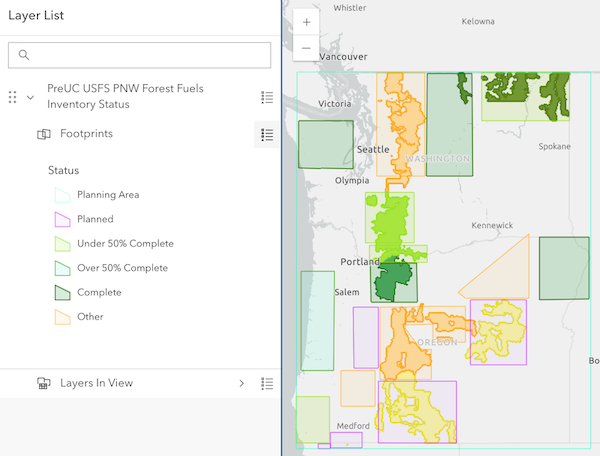
This layer has the same properties as a polygon feature layer, with some exceptions. You can update its visibility and change how the layer is visualized by adding labels, updating the CatalogFootprintLayer.renderer, and extruding the features (in 3D). You can also query the layer to get the footprints of the items in the CatalogLayer.
Dynamic group layer
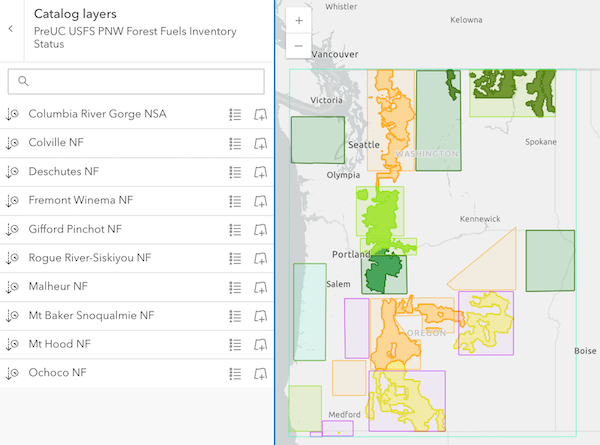
The dynamicGroupLayer dynamically updates to display catalog items (layers) in the current view. By default, it draws up to 10 layers at a time.
This default setting can be changed by adjusting CatalogDynamicGroupLayer.maximumVisibleSublayers
property on the CatalogDynamicGroupLayer. Additionally, the layer can be filtered to show catalog items in a defined scale range, time, or other property.
Because the layer is dynamic, its list of layers in the LayerList.catalogLayerList changes as you pan, zoom, or change the view's extent.
The layers in the dynamicGroupLayer are read-only and not editable. All layers in the dynamicGroupLayer draw with their default symbology. To edit, change, or save a layer, you must add the layer to the map by calling createLayerFromFootprint() method on the parent CatalogLayer.
CatalogLayer attributes
The catalog layer's attribute table can be opened to view all catalog items included in the layer. Each item is a record in the attribute table. A catalog layer's attribute table typically includes the following fields that are required to be present in the catalog layer:
| Field name | Description |
|---|---|
| cd_itemname | The name of the catalog item. |
| cd_itemsource | The source path of the catalog item. |
| cd_itemtype | The type of the catalog item, such as Feature Class or Image Service. |
| cd_maxscale | The maximum scale at which the catalog item can be displayed. |
| cd_minscale | The minimum scale at which the catalog item can be displayed. |
| cd_draworder | The draw order field holds the value to sort catalog items. By default, items with the highest values draw first (on the bottom), and the lowest values draw last (on top). |
Notes
The CatalogLayer's dynamicGroupLayer frequently adds and removes layers from the map which puts more pressure on mobile devices. To improve performance on mobile devices, we recommend the following settings on your CatalogLayer:
- Turn off the visibility of the CatalogDynamicGroupLayer.visible by default.
- Set the CatalogDynamicGroupLayer's CatalogDynamicGroupLayer.maximumVisibleSublayers to a small number.
- Set appropriate scale ranges on catalog items with many features in the service via minScaleField and maxScaleField properties.
- Set scale ranges on the CatalogDynamicGroupLayer via its minsScale and CatalogDynamicGroupLayer.maxScale
properties to visualize
Layers in viewat appropriate scales.
Known Limitations
In 3D SceneView, the CatalogDynamicGroupLayer may load layers outside of the view's visible area. This will be improved in a future release.
Constructors
Constructor
Parameters
| Parameter | Type | Description | Required |
|---|---|---|---|
| properties | | |
Example
// Typical usage// Create catalog layer from a serviceconst layer = new CatalogLayer({ // URL to the service url: "https://services3.arcgis.com/TVDq0jswpjtt1Xia/arcgis/rest/services/PNW_Forest_Fuels_Inventory_Status/FeatureServer"});Properties
| Property | Type | Class |
|---|---|---|
apiKey inherited | ||
blendMode inherited | ||
capabilities readonly inherited | ||
copyright inherited | ||
customParameters inherited | ||
dateFieldsTimeZone inherited | ||
datesInUnknownTimezone readonly inherited | ||
declaredClass readonly inherited | ||
definitionExpression inherited | ||
displayField inherited | ||
displayFilterEnabled inherited | ||
displayFilterInfo inherited | ||
drawOrderField readonly | "cd_draworder" | |
dynamicGroupLayer readonly | | |
editFieldsInfo readonly inherited | ||
editingInfo readonly inherited | EditingInfo | null | undefined | |
effect inherited | ||
effectiveCapabilities readonly inherited | ||
effectiveEditingEnabled readonly inherited | ||
elevationInfo inherited | ||
fields readonly | Field[] | |
fieldsIndex readonly inherited | ||
floorInfo inherited | ||
footprintLayer readonly | | |
fullExtent inherited | ||
gdbVersion inherited | ||
geometryFieldsInfo readonly inherited | ||
geometryType readonly | "polygon" | |
globalIdField inherited | ||
hasM inherited | ||
hasZ inherited | ||
historicMoment inherited | ||
id inherited | ||
isTable readonly inherited | ||
itemNameField readonly | "cd_itemname" | |
itemSourceField readonly | "cd_itemsource" | |
itemTypeField readonly | "cd_itemtype" | |
layerId inherited | ||
layers readonly | | |
| | ||
listMode inherited | ||
loaded readonly inherited | ||
loadError readonly inherited | ||
loadStatus readonly inherited | "not-loaded" | "loading" | "failed" | "loaded" | |
loadWarnings readonly inherited | any[] | |
maxScale inherited | ||
maxScaleField readonly | "cd_maxscale" | |
minScale inherited | ||
minScaleField readonly | "cd_minscale" | |
objectIdField inherited | ||
opacity inherited | ||
orderBy inherited | OrderByInfo[] | null | undefined | |
| | ||
parent inherited | Map | Basemap | Ground | GroupLayer | CatalogDynamicGroupLayer | CatalogLayer | null | undefined | |
persistenceEnabled inherited | ||
portalItem inherited | PortalItem | null | undefined | |
preferredTimeZone readonly inherited | ||
refreshInterval inherited | ||
relationships readonly inherited | Relationship[] | null | undefined | |
returnM inherited | ||
returnZ inherited | ||
serviceDefinitionExpression readonly inherited | ||
serviceItemId readonly inherited | ||
sourceJSON inherited | ||
spatialReference inherited | ||
subtypeField readonly inherited | ||
subtypes readonly inherited | ||
timeExtent inherited | TimeExtent | null | undefined | |
timeInfo inherited | ||
timeOffset inherited | ||
title inherited | ||
type readonly | "catalog" | |
uid readonly inherited | ||
| | ||
useViewTime inherited | ||
version readonly inherited | ||
visibilityTimeExtent inherited | TimeExtent | null | undefined | |
visible inherited |
apiKey
An authorization string used to access a resource or service. This property will append the API key to all requests made by the layer to the service. API keys are generated and managed in the portal. An API key is tied explicitly to an ArcGIS account; it is also used to monitor service usage. Setting a fine-grained API key on a specific class overrides the global API key.
If loading a secure layer with API authentication via a PortalItem, the API key needs to be set on the layer's portalItem property.
Example
// set the api key to access a protected serviceconst layer = new FeatureLayer({ url: serviceUrl, apiKey: "YOUR_API_KEY"}); blendMode
- Type
- BlendMode
Blend modes are used to blend layers together to create an interesting effect in a layer, or even to produce what seems like a new layer. Unlike the method of using transparency which can result in a washed-out top layer, blend modes can create a variety of very vibrant and intriguing results by blending a layer with the layer(s) below it.
When blending layers, a top layer is a layer that has a blend mode applied. All layers underneath the top layer are background layers.
The default blending mode is normal where the top layer is simply displayed over the background layer. While this default behavior is perfectly acceptable,
the use of blend modes on layers open up a world of endless possibilities to generate creative maps.
The layers in a GroupLayer are blended together in isolation from the rest of the map.
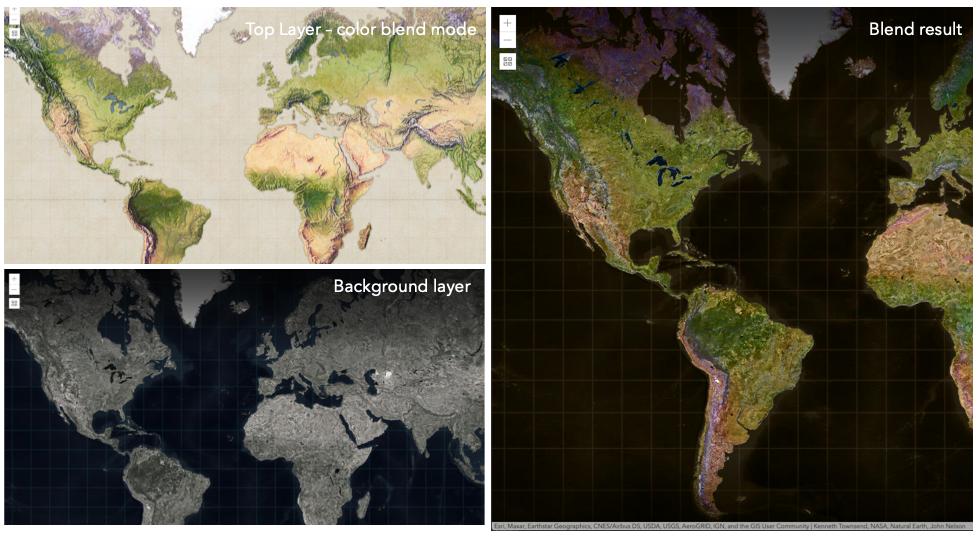
In the following screenshots, the vintage shaded relief
layer is displayed over a firefly world imagery layer. The color blend mode
is applied to the vintage shaded relief and the result looks like a new layer.
Known Limitations
- In 3D SceneViews, the blendMode is supported on BaseTileLayer, ImageryTileLayer, OpenStreetMapLayer, TileLayer, VectorTileLayer, WCSLayer, WebTileLayer, WMTSLayer and GroupLayer.
- When working with GroupLayers in a 3D SceneView, the blendMode is only applied to the sublayers that support it.
- The blendMode is not supported in the Legend.
- See print for known printing limitations.
The following factors will affect the blend result:
- Order of all layers
- Layer opacity
- Opacity of features in layers
- Visibility of layers
- By default, the very bottom layer in a map is drawn on a transparent background. You can change the MapView's background color.
Read More
| Blend mode | Description |
|---|---|
| normal | The top layer is displayed over the background layer. The data of the top layer block the data of background layer where they overlap. |
| average | Takes the mathematical average of top and background layers. Result of average blend mode is often similar to the effect of setting the layer's opacity to 50%. |
Lighten blend modes:
The following blend modes create lighter results than all layers. In lighten blend modes, pure black colors in the top layer become transparent allowing the background layer to show through. White in the top layer will stay unchanged. Any color that is lighter than pure black is going to lighten colors in the top layer to varying degrees all way to pure white.
Lighten blend modes can be useful when lightening dark colors of the top layer or removing black colors from the result.
The plus, lighten and screen modes can be used to brighten layers that have faded or dark colors on a dark background.
| Blend mode | Description |
|---|---|
| lighten | Compares top and background layers and retains the lighter color. Colors in the top layer become transparent if they are darker than the overlapping colors in the background layer allowing the background layer to show through completely. Can be thought of as the opposite of darken blend mode. |
| lighter | Colors in top and background layers are multiplied by their alphas (layer opacity and layer's data opacity. Then the resulting colors are added together. All overlapping midrange colors are lightened in the top layer. The opacity of layer and layer's data will affect the blend result. |
| plus | Colors in top and background layers are added together. All overlapping midrange colors are lightened in the top layer. This mode is also known as add or linear-dodge. |
| screen | Multiplies inverted colors in top and background layers then inverts the colors again. The resulting colors will be lighter than the original color with less contrast. Screen can produce many different levels of brightening depending on the luminosity values of the top layer. Can be thought of as the opposite of the multiply mode. |
| color-dodge | Divides colors in background layer by the inverted top layer. This lightens the background layer depending on the value of the top layer. The brighter the top layer, the more its color affects the background layer. Decreases the contrast between top and background layers resulting in saturated mid-tones and blown highlights. |
Darken blend modes:
The following blend modes create darker results than all layers. In darken blend modes, pure white in the top layer will become transparent allowing the background layer to show through. Black in the top layer will stay unchanged. Any color that is darker than pure white is going to darken a top layer to varying degrees all the way to pure black.
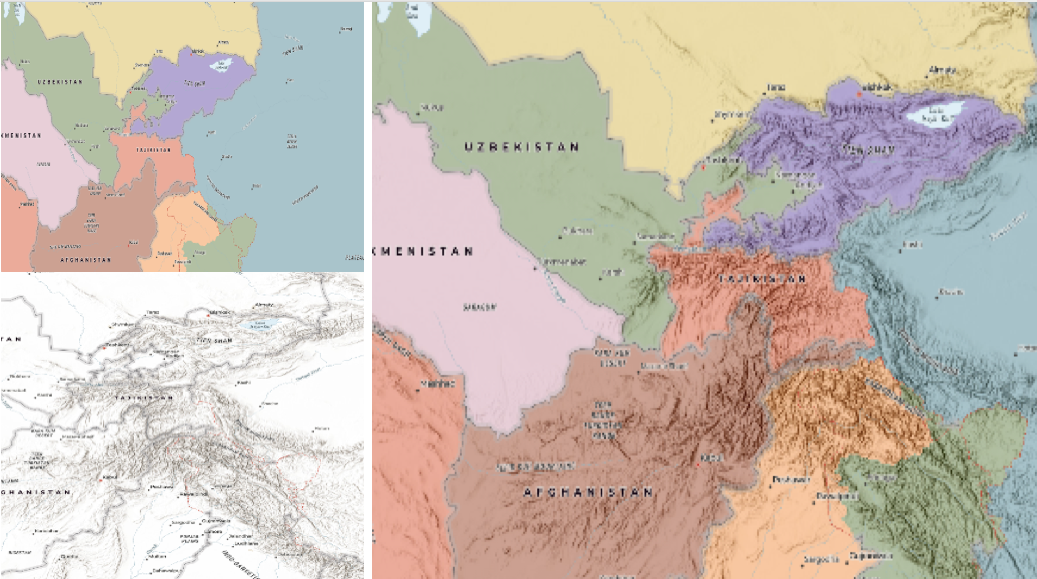
The multiply blend mode is often used to highlight shadows, show contrast, or accentuate an aspect of a map. For example, you can use multiply blend mode on a topographic map
displayed over hillshade when you want to have your elevation show through the topographic layer. See the intro to layer blending sample.
The multiply and darken modes can be used to have dark labels of the basemap to show through top layers. See the darken blending sample.
The color-burn mode works well with colorful top and background layers since it increases saturation in mid-tones. It increases the contrast by tinting pixels in overlapping areas in
top and bottom layers more towards the top layer color. Use this blend mode, when you want an effect with more contrast than multiply or darken.
The following screenshots show how the multiply blend mode used for creating a physical map of the world that shows both boundaries and elevation.
| Blend mode | Description |
|---|---|
| darken | Emphasizes the darkest parts of overlapping layers. Colors in the top layer become transparent if they are lighter than the overlapping colors in the background layer, allowing the background layer to show through completely. |
| multiply | Emphasizes the darkest parts of overlapping layers by multiplying colors of the top layer and the background layer. Midrange colors from top and background layers are mixed together more evenly. |
| color-burn | Intensifies the dark areas in all layers. It increases the contrast between top and background layers, by tinting colors in overlapping area towards the top color. To do this it inverts colors of the background layer, divides the result by colors of the top layer, then inverts the results. |
Contrast blend modes:
The following blend modes create contrast by both lightening the lighter areas and darkening the darker areas in the top layer by using lightening or darkening blend modes to create the blend.
The contrast blend modes will lighten the colors lighter than 50% gray ([128,128,128]), and darken the colors darker than 50% gray. 50% gray will be transparent in the top layer.
Each mode can create a variety of results depending on the colors of top and background layers being blended together.
The overlay blend mode makes its calculations based on the brightness of the colors in the background layer while all of the other contrast blend modes make their calculations based on the brightness of the top layer.
Some of these modes are designed to simulate the effect of shining a light through the top layer, effectively projecting upon the layers beneath it.
Contrast blend modes can be used to increase the contrast and saturation to have more vibrant colors and give a punch to your layers.
For example, you can duplicate a layer and set overlay blend mode on the top layer to increase the contrast and tones of your layer.
You can also add a polygon layer with a white fill symbol over a dark imagery layer and apply soft-light blend mode to increase the brightness in the imagery layer.
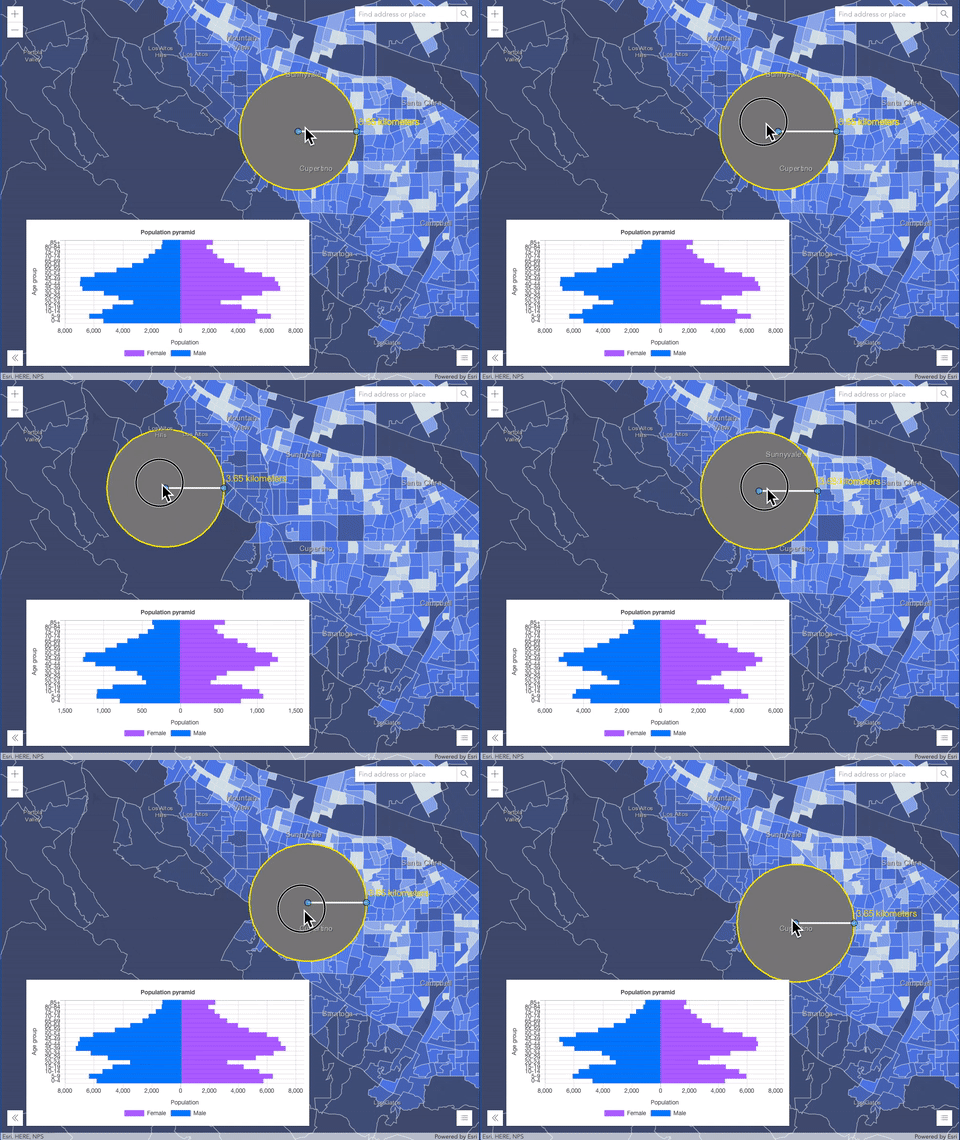
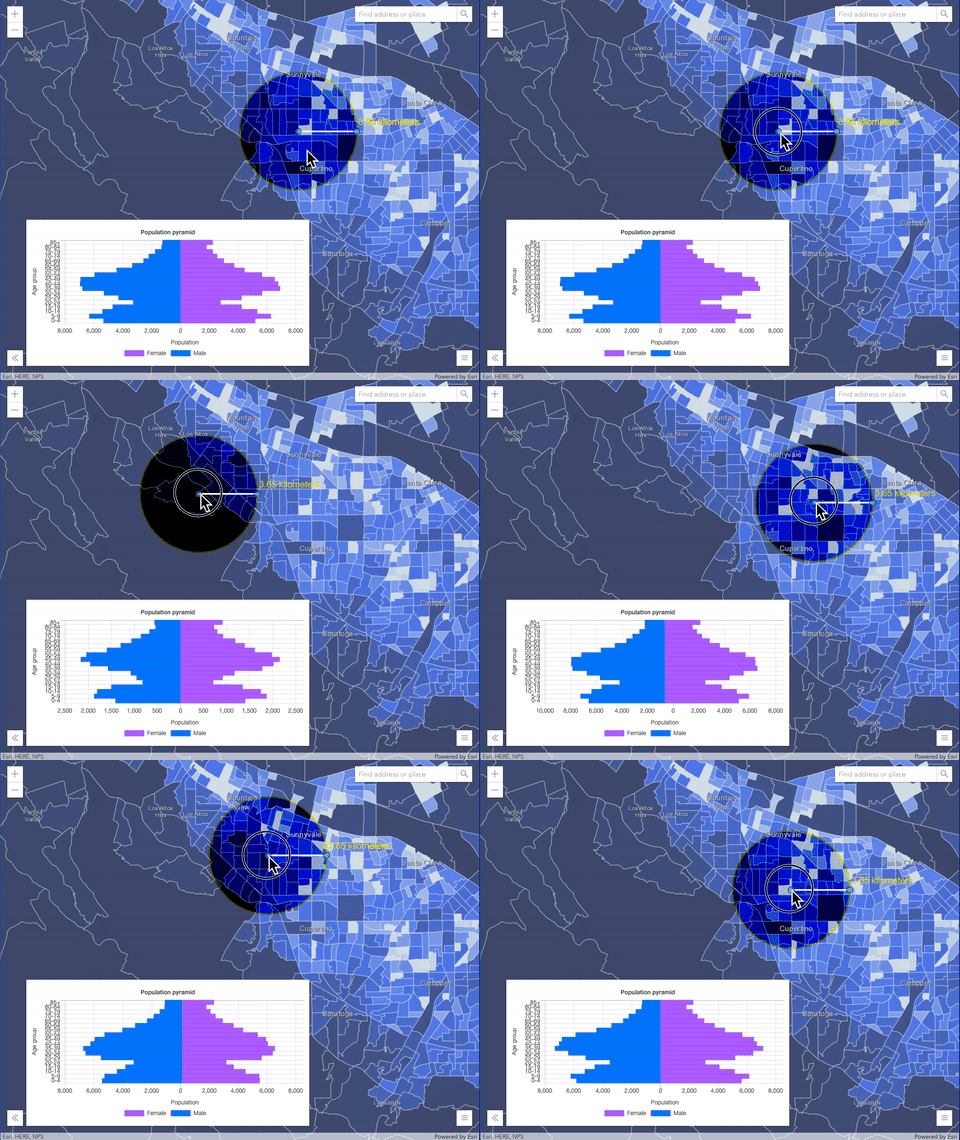
The following screenshots show an effect of the overlay blend mode on a GraphicsLayer. The left image shows when the buffer graphics layer has the normal blend mode.
As you can see, the gray color for the buffer polygon is blocking the intersecting census tracts. The right image shows when the overlay blend mode is applied to the buffer graphics layer.
The overlay blend mode darkens or lightens the gray buffer polygon depending on the colors of the background layer while the census tracts layer is shining through.
See this in action.
| Normal blend mode | Overlay blend mode |
|---|---|
 |  |
| Blend mode | Description |
|---|---|
| overlay | Uses a combination of multiply and screen modes to darken and lighten colors in the top layer with the background layer always shining through. The result is darker color values in the background layer intensify the top layer, while lighter colors in the background layer wash out overlapping areas in the top layer. |
| soft-light | Applies a half strength screen mode to lighter areas and half strength multiply mode to darken areas of the top layer. You can think of the soft-light as a softer version of the overlay mode. |
| hard-light | Multiplies or screens the colors, depending on colors of the top layer. The effect is similar to shining a harsh spotlight on the top layer. |
| vivid-light | Uses a combination of color-burn or color-dodge by increasing or decreasing the contrast, depending on colors in the top layer. |
Component blend modes:
The following blend modes use primary color components, which are hue, saturation and luminosity to blend top and background layers.
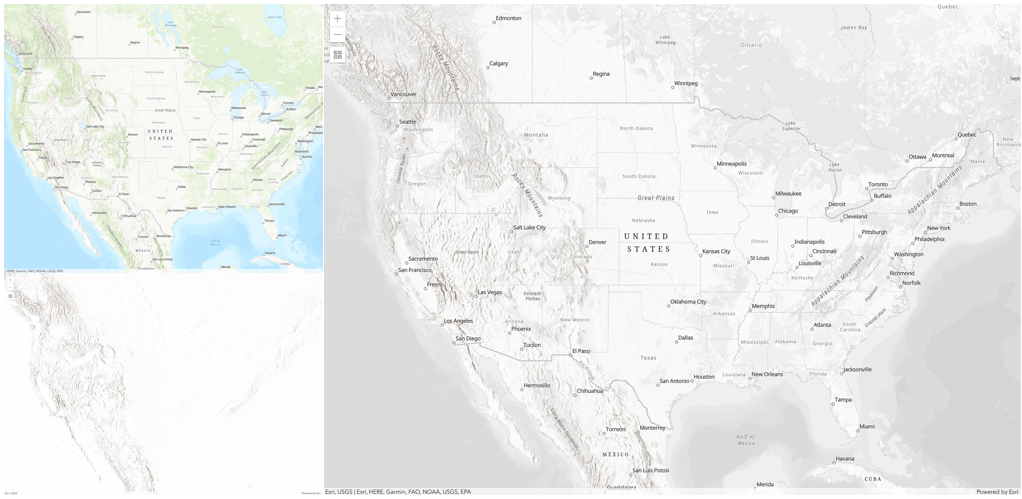
You can add a feature layer with a simple renderer over any layer and set hue, saturation, color or luminosity blend mode on this layer. With this technique, you create a brand new looking map.
The following screenshots show where the topo layer is blended with
world hillshade layer with luminosity blend mode.
The result is a drastically different looking map which preserves the brightness of the topo layer while adapting the hue and saturation of the hillshade layer.
| Blend mode | Description |
|---|---|
| hue | Creates an effect with the hue of the top layer and the luminosity and saturation of the background layer. |
| saturation | Creates an effect with the saturation of the top layer and the hue and luminosity of the background layer. 50% gray with no saturation in the background layer will not produce any change. |
| luminosity | Creates effect with the luminosity of the top layer and the hue and saturation of the background layer. Can be thought of as the opposite of color blend mode. |
| color | Creates an effect with the hue and saturation of the top layer and the luminosity of the background layer. Can be thought of as the opposite of luminosity blend mode. |
Composite blend modes:
The following blend modes can be used to mask the contents of top, background or both layers.
Destinationmodes are used to mask the data of the top layer with the data of the background layer.Sourcemodes are used to mask the data of the background layer with the data of the top layer.
The destination-in blend mode can be used to show areas of focus such as earthquakes, animal migration, or point-source pollution by revealing the underlying map,
providing a bird's eye view of the phenomenon. Check out multiple blending and groupLayer blending
samples to see composite blend modes in action.
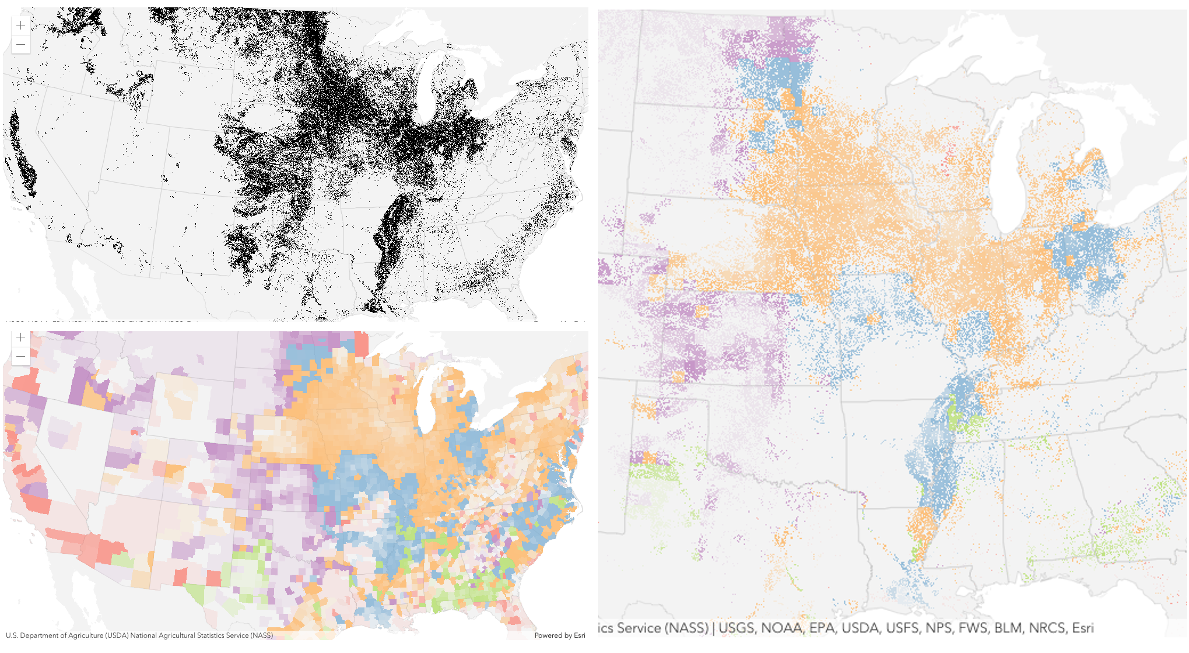
The following screenshots show feature and imagery layers on the left side on their own in the order they are drawn in the view. The imagery layer that contains land cover classification rasters.
The feature layer contains 2007 county crops data. The right image shows the result of layer blending where destination-in blendMode is set on the imagery layer. As you can see, the effect is
very different from the original layers. The blended result shows areas of cultivated crops only (where both imagery and feature layers overlap).
| Blend mode | Description |
|---|---|
| destination-over | Destination/background layer covers the top layer. The top layer is drawn underneath the destination layer. You'll see the top layer peek through wherever the background layer is transparent or has no data. |
| destination-atop | Destination/background layer is drawn only where it overlaps the top layer. The top layer is drawn underneath the background layer. You'll see the top layer peek through wherever the background layer is transparent or has no data. |
| destination-in | Destination/background layer is drawn only where it overlaps with the top layer. Everything else is made transparent. |
| destination-out | Destination/background layer is drawn where it doesn't overlap the top layer. Everything else is made transparent. |
| source-atop | Source/top layer is drawn only where it overlaps the background layer. You will see the background layer peek through where the source layer is transparent or has no data. |
| source-in | Source/top layer is drawn only where it overlaps with the background layer. Everything else is made transparent. |
| source-out | Source/top layer is drawn where it doesn't overlap the background layer. Everything else is made transparent. |
| xor | Top and background layers are made transparent where they overlap. Both layers are drawn normal everywhere else. |
Invert blend modes:
The following blend modes either invert or cancel out colors depending on colors of the background layer.
These blend modes look for variations between top and background layers.
For example, you can use difference or exclusion blend modes on two imagery layers of forest covers to visualize how forest covers changed from one year to another.
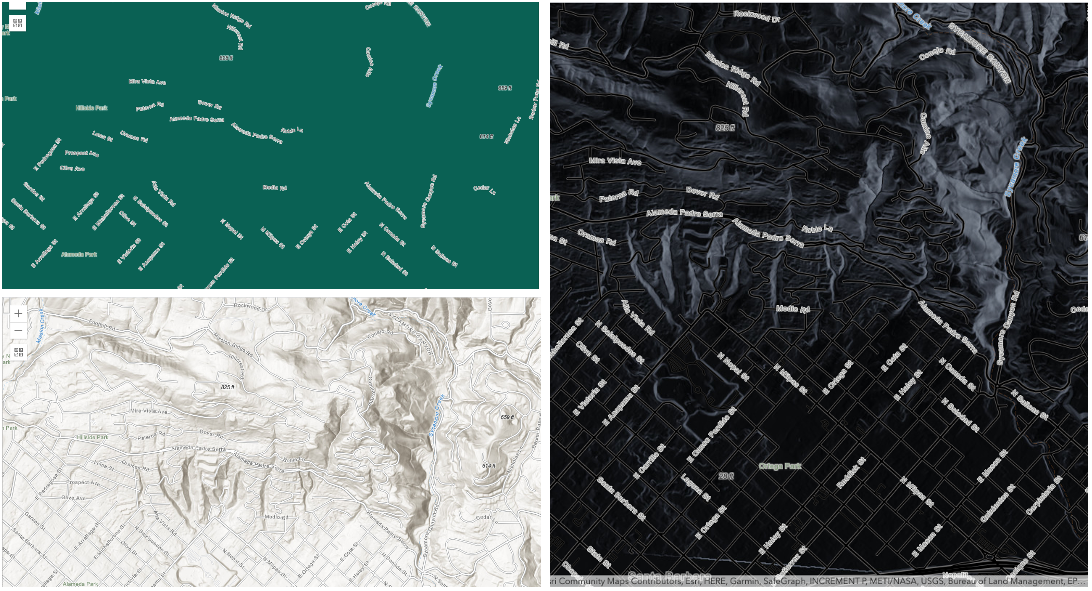
The invert blend mode can be used to turn any light basemap into a dark basemap to accommodate those who work in low-light conditions. The following screenshots show
how setting the invert blend mode set on a feature layer with a simple renderer turns the world Hillshade
into a dark themed basemap in no time.
| Blend mode | Description |
|---|---|
| difference | Subtracts the darker of the overlapping colors from the lighter color. When two pixels with the same value are subtracted, the result is black. Blending with black produces no change. Blending with white inverts the colors. This blending mode is useful for aligning layers with similar content. |
| exclusion | Similar to the difference blend mode, except that the resulting image is lighter overall. Overlapping areas with lighter color values are lightened, while darker overlapping color values become transparent. |
| minus | Subtracts colors of the top layer from colors of the background layer making the blend result darker. In the case of negative values, black is displayed. |
| invert | Inverts the background colors wherever the top and background layers overlap. The invert blend mode inverts the layer similar to a photographic negative. |
| reflect | This blend mode creates effects as if you added shiny objects or areas of light in the layer. Black pixels in the background layer are ignored as if they were transparent. |
- See also
- Default value
- "normal"
capabilities
Describes the layer's supported capabilities.
Example
// Once the layer loads, check if the// supportsAdd operations is enabled on the layerawait featureLayer.load();if (featureLayer.capabilities.operations.supportsAdd) { // if new features can be created in the layer // set up the UI for editing setupEditing();} customParameters
- Type
- CustomParameters | null | undefined
A list of custom parameters appended to the URL of all resources fetched by the layer.
It's an object with key-value pairs where value is a string.
The layer's refresh() method needs to be called if the customParameters are updated at runtime.
Example
// send a custom parameter to your special servicelet layer = new MapImageLayer({ url: serviceUrl, customParameters: { "key": "my-special-key" }}); dateFieldsTimeZone
The time zone that dates are stored in. This property does not apply to date fields referenced by timeInfo or editFieldsInfo.
Even though dates are transmitted as UTC epoch values, this property may be useful when constructing date or time where clauses for querying. If constructing date or time where clauses, use FieldsIndex.getTimeZone() to get the time zone for the given date field.
Set this property in the layer constructor if you are creating client-side feature layers
to indicate the time zone of the date fields. The date field must exist in the layer's fields array for client-side
feature layers if the dateFieldsTimeZone is specified.
Example
const layer = new FeatureLayer({ // layer's fields definition fields: [ { name: "ObjectID", alias: "ObjectID", type: "oid" }, { name: "type", alias: "Type", type: "string" }, { name: "recordedDate", alias: "recordedDate", type: "date" }], dateFieldsTimeZone: "America/New_York", // date field values in are eastern time zone objectIdField: "ObjectID", // inferred from fields array if not specified geometryType: "point", // geometryType and spatialReference are inferred from the first feature // in the source array if they are not specified. spatialReference: { wkid: 4326 }, source: graphics // an array of graphics with geometry and attributes});map.add(layer); datesInUnknownTimezone
- Type
- boolean
This property is set by the service publisher and indicates that dates should be considered without the local timezone. This applies to both requests and responses.
Known Limitations
- This capability is only available with services published with ArcGIS Enterprise 10.9 or greater.
- Editing is not supported for FeatureLayers if
datesInUnknownTimezoneis true. The layer's editingEnabled property will be set tofalse. - When setting
timeExtentin a Query, the layer view's filter.timeExtent or layer's timeExtent, dates must be defined in terms of UTC as illustrated in the code below. When usinglayer.timeInfo.fullTimeExtentin conjunction with TimeSlider, the local timezone offset must be removed. See the code snippet below.
- Default value
- false
Examples
// Only download data for the year 2020.// if the layer supports unknown time zone then create// the dates in UTCif (layer.datesInUnknownTimezone) { layer.timeExtent = new TimeExtent({ start: new Date(Date.UTC(2020, 0, 1)), end: new Date(Date.UTC(2021, 0, 1)) });}else { layer.timeExtent = new TimeExtent({ start: new Date(2020, 0, 1), end: new Date(2021, 0, 1) });}// set up the timeslider for a service with an unknown timezoneif (layer.datesInUnknownTimezone) { const timeSlider = new TimeSlider({ view: view, container: "timeSliderDiv", timeVisible: true, }); view.ui.add(timeSlider, "bottom-left");
view.whenLayerView(layer).then((layerView) => { // get the layer's fullTimeExtent and remove the local // time zone offset const timExtent = new TimeExtent({ start: removeLocalOffset(layer.timeInfo.fullTimeExtent.start), end: removeLocalOffset(layer.timeInfo.fullTimeExtent.end) });
timeSlider.fullTimeExtent = timExtent; timeSlider.stops = { interval: layer.timeInfo.interval; }; });}
// Remove the local time zone offset from datesfunction removeLocalOffset(localTime) { return new Date( localTime.getUTCFullYear(), localTime.getUTCMonth(), localTime.getUTCDate(), localTime.getUTCHours(), localTime.getUTCMinutes(), localTime.getUTCSeconds(), localTime.getUTCMilliseconds() );} definitionExpression
The SQL where clause used to filter features on the client. Only the features that satisfy the definition expression are displayed in the View. Setting a definition expression is useful when the dataset is large and you don't want to bring all features to the client for analysis. Definition expressions may be set when a layer is constructed prior to it loading in the view or after it has been added to the map. If the definition expression is set after the layer has been added to the map, the view will automatically refresh itself to display the features that satisfy the new definition expression.
Examples
// Set definition expression in constructor to only display trees with scientific name Ulmus pumilaconst layer = new FeatureLayer({ url: "https://services.arcgis.com/V6ZHFr6zdgNZuVG0/arcgis/rest/services/Landscape_Trees/FeatureServer/0", definitionExpression: "Sci_Name = 'Ulmus pumila'"});// Set the definition expression directly on layer instance to only display trees taller than 50ftlayer.definitionExpression = "HEIGHT > 50"; displayField
The name of the layer's primary display field. The value of this property matches the name of one of the fields of the layer.
displayFilterEnabled
- Type
- boolean
- Since
- ArcGIS Maps SDK for JavaScript 4.32
Indicates whether the layer's displayFilterInfo is applied when rendering the layer in the view.
If false, the layer's display filter is ignored and all features are rendered without filtering.
To ignore display filters across all layers in the view, set the view's View.displayFilterEnabled
property to false.
- Default value
- true
displayFilterInfo
- Type
- DisplayFilterInfo | null | undefined
- Since
- ArcGIS Maps SDK for JavaScript 4.32
Information related to a display filter associated with a layer. Display filters control which features are visible on the map. They allow you to display a subset of features while retaining access to all features
for querying and analysis. Unlike FeatureLayer.definitionExpression, which filters data at the source level, display filters only affect visibility on the map.
Therefore display filters should be ignored when querying data to present to users.
Display filters can be disabled for all layers in the map by setting the view's View.displayFilterEnabled property to false.
Notes:
To optimize memory usage for rendering, display filters may be appended to the layer's FeatureLayer.definitionExpression when querying the service.
As a result, the filtered features may not be available on the client for executing layer view queries.
To determine if all features are available in the view, check the layer view's FeatureLayerView.hasAllFeaturesInView
property when layer view's FeatureLayerView.dataUpdating is false. If false, the layer view does not have all features in the view
and you should query the layer instead.
Example
// set a scale-dependent display filter on a layerconst layer = new FeatureLayer({ portalItem: { id: "28dbd58ad90e4a47ab0e0334d2b69427" }, minScale: 0, maxScale: 0, outFields: ["*"], // set scale-dependent display filters to declutter the display at different scales. // Show more streams as user zooms in and less as user zooms out. displayFilterInfo: new DisplayFilterInfo({ mode: "scale", filters: [ { title: "streamOrder >= 8", minScale: 0, maxScale: 18_489_297.737236, where: "streamOrder >= 8" }, { title: "streamOrder >= 6", minScale: 18_489_297.737236 maxScale: 9_244_648.868618, where: "streamOrder >= 6" }, { title: "streamOrder >= 4", minScale: 9_244_648.868618, maxScale: 577790.5542885 where: "streamOrder >= 4" }, { title: "all", minScale: 577790.5542885, maxScale: 0 } ] })}); drawOrderField
- Type
- "cd_draworder"
The draw order field holds the value to sort catalog items (layers). By default, layers with the highest values draw first (on the bottom), and the lowest values draw last (on top). This can be changed by specifying the orderBy property.
dynamicGroupLayer
The dynamicGroupLayer includes the catalog items (layers) that are currently visible in your view. Since it's dynamic, its list of layers in the LayerList.catalogLayerList changes as you interact with the map. By default, CatalogLayer draws up to 10 layers at a time. This default setting can be changed by adjusting the CatalogDynamicGroupLayer.maximumVisibleSublayers property.
Example
// Change the maximumVisibleSublayers of the dynamicGroupLayer after the catalog layer is loadedconst layerView = await view.whenLayerView(layer);await reactiveUtils.whenOnce(() => !layerView.updating);layer.dynamicGroupLayer.maximumVisibleSublayers = 20; editFieldsInfo
- Type
- EditFieldsInfo | null | undefined
The editor tracking fields, which record who adds or edits the data through the feature service and when edits are made.
editingInfo
- Type
- EditingInfo | null | undefined
Specifies information about editing.
effect
Effect provides various filter functions that can be performed on the layer to achieve different visual effects similar to
how image filters work. This powerful capability allows you to apply css filter-like
functions to layers to create custom visual effects to enhance the cartographic quality of your maps. This is done by applying the desired
effect to the layer's effect property as a string or an array of objects to set scale dependent effects.
Notes
Set featureEffect property on a layer if different effects need to be applied features that meet or fail a specified filter. If all of the following four properties are applied, then they will be applied in this order: featureEffect, effect, opacity and blendMode.
Known Limitations
- The effect is not supported in 3D SceneViews.
- The effect cannot be applied to a layer with a heatmap renderer.
- The effect is not supported in layers with FeatureLayer.featureReduction of type
clusterenabled. - See print for known printing limitations.
Examples
// the following effect will be applied to the layer at all scales// brightness will be applied first, then hue-rotate followed by contrast// changing order of the effects will change the final resultlayer.effect = "brightness(5) hue-rotate(270deg) contrast(200%)";// set a scale dependent bloom effect on the layerlayer.effect = [ { scale: 36978595, value: "drop-shadow(3px, 3px, 4px)" }, { scale: 18489297, value: "drop-shadow(2px, 2px, 3px)" }, { scale: 4622324, value: "drop-shadow(1px, 1px, 2px)" }]; effectiveCapabilities
- Type
- FeatureLayerCapabilities | null | undefined
Describes effective capabilities of the layer taking in to consideration privileges of the currently signed-in user.
effectiveEditingEnabled
- Type
- boolean
Indicates whether the layer is editable taking in to consideration privileges of the currently signed-in user.
elevationInfo
- Type
- ElevationInfo | null | undefined
Specifies how features are placed on the vertical axis (z). This property may only be used in a SceneView. See the ElevationInfo sample for an example of how this property may be used.
If the elevation info is not specified, the effective elevation depends on the context and could vary per graphic.
fields
- Type
- Field[]
An array of fields in the layer. Each field represents an attribute that may contain a value for each feature in the layer.
For example, a field named cd_itemtype, stores information about the type of the catalog item, such as Feature Service or Map Service.
Example
// Create popup template for the footprint layer after the catalog layer is loadedconst layerView = await view.whenLayerView(layer);
layer.footprintLayer.fields.forEach((field) => {  let fieldInfo = {    fieldName: field.name  };  fieldInfosArray.push(fieldInfo);});
layer.footprintLayer.popupTemplate = new PopupTemplate({  title: layer.title,  fieldInfos: fieldInfosArray,  content: [    {      type: "fields"    }  ]});
fieldsIndex
- Type
- FieldsIndex<Field>
A convenient property that can be used to make case-insensitive lookups for a field by name. It can also provide a list of the date fields in a layer.
Example
// lookup a field by name. name is case-insensitiveconst field = layer.fieldsIndex.get("SoMeFiEld");
if (field) {  console.log(field.name); // SomeField}
floorInfo
- Type
- LayerFloorInfo | null | undefined
When a feature layer is configured as floor-aware, it has a floorInfo property defined. A floor-aware layer is a layer that contains indoor GIS data representing features that can be located on a specific floor of a building.
footprintLayer
The footprint layer is a layer that displays footprints of items referenced in a CatalogLayer. In the CatalogLayer, each service or item has a footprint, which is a visual representation covering all features, rasters, etc., within it. The attributes of each footprint feature provide details about the item's name, type, source, min and max scales.
Example
layer.footprintLayer.fields.forEach((field) => {  let fieldInfo = {    fieldName: field.name  };  fieldInfosArray.push(fieldInfo);});
// Create popup template for the footprint layer and add a button in the popup template// When button is clicked, create a new layer for the catalog item associated with the clicked// footprint feature and add it to the maplayer.footprintLayer.popupTemplate = new PopupTemplate({  title: layer.title,  fieldInfos: fieldInfosArray,  content: [    {      type: "fields"    }  ],  actions: [    {      type: "button",      id: "add-layer",      icon: "add-layer",      title: "Add layer"    }  ]});
// Create a new layer for the catalog item associated from the clicked the footprint// feature and add it to the map when the button is clickedreactiveUtils.on(() => view.popup, "trigger-action", async (event) => { if (event.action.id === "add-layer") { const sublayer = await layer.createLayerFromFootprint(view.popup.selectedFeature); map.layers.push(sublayer); }}); gdbVersion
The version of the geodatabase of the feature service data. Read the Overview of versioning topic for more details about this capability.
geometryFieldsInfo
- Type
- GeometryFieldsInfo | null | undefined
Provides information on the system maintained area and length fields along with their respective units.
- See also
globalIdField
- Since
- ArcGIS Maps SDK for JavaScript 4.33
The name of a gid field containing a globally unique identifier for each
feature in the layer. This may be null or undefined if the layer does not have a
globally unique identifier field.
- See also
hasM
- Type
- boolean
Indicates whether the client-side features in the layer have M (measurement) values.
Use the supportsM property in the FeatureLayer's capabilities.data
object to verify if M values are supported on feature service features.
hasZ
- Type
- boolean
Indicates whether the client-side features in the layer have Z (elevation) values.
Refer to elevationInfo for details regarding placement and rendering
of features with z-values in 3D SceneViews.
Use the supportsZ property in the FeatureLayer's capabilities.data
object to verify if Z values are supported on feature service features.
historicMoment
The historic moment to query. If historicMoment is not specified, the query will apply to the current features.
isTable
- Type
- boolean
Returns true if the layer is loaded from a non-spatial table in a service. Non-spatial tables do not have
a spatial column that represent geographic features.
- Default value
- false
layerId
- Type
- number
The layer ID, or layer index, of a Feature Service layer. This is particularly useful when loading a single feature layer with the portalItem property from a service containing multiple layers. You can specify this value in one of two scenarios:
- When loading the layer via the portalItem property.
- When pointing the layer's url directly to a feature service.
If a layerId is not specified in either of the above scenarios, then the first layer
in the service (layerId = 0) is selected.
Examples
// loads the third layer in the given Portal Itemconst layer = new FeatureLayer({ portalItem: { id: "8d26f04f31f642b6828b7023b84c2188" }, layerId: 2});// If not specified, the first layer (layerId: 0) will be returnedconst layer = new FeatureLayer({ portalItem: { id: "8d26f04f31f642b6828b7023b84c2188" }});// Can also be used if URL points to service and not layerconst layer = new FeatureLayer({ // Notice that the url doesn't end with /2 url: "http://services.arcgis.com/V6ZHFr6zdgNZuVG0/arcgis/rest/services/MonterreyBayCanyon_WFL/FeatureServer", layerId: 2});// This code returns the same layer as the previous snippetconst layer = new FeatureLayer({ // The layer id is specified in the URL url: "http://services.arcgis.com/V6ZHFr6zdgNZuVG0/arcgis/rest/services/MonterreyBayCanyon_WFL/FeatureServer/2",}); layers
A collection of CatalogFootprintLayer and CatalogDynamicGroupLayers.
legendEnabled
- Type
- boolean
Indicates whether the layer will be included in the legend. When false, the layer will be excluded from the legend.
- Default value
- true
listMode
- Type
- LayerListMode
Indicates how the layer should display in the Layer List component. The possible values are listed below.
| Value | Description |
|---|---|
| show | The layer is visible in the table of contents. |
| hide | The layer is hidden in the table of contents. |
| hide-children | If the layer is a GroupLayer, BuildingSceneLayer, KMLLayer, MapImageLayer, SubtypeGroupLayer, TileLayer, or WMSLayer, hide the children layers from the table of contents. |
- Default value
- "show"
loadError
The Error object returned if an error occurred while loading.
loadStatus
- Type
- "not-loaded" | "loading" | "failed" | "loaded"
Represents the status of a load() operation.
| Value | Description |
|---|---|
| not-loaded | The object's resources have not loaded. |
| loading | The object's resources are currently loading. |
| loaded | The object's resources have loaded without errors. |
| failed | The object's resources failed to load. See loadError for more details. |
- Default value
- "not-loaded"
loadWarnings
- Type
- any[]
A list of warnings which occurred while loading.
maxScale
- Type
- number
The maximum scale (most zoomed in) at which the layer is visible in the view.
If the map is zoomed in beyond this scale, the layer will not be visible.
A value of 0 means the layer does not have a maximum scale.
The maxScale value should always be smaller than the minScale value,
and greater than or equal to the service specification.
- Default value
- 0
Examples
// The layer will not be visible when the view is zoomed in beyond a scale of 1:1,000layer.maxScale = 1000;// The layer's visibility is not restricted to a maximum scale.layer.maxScale = 0; maxScaleField
- Type
- "cd_maxscale"
The max scale field holds the maximum scale at which the catalog item is visible in the view. If the map is zoomed in beyond this scale,
the item will not be visible. A value of 0 or null means the catalog item does not have a maximum scale. The maxScale value should always be smaller
than the minScale value, and greater than or equal to the service specification.
minScale
- Type
- number
The minimum scale (most zoomed out) at which the layer is visible in the view.
If the map is zoomed out beyond this scale, the layer will not be visible.
A value of 0 means the layer does not have a minimum scale.
The minScale value should always be larger than the maxScale value,
and lesser than or equal to the service specification.
- Default value
- 0
Examples
// The layer will not be visible when the view is zoomed out beyond a scale of 1:3,000,000layer.minScale = 3000000;// The layer's visibility is not restricted to a minimum scale.layer.minScale = 0; minScaleField
- Type
- "cd_minscale"
The min scale field holds the minimum scale at which the catalog item is visible in the view. If the map is zoomed in beyond this scale,
the item will not be visible. A value of 0 or null means the catalog item does not have a minimum scale. The minScale value should always
be larger than the maxScale value, and lesser than or equal to the service specification.
objectIdField
- Type
- string
The name of the object id Field containing a unique identifier for each feature in the layer. The object id field for a FeatureLayer can contain either numeric or string values. Some feature layers use one or more unique id fields to uniquely identify features. Due to the complexity of object ids and unique ids, it is strongly recommended to use Graphic.getObjectId() method to obtain a feature's unique identifier.
If this property is not defined when creating a client-side feature layer,
the object-id field will be automatically inferred from the layer's fields array.
Example
// See the sample snippet for the source and fields propertiesconst layer = new FeatureLayer({ source: features, fields: fields, objectIdField: "ObjectID", // field name of the Object IDs geometryType: "point", renderer: <renderer>}); opacity
- Type
- number
The opacity of the layer. This value can range between 1 and 0, where 0 is 100 percent
transparent and 1 is completely opaque.
Known Limitations
In a 3D SceneView, modifying opacity is not supported for DimensionLayer, GaussianSplatLayer, IntegratedMesh3DTilesLayer, IntegratedMeshLayer, LineOfSightLayer, PointCloudLayer, ViewshedLayer, and VoxelLayer.
- Default value
- 1
Example
// Makes the layer 50% transparentlayer.opacity = 0.5; orderBy
- Type
- OrderByInfo[] | null | undefined
Determines the order in which features are drawn in the view. You can sort features by a field value or the value returned from an Arcade expression in ascending or descending order.
When null (default), features are drawn in the order they are returned from
the service or client.
Known Limitations
- This property only controls feature drawing order in MapView. Configuring feature drawing order in SceneView is not supported.
- This property does not control the drawing order of clusters. It only applies to individual features.
- Feature drawing order configurations defined with Arcade expressions cannot be saved to web maps.
- Currently, you can only sort features by one field or expression.
- See also
Examples
// Features with smaller population values will// be rendered on top of larger features.layer.orderBy = [{ field: "POPULATION"}];// Features with larger population values will// be rendered on top of smaller features.layer.orderBy = [{ field: "POPULATION", order: "descending"}];// Orders features by date in descending order.// The most recent features will be rendered// on top of older features.layer.orderBy = [{ field: "Alarm_Date", order: "descending"}];// Orders features by storm warning duration in descending order.// Warnings with longer durations// be rendered on top of warnings with shorter durations.layer.orderBy = [{ valueExpression: "DateDiff($feature.Watch_End, $feature.Watch_Start, 'hours' )", order: "descending"}];// Orders features by data values used in a size visual variableconst sizeVariable = layer.renderer.visualVariables.find( vv => vv.type === "size");const { field, valueExpression } = sizeVariable;layer.orderBy = [{ field, valueExpression, order: "ascending"}]; outFields
An array of field names from the service to include with each feature. To fetch the values from all fields in the layer, use ["*"].
Fields specified in outFields will be requested alongside with required fields for rendering,
labeling and setting the elevation info for the layer.
- See also
Examples
// Includes all fields from the service in the layercatalogLayer.outFields = ["*"];// Get the specified fields from the service in the layer. These fields will be added to// catalogFootprintLayerView.availableFields along with rendering and labeling fields.// Use these fields for client-side filtering and querying.catalogLayer.outFields = ["NAME", "POP_2010", "FIPS", "AREA"];// set the outFields for the layer coming from webmapwebmap.when(function () { const catalogLayer = webmap.layers.at(1); catalogLayer.outFields = ["*"];}); parent
- Type
- Map | Basemap | Ground | GroupLayer | CatalogDynamicGroupLayer | CatalogLayer | null | undefined
The parent to which the layer belongs.
persistenceEnabled
- Type
- boolean
- Default value
- true
portalItem
- Type
- PortalItem | null | undefined
The portal item from which the layer is loaded. If the portal item references
a feature or scene service, then you can specify a single layer
to load with the layer's layerId property.
Loading non-spatial tables
Non-spatial tables can be loaded from service items hosted in ArcGIS Online and ArcGIS Enterprise. This only applies to:
- FeatureLayer if the layer's isTable returns
trueat version 4.17. - SubtypeGroupLayer if the layer's isTable returns
trueat version 4.32.
Examples
// While this example uses FeatureLayer, this same pattern can be// used for other layers that may be loaded from portalItem ids.const layer = new FeatureLayer({ portalItem: { // autocasts as new PortalItem() id: "caa9bd9da1f4487cb4989824053bb847" } // the first layer in the service is returned});// Set hostname when using an on-premise portal (default is ArcGIS Online)// esriConfig.portalUrl = "http://myHostName.esri.com/arcgis";
// While this example uses FeatureLayer, this same pattern can be// used for SceneLayers.const layer = new FeatureLayer({ portalItem: { // autocasts as new PortalItem() id: "8d26f04f31f642b6828b7023b84c2188" }, // loads the third item in the given feature service layerId: 2});// Initialize GeoJSONLayer by referencing a portalItem id pointing to geojson file.const layer = new GeoJSONLayer({ portalItem: new PortalItem({ id: "81e769cd7031482797e1b0768f23c7e1", // optionally define the portal, of the item. // if not specified, the default portal defined is used. // see https://developers.arcgis.com/javascript/latest/references/core/config/#portalUrl portal: new Portal({ url: "https://jsapi.maps.arcgis.com/" }) }});// This snippet loads a table hosted in ArcGIS Online.const table = new FeatureLayer({ portalItem: { // autocasts as esri/portal/PortalItem id: "123f4410054b43d7a0bacc1533ceb8dc" }});
// Before adding the table to the map, it must first be loaded and confirm it is the right type.table.load().then(() => { if (table.isTable) { map.tables.add(table); }});// While this example uses FeatureLayer, this same pattern can be// used for other layers that may be loaded from portalItem ids.const layer = new FeatureLayer({ portalItem: { // autocasts as esri/portal/PortalItem id: "caa9bd9da1f4487cb4989824053bb847", // Set an API key to access a secure portal item configured with API key authentication. apiKey: "APIKEY" }}); preferredTimeZone
The IANA time zone the author of the service intended data from date fields to be viewed in.
refreshInterval
- Type
- number
Refresh interval of the layer in minutes. Value of 0 indicates no refresh.
- Default value
- 0
Example
// the layer will be refreshed every minute.layer.refreshInterval = 1; relationships
- Type
- Relationship[] | null | undefined
Array of relationships set up for the layer. Each object in the array describes the layer's Relationship with another layer or table.
Example
// print out layer's relationship length and each relationship info to consolelayer.when(function () {  console.log("layer relationships", layer.relationships.length);
  layer.relationships.forEach(function (relationship) {    console.log("relationship id:", relationship.id)    console.log("relationship cardinality:", relationship.cardinality)    console.log("relationship key field:", relationship.keyField)    console.log("relationship name:", relationship.name)    console.log("relationship relatedTableId:", relationship.relatedTableId)  });});
returnM
When true, indicates that M values will be returned. When
false, indicates that M values will never be returned. The layer view
determines whether to include M values in feature queries when the
property value is undefined.
returnZ
When true, indicates that z-values will always be returned. When
false, indicates that z-values will never be returned. The layer view
determines whether to include z-values in feature queries when the
property value is undefined.
serviceDefinitionExpression
The service definition expression limits the features available for display and query. You can define additional filters on the layer in addition to the service definition expression
by setting layer's definitionExpression. For example, if the service definition expression is set to display data where "STATE_NAME = 'California'"
you could use definitionExpression to only display a subset of the features in California, for example using "COUNTY='San Diego'".
serviceItemId
- Since
- ArcGIS Maps SDK for JavaScript 5.0
Indicates the portal item of the hosted feature service that contains this layer.
sourceJSON
The feature service's metadata JSON exposed by the ArcGIS REST API. While most commonly used properties are exposed on the FeatureLayer class directly, this property gives access to all information returned by the feature service. This property is useful if working in an application built using an older version of the API which requires access to feature service properties from a more recent version.
subtypeField
- Type
- string
The name of the field which holds the id of the subtypes.
subtypes
An array of subtypes defined in the layer.
- See also
timeExtent
- Type
- TimeExtent | null | undefined
The layer's time extent. When the layer's useViewTime is false, the layer
instructs the view to show data from the layer based on this time extent.
If the useViewTime is true, and both layer and view time extents are set, then features that fall within
the intersection of the view and layer time extents will be displayed.
For example, if the layer's time extent is set to display features between 1970 and 1975 and
the view has a time extent set to 1972-1980, the effective time on the feature layer will be 1972-1975.
Examples
if (!layer.useViewTime) { if (layer.timeExtent) { console.log("Current timeExtent:", layer.timeExtent.start, " - ", layer.timeExtent.end} } else { console.log("The layer will display data within the view's timeExtent."); console.log("Current view.timeExtent:", view.timeExtent.start, " - ", view.timeExtent.end} }}// set the timeExtent on the layer and useViewTime false// In this case, the layer will honor its timeExtent and ignore// the view's timeExtentconst layer = new ImageryLayer({ url: "https://sampleserver6.arcgisonline.com/arcgis/rest/services/ScientificData/SeaTemperature/ImageServer", timeExtent: { start: new Date(2014, 4, 18), end: new Date(2014, 4, 19) }, useViewTime: false});// timeExtent is set on the layer and the view// In this case, the layer will display features that fall// within the intersection of view and layer time extents// features within Jan 1, 1976 - Jan 1, 1981 will be displayedconst view = new MapView({ timeExtent: { start: new Date(1976, 0, 1), end: new Date(2002, 0, 1) }});const layer = new FeatureLayer({ url: myUrl, timeExtent: { start: new Date(1974, 0, 1), end: new Date(1981, 0, 1) }}); timeInfo
TimeInfo provides information such as date fields that store
start
and end time
for each feature and the fullTimeExtent
for the layer. The timeInfo property, along with its startField and endField properties, must be set at the
time of layer initialization if it is being set for a
CSVLayer,
GeoJSONLayer or
FeatureLayer
initialized from client-side features.
The fullTimeExtent for timeInfo is
automatically calculated based on its startField and endField properties.
The timeInfo parameters cannot be changed after the layer is loaded.
TimeInfo's TimeInfo.startField and endField
can be date, date-only or timestamp-offset field type for FeatureLayer
and MapImageLayer.
Example
// create geojson layer from usgs earthquakes geojson feedconst geojsonLayer = new GeoJSONLayer({ url: "https://earthquake.usgs.gov/earthquakes/feed/v1.0/summary/all_month.geojson", copyright: "USGS Earthquakes", fields: [ { "name": "mag", "type": "double" }, { "name": "place", "type": "string" }, { "name": "time", "type": "date" }, // date field { "name": "depth", "type": "double" } ], // timeInfo can be used to do temporal queries // set the startField and endField. // timeExtent is automatically calculated from the // the start and end date fields // The date values must be in milliseconds number from the UNIX epoch specified in UTC. timeInfo: { startField: "time" }}); timeOffset
- Type
- TimeInterval | null | undefined
A temporary offset of the time data based on a certain TimeInterval. This allows users to overlay features from two or more time-aware layers with different time extents. For example, if a layer has data recorded for the year 1970, an offset value of 2 years would temporarily shift the data to 1972. You can then overlay this data with data recorded in 1972. A time offset can be used for display purposes only. The query and selection are not affected by the offset.
Example
// Offset a CSV Layer containing hurricanes from 2015 so that they appear in 2019 (+4 years).let layer = new CSVLayer({ url: `hurricanes-and-storms-2015.csv`, timeOffset: { value: 4, unit: "years" }, timeInfo: { startField: "ISO_time" }, renderer: { type: "simple", symbol: { type: "simple-marker", size: 6, color: "red", outline: { width: 0.5, color: "black" } } }}); title
The title of the layer used to identify it in places such as the Legend and LayerList.
When loading a layer by service url, the title is derived from the service name. If the service has several layers, then the title of each layer will be the concatenation of the service name and the layer name. When the layer is loaded from a portal item, the title of the portal item will be used instead. Finally, if a layer is loaded as part of a webmap or a webscene, then the title of the layer as stored in the webmap/webscene will be used.
uid
- Type
- string
- Since
- ArcGIS Maps SDK for JavaScript 4.33
An automatically generated unique identifier assigned to the instance. The unique id is generated each time the application is loaded.
url
The absolute URL of the REST endpoint of a catalog service.
Examples
// Create a catalog layer from a serviceconst layer = new CatalogLayer({ url: "https://services3.arcgis.com/TVDq0jswpjtt1Xia/arcgis/rest/services/PNW_Forest_Fuels_Inventory_Status/FeatureServer"});// Hosted Feature Service on ArcGIS Onlinelayer.url = "http://services.arcgis.com/V6ZHFr6zdgNZuVG0/arcgis/rest/services/origins/FeatureServer/0";// Layer from Map Service on ArcGIS Serverlayer.url = "http://sampleserver6.arcgisonline.com/arcgis/rest/services/Census/MapServer/2";// Can also be used if URL points to service and not layerconst layer = new FeatureLayer({ // Notice that the url doesn't end with /2 url: "http://services.arcgis.com/V6ZHFr6zdgNZuVG0/arcgis/rest/services/MonterreyBayCanyon_WFL/FeatureServer", layerId: 2});// Non-spatial table in San Francisco incidents service.const table = new FeatureLayer({ url: "https://sampleserver6.arcgisonline.com/arcgis/rest/services/SF311/FeatureServer/1"});// table must be loaded so it can be used in the app.table.load().then(function() { // table is loaded. ready to be queried.}); useViewTime
- Type
- boolean
Determines if the time enabled layer will update its temporal data based on the view's
timeExtent. When false, the layer will display its temporal
data based on the layer's timeExtent, regardless of changes to the view.
If both view and layer time extents are set while this property is true, then the features that fall within
the intersection of the view and layer time extents will be displayed.
For example, if a layer's time extent is set to display features between 1970 and 1975 and
the view has a time extent set to 1972-1980, the effective time on the feature layer will be 1972-1975.
Changing useViewTime to false does not affect layer's visibilityTimeExtent.
- Default value
- true
Example
if (featureLayer.useViewTime) { console.log("Displaying data between:", view.timeExtent.start, " - ", view.timeExtent.end);} version
The version of ArcGIS Server in which the layer is published.
Example
// Prints the version number to the console - e.g. 10.91, 11.2, 11.3.console.log(layer.version); visibilityTimeExtent
- Type
- TimeExtent | null | undefined
Specifies a fixed time extent during which a layer should be visible. This property can be used to configure a layer that does not have time values stored in an attribute field to work with time. Once configured, the TimeSlider widget will display the layer within the set time extent. In the case that only one of the TimeExtent.start or TimeExtent.end date values are available, the layer remains visible indefinitely in the direction where there is no time value.
Aerial imagery can capture seasonal variations in vegetation, water bodies, and land use patterns. For example, in agricultural regions, aerial imageries taken during different growing seasons provide insights into crop health and productivity. Defining a fixed time extent on imageries from specific time periods provides temporal context and facilitates focused analysis based on specific time periods or events.
visible
- Type
- boolean
Indicates if the layer is visible in the View. When false,
the layer may still be added to a Map
instance that is referenced in a view, but its features will not be visible in the view.
- Default value
- true
Example
// The layer is no longer visible in the viewlayer.visible = false;
// Watch for changes in the layer's visibility// and set the visibility of another layer when it changesreactiveUtils.watch(  () => layer.visible,  (visible) => {    if (visible) {      anotherLayer.visible = true;    } else {      anotherLayer.visible = false;    }  });
Methods
| Method | Signature | Class |
|---|---|---|
fromArcGISServerUrl inherited static | fromArcGISServerUrl(params: string | FromArcGISServerUrlParameters): Promise<Layer> | |
fromPortalItem inherited static | fromPortalItem(params: LayerFromPortalItemParameters): Promise<Layer> | |
cancelLoad inherited | cancelLoad(): this | |
createFootprintFromLayer(layer: Layer): Graphic | null | undefined | | |
createLayerFromFootprint(footprint: Graphic): Promise<Layer> | | |
createLayerView inherited | createLayerView<T extends LayerView = LayerView>(view: View<T>, options?: AbortOptions): Promise<T> | |
createQuery(): Query | | |
destroy inherited | destroy(): void | |
emit inherited | emit<Type extends EventNames<this>>(type: Type, event?: this["@eventTypes"][Type]): boolean | |
fetchAttributionData inherited | fetchAttributionData(): Promise<any> | |
getField inherited | getField(fieldName: string): Field | null | undefined | |
getFieldDomain inherited | getFieldDomain(fieldName: string, options?: FieldDomainOptions): DomainUnion | null | undefined | |
hasEventListener inherited | hasEventListener<Type extends EventNames<this>>(type: Type): boolean | |
isFulfilled inherited | isFulfilled(): boolean | |
isRejected inherited | isRejected(): boolean | |
isResolved inherited | isResolved(): boolean | |
load inherited | load(options?: AbortOptions | null | undefined): Promise<this> | |
on inherited | on<Type extends EventNames<this>>(type: Type, listener: EventedCallback<this["@eventTypes"][Type]>): ResourceHandle | |
queryAttributeBins(binsQuery: AttributeBinsQueryProperties, options?: RequestOptions): Promise<AttributeBinsFeatureSet> | | |
 queryExtent(query?: QueryProperties | null | undefined, options?: RequestOptions): Promise<{
    count: number;
    extent: Extent | null;
}> | | |
queryFeatureCount(query?: QueryProperties | null | undefined, options?: RequestOptions): Promise<number> | | |
queryFeatures(query?: QueryProperties | null | undefined, options?: RequestOptions): Promise<FeatureSet> | | |
queryObjectIds(query?: QueryProperties | null | undefined, options?: RequestOptions): Promise<ObjectId[]> | | |
refresh inherited | refresh(): void | |
when inherited | when<TResult1 = this, TResult2 = never>(onFulfilled?: OnFulfilledCallback<this, TResult1> | null | undefined, onRejected?: OnRejectedCallback<TResult2> | null | undefined): Promise<TResult1 | TResult2> |
fromArcGISServerUrl
- Signature
-
fromArcGISServerUrl (params: string | FromArcGISServerUrlParameters): Promise<Layer>
Creates a new layer instance from an ArcGIS Server URL. Depending on the URL, the returned layer type may be a BuildingSceneLayer, CatalogLayer, ElevationLayer, FeatureLayer, GroupLayer, ImageryLayer, ImageryTileLayer, IntegratedMeshLayer, KnowledgeGraphLayer, MapImageLayer, OrientedImageryLayer, PointCloudLayer, SceneLayer, StreamLayer, SubtypeGroupLayer, TileLayer, or VideoLayer.
This is useful when you work with various ArcGIS Server URLs, but you don't necessarily know which layer type(s) they create. This method creates the appropriate layer type for you. In case of a feature service or a scene service, when the URL points to the service and the service has multiple layers, the returned promise will resolve to a GroupLayer.
Beginning with version 4.17, it is possible to load tables from hosted feature services.
This only applies to feature layers, and will successfully load if FeatureLayer.isTable returns true.
The following table details what is returned when loading specific URL types.
| URL | Returns |
|---|---|
| Feature service with one layer | FeatureLayer where FeatureLayer.isTable returns false. |
| Feature service with one table | FeatureLayer where FeatureLayer.isTable returns true. |
| Feature service with more than one layer(s)/table(s) | GroupLayer with layers and tables. |
| Layers with type other than "Feature Layer" are discarded, e.g. Utility Network Layers | N/A |
- See also
Parameters
| Parameter | Type | Description | Required |
|---|---|---|---|
| params | Input parameters for creating the layer. | |
Examples
// This snippet shows how to add a feature layer from an ArcGIS Server URL// Get an ArcGIS Server URL from a custom functionconst arcgisUrl = getLayerUrl();
Layer.fromArcGISServerUrl({  url: arcgisUrl,  properties: {    // set any layer properties here    popupTemplate: new PopupTemplate()  }}).then(function(layer){  // add the layer to the map  map.add(layer);});
// This snippet shows how to add a table from an ArcGIS Server URL// Get an ArcGIS Server URL from a custom functionconst arcgisUrl = getLayerUrl();
Layer.fromArcGISServerUrl({ url: arcgisUrl}).then(function(layer){ // Load the table before it can be used layer.load().then(function() { // Check that it is the right type if (layer.isTable) { // Add table to map's tables collection map.tables.add(layer); } });}); fromPortalItem
- Signature
-
fromPortalItem (params: LayerFromPortalItemParameters): Promise<Layer>
Creates a new layer instance of the appropriate layer class from an ArcGIS Online or ArcGIS Enterprise portal item. If the item points to a feature service with multiple layers, then a GroupLayer is created. If the item points to a service with a single layer, then it resolves to a layer of the same type of class as the service.
Note
- At version 4.29, MediaLayer can be loaded from portal items.
- At version 4.28, GroupLayer and OrientedImageryLayer can be loaded from portal items.
- At version 4.25, CSVLayer and GeoJSONLayer can be loaded from CSV and GeoJSON portal items respectively.
- At version 4.17, it is possible to load tables from feature service items hosted in ArcGIS Online and ArcGIS Enterprise.
This only applies to feature layers, and will successfully load
if FeatureLayer.isTable returns
true.
The following table details what is returned when loading specific item types.
| Item(s) | Returns |
|---|---|
| Feature service with one layer | FeatureLayer where FeatureLayer.isTable returns false. |
| Feature service with one table | FeatureLayer where FeatureLayer.isTable returns true. |
| Feature service with more than one layer(s)/table(s) | GroupLayer with layers and tables. |
| Feature collection with one layer | FeatureLayer where FeatureLayer.isTable returns false. |
| Feature collection with one table | FeatureLayer where FeatureLayer.isTable returns true. |
| Feature collection with more than one layer(s)/table(s) | GroupLayer with layers and tables. |
Known Limitations
- This method does not currently work with OGCFeatureServer portal items.
Parameters
| Parameter | Type | Description | Required |
|---|---|---|---|
| params | The parameters for loading the portal item. | |
Examples
// Create a layer from a specified portal item and add to the mapLayer.fromPortalItem({ portalItem: { // autocasts new PortalItem() id: "8444e275037549c1acab02d2626daaee" }}).then(function(layer){ // add the layer to the map map.add(layer);});// Create a table from a specified portal item and add it to the map's tables collectionLayer.fromPortalItem({ portalItem: { // autocasts new PortalItem() id: "123f4410054b43d7a0bacc1533ceb8dc" // This is a hosted table stored in a feature service }}).then(function(layer) { // Necessary to load the table in order for it to be read correctly layer.load().then(function() { // Confirm this reads as a table if (layer.isTable) { // Add the new table to the map's table collection map.tables.add(layer); } });}); cancelLoad
- Signature
-
cancelLoad (): this
Cancels a load() operation if it is already in progress.
- Returns
- this
createFootprintFromLayer
- Signature
-
createFootprintFromLayer (layer: Layer): Graphic | null | undefined
Returns a footprint Graphic that represents a layer in the dynamicGroupLayer. The layer can be created by calling createLayerFromFootprint(), or found in the CatalogDynamicGroupLayer.layers collection.
Parameters
| Parameter | Type | Description | Required |
|---|---|---|---|
| layer | A layer in a dynamicGroupLayer for which to obtain its footprint from. | |
createLayerFromFootprint
- Signature
-
createLayerFromFootprint (footprint: Graphic): Promise<Layer>
Creates a new instance of a layer for the given layer in the dynamicGroupLayer based on its footprint feature. The instance of the footprint feature associated with the layer can be obtained by calling the createFootprintFromLayer() method.
Parameters
| Parameter | Type | Description | Required |
|---|---|---|---|
| footprint | The footprint feature used to instantiate a layer within its bounds. | |
Example
// This example demonstrates how to create a new layer for the catalog item from its footprint feature.// Create popup template for a footprint layer, add a button to create a new layer from the footprint featurelayer.footprintLayer.popupTemplate = new PopupTemplate({  title: "{cd_itemname}",  fieldInfos: fieldInfosArray,  actions: [    {      type: "button",      id: "add-layer",      icon: "add-layer",      title: "Add layer"   }  ]});
// Create a new layer for a catalog item from the given footprint featurereactiveUtils.on(() => view.popup, "trigger-action", async (event) => {  if (event.action.id === "add-layer") {    const sublayer = await layer.createLayerFromFootprint(view.popup.selectedFeature);    map.layers.push(sublayer);  }});
createLayerView
- Signature
-
createLayerView <T extends LayerView = LayerView>(view: View<T>, options?: AbortOptions): Promise<T>
Called by the views, such as MapView and SceneView, when the layer is added to the Map.layers collection and a layer view must be created for it. This method is used internally and there is no use case for invoking it directly.
- See also
Parameters
| Parameter | Type | Description | Required |
|---|---|---|---|
| view | The parent view. | | |
| options | An object specifying additional options. See the object specification table below for the required properties of this object. | |
createQuery
- Signature
-
createQuery (): Query
Creates query parameter object that can be used to fetch features that satisfy the layer's configurations such as definitionExpression.
It will return Z and M values based on the layer's data capabilities.
It sets the query parameter's Query.outFields property to ["*"].
The results will include geometries of features and values for all available fields for
client-side queries or all fields in the layer for server side queries.
- Returns
- Query
The query object representing the layer's definition expression and other configurations.
Example
// Get a query object for the layer's current configuration and set// additional parameters to filter features by a region of interest and typeconst queryParams = footprintLayer.createQuery();// set a geometry for filtering features by a region of interestqueryParams.geometry = extentForRegionOfInterest;// Add to the layer's current definitionExpressionqueryParams.where = queryParams.where + " AND TYPE = 'Extreme'";
// query the layer with the modified params objectfootprintLayer.queryFeatures(queryParams).then((results) =>{  // prints the array of result graphics to the console  console.log(results.features);});
destroy
- Signature
-
destroy (): void
Destroys the layer and any associated resources (including its portalItem, if it is a property on the layer). The layer can no longer be used once it has been destroyed.
The destroyed layer will be removed from its parent object like Map, WebMap, WebScene, Basemap, Ground, or GroupLayer.
- Returns
- void
emit
- Signature
-
emit <Type extends EventNames<this>>(type: Type, event?: this["@eventTypes"][Type]): boolean
- Type parameters
- <Type extends EventNames<this>>
Emits an event on the instance. This method should only be used when creating subclasses of this class.
getField
- Signature
-
getField (fieldName: string): Field | null | undefined
Returns the Field instance for a field name (case-insensitive).
- See also
getFieldDomain
- Signature
-
getFieldDomain (fieldName: string, options?: FieldDomainOptions): DomainUnion | null | undefined
Returns the Domain associated with the given field name. The domain can be either a CodedValueDomain or RangeDomain.
Parameters
| Parameter | Type | Description | Required |
|---|---|---|---|
| fieldName | Name of the field. | | |
| options | An object specifying additional options. See the object specification table below for the required properties of this object. | |
- Returns
- DomainUnion | null | undefined
The Domain object associated with the given field name for the given feature.
Example
// Get a range domain associated with the first feature// returned from queryFeatures().layer.queryFeatures(query).then(function(results){ const domain = layer.getFieldDomain("Height", {feature: results.features[0]}); console.log("domain", domain)}); hasEventListener
- Signature
-
hasEventListener <Type extends EventNames<this>>(type: Type): boolean
- Type parameters
- <Type extends EventNames<this>>
Indicates whether there is an event listener on the instance that matches the provided event name.
Parameters
| Parameter | Type | Description | Required |
|---|---|---|---|
| type | Type | The name of the event. | |
- Returns
- boolean
Returns true if the class supports the input event.
isFulfilled
- Signature
-
isFulfilled (): boolean
isFulfilled() may be used to verify if creating an instance of the class is fulfilled (either resolved or rejected).
If it is fulfilled, true will be returned.
- Returns
- boolean
Indicates whether creating an instance of the class has been fulfilled (either resolved or rejected).
isRejected
- Signature
-
isRejected (): boolean
isRejected() may be used to verify if creating an instance of the class is rejected.
If it is rejected, true will be returned.
- Returns
- boolean
Indicates whether creating an instance of the class has been rejected.
isResolved
- Signature
-
isResolved (): boolean
isResolved() may be used to verify if creating an instance of the class is resolved.
If it is resolved, true will be returned.
- Returns
- boolean
Indicates whether creating an instance of the class has been resolved.
load
- Signature
-
load (options?: AbortOptions | null | undefined): Promise<this>
Loads the resources referenced by this class. This method automatically executes for a View and all of the resources it references in Map if the view is constructed with a map instance.
This method must be called by the developer when accessing a resource that will not be loaded in a View.
The load() method only triggers the loading of the resource the first time it is called. The subsequent calls return the same promise.
It's possible to provide a signal to stop being interested into a Loadable instance load status.
When the signal is aborted, the instance does not stop its loading process, only cancelLoad() can abort it.
on
- Signature
-
on <Type extends EventNames<this>>(type: Type, listener: EventedCallback<this["@eventTypes"][Type]>): ResourceHandle
- Type parameters
- <Type extends EventNames<this>>
Registers an event handler on the instance. Call this method to hook an event with a listener.
Parameters
| Parameter | Type | Description | Required |
|---|---|---|---|
| type | Type | An event or an array of events to listen for. | |
| listener | EventedCallback<this["@eventTypes"][Type]> | The function to call when the event fires. | |
- Returns
- ResourceHandle
Returns an event handler with a
remove()method that should be called to stop listening for the event(s).Property Type Description remove Function When called, removes the listener from the event.
Example
view.on("click", function(event){ // event is the event handle returned after the event fires. console.log(event.mapPoint);}); queryAttributeBins
- Signature
-
queryAttributeBins (binsQuery: AttributeBinsQueryProperties, options?: RequestOptions): Promise<AttributeBinsFeatureSet>
- Since
- ArcGIS Maps SDK for JavaScript 4.33
Executes an AttributeBinsQuery against a CatalogLayer, which groups features into bins based on ranges in numeric or date fields, and returns an AttributeBinsFeatureSet containing the series of bins. Please refer to the AttributeBinsQuery document for more detailed information on how to configure the bin parameters.
Binned data can condense complex information into meaningful insight. This query allows you to classify data into meaningful categories and summarize the data within each bin with summary statistics. Binned data can be effectively visualized in histograms (or bar charts), providing clearer insights into data distributions and trends. It can reveal underlying patterns that might be obscured in raw data. For example, bins can show concentrations of values in common ranges.
Notes
The queryAttributeBins() method is unrelated to querying bins in FeatureReductionBinning.
Parameters
| Parameter | Type | Description | Required |
|---|---|---|---|
| binsQuery | Specifies the parameters of the | | |
| options | An object with the following properties. | |
- Returns
- Promise<AttributeBinsFeatureSet>
When resolved, returns an AttributeBinsFeatureSet containing a series of bins. Each feature in the AttributeBinsFeatureSet represents a bin. The attributes of each feature contains statistics summarizing the data in the bin, including count, average, standard deviation, etc.
Example
// Query the temperature field in the feature layer and create a histogram// Analyze temperature data over a year, create 100 bins for different temperature ranges// to assess frequency and identify patterns.const binQuery = new AttributeBinsQuery({  where: "UnitTop = 0",  binParameters: new AutoIntervalBinParameters({    bins: 100,    field: "temp",    start: 0, // lowest temp value to be included in the bin query    end: 30 // highest temp value to be included  })});
layer.queryAttributeBins(query).then((results) => {  const bins = results.features.map((bin) => {    return {      minValue: bin.attributes.lowerBoundary,      maxValue: bin.attributes.upperBoundary,      count: bin.attributes.temperature_count,    };  });
  // get the lower boundary of the first bin  const min = results.features[0].attributes.lowerBoundary;  // get the upper boundary of the last bin  const max = results.features[results.features.length - 1].attributes.upperBoundary;  // calculate the average for the bins  const average = results.features[0].attributes.lowerBoundary + results.features[results.features.length - 1].attributes.upperBoundary) / 2;
  const histogram = new Histogram({    container: "histogramDiv",    bins: bins,    min: min,    max: max,    average: average,    barCreatedFunction:(index, element) => {      element.setAttribute("fill", "#FFA500");      element.setAttribute("opacity", 0.5);    },    labelFormatFunction: (value, type) => {      return (Math.round(value)).toLocaleString();    },    dataLines: [{      value: histogram.min,      label: histogram.min.toLocaleString()    }, {      value: histogram.average,      label: histogram.average.toLocaleString()    }, {      value: histogram.max,      label: histogram.max.toLocaleString()    }]  });});
queryExtent
- Signature
-
 queryExtent (query?: QueryProperties | null | undefined, options?: RequestOptions): Promise<{
    count: number;
    extent: Extent | null;
}>
Executes a Query against the feature service and returns the Extent of features that satisfy the query. If no parameters are specified, then the extent and count of all features satisfying the layer's configuration/filters are returned.
To query for the extent of features/graphics available to or visible in the View on the client rather than making a server-side query, you must use the CatalogFootprintLayerView#queryExtent method.
Parameters
| Parameter | Type | Description | Required |
|---|---|---|---|
| query | Specifies the attributes and spatial filter of the query. If no parameters are specified, then the extent and count of all features satisfying the layer's configuration/filters are returned. | | |
| options | An object with the following properties. | |
- Returns
- Promise<{
count: number;
extent: Extent | null;
}>
When resolved, returns the extent and count of the features that satisfy the input query. See the object specification table below for details.
Property Type Description count Number The number of features that satisfy the input query. extent Extent | null The extent of the features that satisfy the query.
Examples
// Queries for the extent of all features matching the layer's configurations// e.g. definitionExpressionlayer.queryExtent().then(function(results){ // go to the extent of the results satisfying the query view.goTo(results.extent);});const query = new Query();query.where = "region = 'Southern California'";
layer.queryExtent(query).then((results) =>{ view.goTo(results.extent); // go to the extent of the results satisfying the query}); queryFeatureCount
- Signature
-
queryFeatureCount (query?: QueryProperties | null | undefined, options?: RequestOptions): Promise<number>
Executes a Query against the service and returns the number of features that satisfy the query. If no parameters are specified, then the total number of features satisfying the layer's configuration/filters is returned.
Parameters
| Parameter | Type | Description | Required |
|---|---|---|---|
| query | Specifies the attributes and spatial filter of the query.
When no parameters are passed to this method, all features in the client are returned. To only return features
visible in the view, set the | | |
| options | An object with the following properties. | |
Example
// returns a count of all features in the layerconst count = await layer.queryFeatureCount();console.log("Feature count: ", count); queryFeatures
- Signature
-
queryFeatures (query?: QueryProperties | null | undefined, options?: RequestOptions): Promise<FeatureSet>
Executes a Query against the service and returns a FeatureSet once the promise resolves. A FeatureSet contains an array of Graphic features, which can be added to the view's graphics. This array will not be populated if zero results are found.
Parameters
| Parameter | Type | Description | Required |
|---|---|---|---|
| query | Specifies the attributes and spatial filter of the query. When no parameters are passed to this method,
all features in the client are returned. To only return features visible in the view, set the | | |
| options | An object with the following properties. | |
- Returns
- Promise<FeatureSet>
When resolved, a FeatureSet containing an array of graphic features is returned.
Examples
// Queries for all the features in the servicecatalogLayer.queryFeatures().then((results) => { // prints the array of result graphics to the console console.log(results.features);});// query all feature service types from the catalog layerlet query = new Query({ where: "cd_itemtype = 'Feature Service'", returnGeometry: true});
catalogLayer.queryFeatures(query).then((results) => { processResults(results);}).catch(function (error) { console.log(error)}); queryObjectIds
- Signature
-
queryObjectIds (query?: QueryProperties | null | undefined, options?: RequestOptions): Promise<ObjectId[]>
Executes a Query against the service and returns an array of Object IDs for features that satisfy the input query. If no parameters are specified, then the Object IDs of all features satisfying the layer's configuration/filters are returned.
Parameters
| Parameter | Type | Description | Required |
|---|---|---|---|
| query | Specifies the attributes and spatial filter of the query.
When no parameters are passed to this method, all features in the client are returned. To only return features
visible in the view, set the | | |
| options | An object with the following properties. | |
Examples
// Queries for all the Object IDs of featuresconst result = await catalogLayer.queryObjectIds();// prints the array of Object IDs to the consoleconsole.log(result);const query = new Query({ where: "state = California"});
//query objectIds of features belonging to CaliforniacatalogLayer.queryObjectIds(query).then((ids) => { console.log(ids); // an array of object IDs}); refresh
- Signature
-
refresh (): void
Fetches all the data for the layer.
- Returns
- void
when
- Signature
-
when <TResult1 = this, TResult2 = never>(onFulfilled?: OnFulfilledCallback<this, TResult1> | null | undefined, onRejected?: OnRejectedCallback<TResult2> | null | undefined): Promise<TResult1 | TResult2>
when() may be leveraged once an instance of the class is created. This method takes two input parameters: an onFulfilled function and an onRejected function.
The onFulfilled executes when the instance of the class loads. The
onRejected executes if the instance of the class fails to load.
Parameters
| Parameter | Type | Description | Required |
|---|---|---|---|
| onFulfilled | OnFulfilledCallback<this, TResult1> | null | undefined | The function to call when the promise resolves. | |
| onRejected | The function to execute when the promise fails. | |
- Returns
- Promise<TResult1 | TResult2>
Returns a new promise for the result of
onFulfilledthat may be used to chain additional functions.
Example
// Although this example uses MapView, any class instance that is a promise may use when() in the same waylet view = new MapView();view.when(function(){ // This function will execute once the promise is resolved}, function(error){ // This function will execute if the promise is rejected due to an error});Events
| Name | Type |
|---|---|
edits inherited | |
layerview-create inherited | |
layerview-create-error inherited | |
layerview-destroy inherited | |
refresh inherited |
edits
edits: CustomEvent<EditsResultEvent> Fires after FeatureLayer.applyEdits() is completed successfully.
The event payload includes only successful edits, not the failed edits.
applyEdits() will pass in a sessionId during an active edit session.
- See also
Example
// This function will fire each time applyEdits() is completed successfullylayer.on("edits", function(event) {
  const extractObjectId = function(result) {    return result.objectId;  };
  const adds = event.addedFeatures.map(extractObjectId);  console.log("addedFeatures: ", adds.length, adds);
  const updates = event.updatedFeatures.map(extractObjectId);  console.log("updatedFeatures: ", updates.length, updates);
  const deletes = event.deletedFeatures.map(extractObjectId);  console.log("deletedFeatures: ", deletes.length, deletes);});
layerview-create
layerview-create: CustomEvent<LayerLayerviewCreateEvent> Fires after the layer's LayerView is created and rendered in a view.
- See also
Example
// This function will fire each time a layer view is created for this// particular view.layer.on("layerview-create", function(event){ // The LayerView for the layer that emitted this event event.layerView;}); layerview-create-error
layerview-create-error: CustomEvent<LayerLayerviewCreateErrorEvent> Fires when an error emits during the creation of a LayerView after a layer has been added to the map.
- See also
Example
// This function fires when an error occurs during the creation of the layer's layerviewlayer.on("layerview-create-error", function(event) { console.error("LayerView failed to create for layer with the id: ", layer.id, " in this view: ", event.view);}); layerview-destroy
layerview-destroy: CustomEvent<LayerLayerviewDestroyEvent> Fires after the layer's LayerView is destroyed and no longer renders in a view.
refresh
refresh: CustomEvent<RefreshEvent> Fires if the layer has the refreshInterval set or when refresh() method is called. The event payload indicates if the layer's data has changed.
Examples
// listen to layer's refresh event to fetch the attachments// for the updated features.layer.on("refresh", async (event) =>{  if (!event.dataChanged){    return;  }
  try {    const query = layer.createQuery();    const objectIds = await layer.queryObjectIds(query);    let attachmentQuery = {      objectIds: objectIds,      definitionExpression: layer.definitionExpression,      attachmentTypes: ["image/jpeg"]    };
    const attachments = await layer.queryAttachments(attachmentQuery);
    attachmentQuery.objectIds.forEach(function (objectId) {      if (attachments[objectId]) {        // process the updated attachments        let attachment = attachments[objectId];        console.log("Attachments for objectId ", objectId, attachment);      }    });  } catch (error) {    console.log("attachment query error", error);  }});
// listen to layer's refresh event to fetch object ids of completed featureslayer.on("refresh", function(event){ if (event.dataChanged){ const query = layer.createQuery(); query.where = "Status = 'Completed'"; layer.queryObjectIds(query).then((objectIds) => { // process returned features }); }});