import UtilityNetworkTrace from "@arcgis/core/widgets/UtilityNetworkTrace.js";const UtilityNetworkTrace = await $arcgis.import("@arcgis/core/widgets/UtilityNetworkTrace.js");- Since
- ArcGIS Maps SDK for JavaScript 4.22
The UtilityNetworkTrace widget provides a way to run traces in a Utility Network based on connectivity or traversability from set input flags.
Input flags (starting points and barriers) can be set by clicking the view. Alternatively, the widget allows setting input flags programmatically on creation, or at runtime, by setting the flags property.
The widget can execute one or multiple traces concurrently by selecting them from the trace types dropdown. Trace types can be preset in the widget programmatically on creation, or at runtime, by setting the selectedTraces property.

The trace results are returned as a selection or as graphics, or both (if aggregated geometry is set as a Result Type).
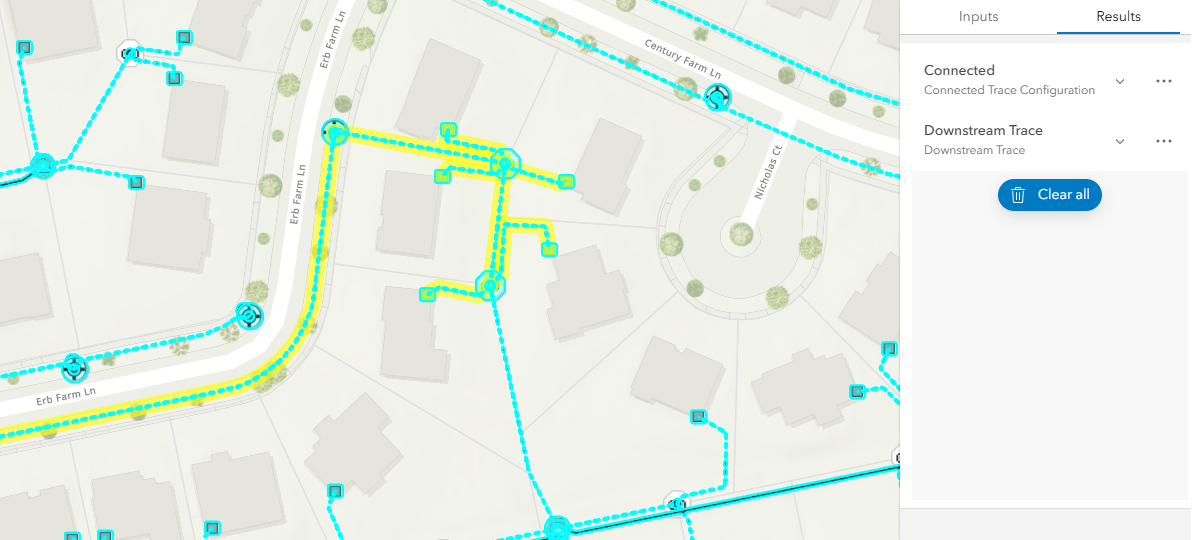
The resulting selection of features can be visualized in a list organized by asset groups and asset types if the showSelectionAttributes property is true.
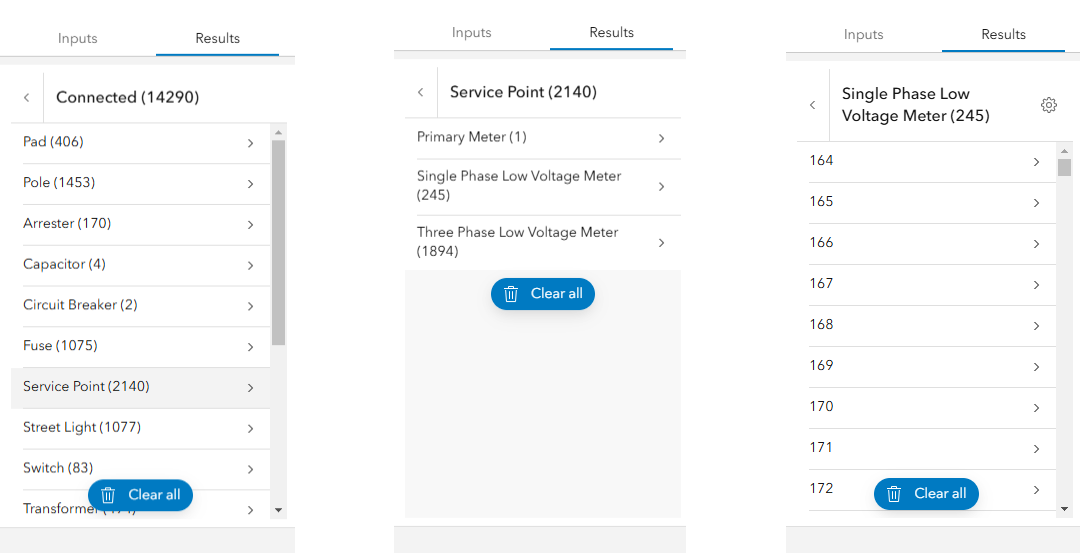 In the image above, the left image displays a list of trace results filtered by asset group. The center image displays a list of asset types for the asset group "Service Point". The right image displays a list of features for the asset type "Single Phase Low Voltage Meter".
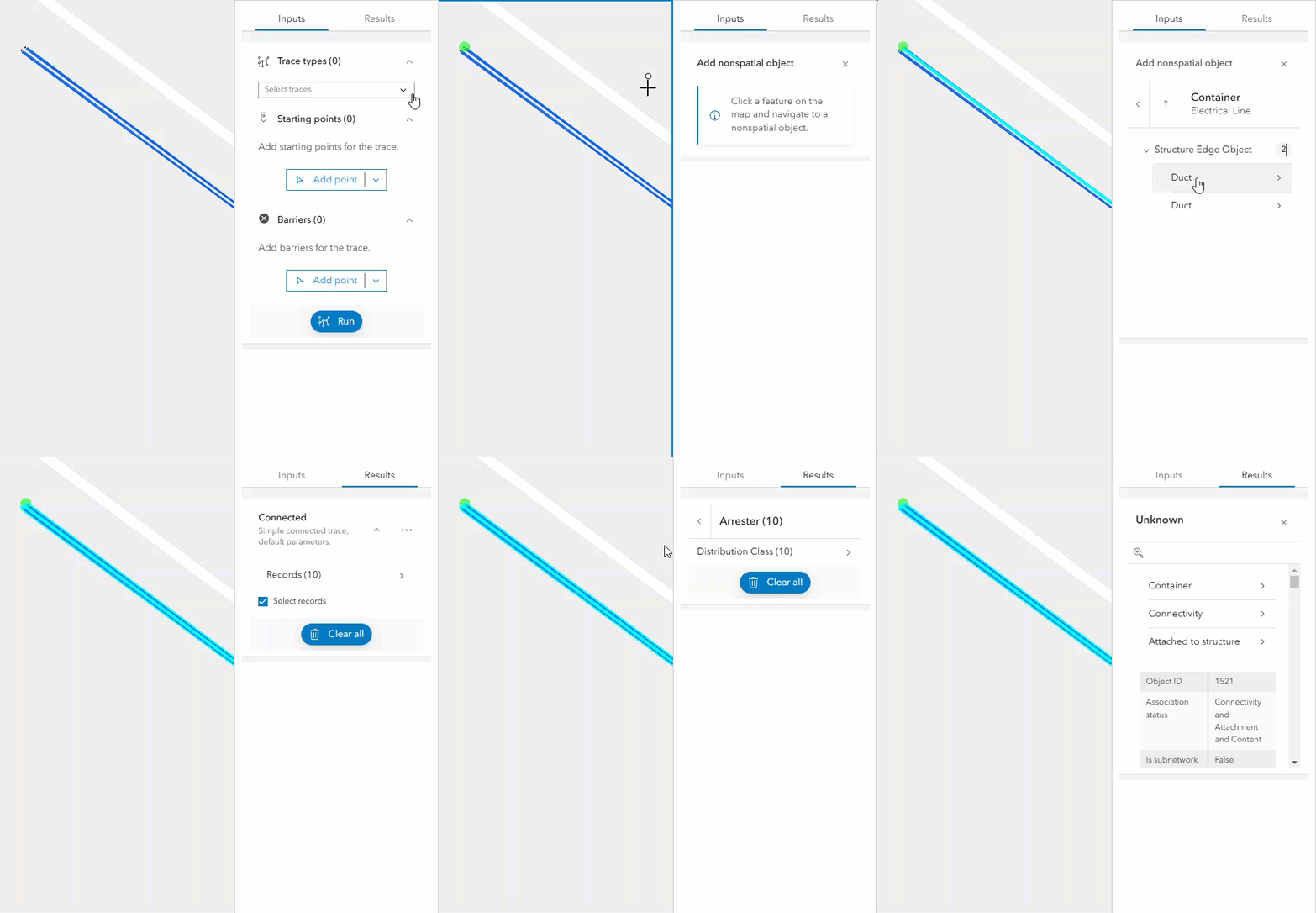
Nonspatial data can be included as trace starting points and barriers. Additionally, users can examine nonspatial data within the trace results.
Notes
The UtilityNetworkTrace widget class is unable to support proxied feature services or feature services that utilize stored credentials.
Requires a WebMap published with a Utility Network and shared named trace configurations (Available at Enterprise 10.9).
The network topology must be enabled and the results of a trace are not guaranteed to be accurate if dirty areas are traced. The network topology for the area to be traced must be validated to reflect the most recent edits or updates made to the network.
Running traces on map services is not supported.
Support for adding nonspatial features as trace locations and displaying Utility Network Associations info in the trace result require using a WebMap with popups including UtilityNetworkAssociationsContent.
Updating the map property in the View does not automatically refresh the contents of the UtilityNetworkTrace widget.
Example
// Create a new instance of the UtilityNetworkTrace widget and set// its required parameters.const unTraceWidget = new UtilityNetworkTrace({  view: view});
view.ui.add(unTraceWidget, "top-right");
Constructors
Constructor
Parameters
| Parameter | Type | Description | Required |
|---|---|---|---|
| properties | | |
Properties
| Property | Type | Class |
|---|---|---|
container inherited | HTMLElement | null | undefined | |
declaredClass readonly inherited | ||
| | ||
destroyed readonly inherited | ||
| | ||
| | ||
| | ||
Icon["icon"] | | |
id inherited | ||
| | ||
| | ||
| | ||
string[] | | |
| | ||
| | ||
| | ||
traceResults readonly | | |
| | ||
| | ||
| | ||
visible inherited |
container
- Type
- HTMLElement | null | undefined
The ID or node representing the DOM element containing the widget. This property can only be set once. The following examples are all valid use case when working with widgets.
Examples
// Create the HTML div element programmatically at runtime and set to the widget's containerconst basemapGallery = new BasemapGallery({  view: view,  container: document.createElement("div")});
// Add the widget to the top-right corner of the viewview.ui.add(basemapGallery, {  position: "top-right"});
// Specify an already-defined HTML div element in the widget's container
const basemapGallery = new BasemapGallery({ view: view, container: basemapGalleryDiv});
// Add the widget to the top-right corner of the viewview.ui.add(basemapGallery, { position: "top-right"});
// HTML markup<body> <div id="viewDiv"></div> <div id="basemapGalleryDiv"></div></body>// Specify the widget while adding to the view's UIconst basemapGallery = new BasemapGallery({ view: view});
// Add the widget to the top-right corner of the viewview.ui.add(basemapGallery, { position: "top-right"}); defaultGraphicColor
- Type
- GraphicColor
- Since
- ArcGIS Maps SDK for JavaScript 4.23
The default color to assign the aggregated geometry of a trace result.
- Default value
- { color: [255, 255, 0, 0.6], haloOpacity: 0.9, fillOpacity: 0.2, hex: "#FFFF00" }
disabled
- Type
- boolean
When true, the widget is visually withdrawn and cannot be interacted with.
- Default value
- true
enableResultArea
- Type
- boolean
- Since
- ArcGIS Maps SDK for JavaScript 4.27
When true, provides the ability to show the convex hull or buffer.
- Default value
- false
flags
- Type
- FlagProperty[]
An array of map points to load into the widget to lookup flags.
- Default value
- []
Example
const unt = new UtilityNetworkTrace({ view: view, showSelectionAttributes: true, selectOnComplete: true, showGraphicsOnComplete: true, selectedTraces: ["{E8D545B8-596D-4656-BF5E-16C1D7CBEC9B}"], flags: [ { type: "starting-point", mapPoint: { spatialReference: { latestWkid: 3857, wkid: 102100 }, x: -9814829.166046409, y: 5127094.1017433 } }, { type: "barrier", mapPoint: { spatialReference: { latestWkid: 3857, wkid: 102100 }, x: -9814828.449441982, y: 5127089.085566963 } } ]}); icon
- Type
- Icon["icon"]
- Since
- ArcGIS Maps SDK for JavaScript 4.27
Icon displayed in the widget's button.
- Default value
- "utility-network-trace"
inputSettings
- Type
- InputSetting[]
- Since
- ArcGIS Maps SDK for JavaScript 4.23
Custom labels, descriptions, and symbol for the input flags.
- Default value
- []
resultAreaProperties
- Since
- ArcGIS Maps SDK for JavaScript 4.27
The properties to determine the size and color of the result area convex hull or buffer, and determines if it displays on the map when the trace completes.
- Default value
- { type: "convexhull", distance: 10, unit: "meters", areaUnit: "square-meters", color: { color: [255, 165, 0, 0.5], haloOpacity: 0.9, fillOpacity: 0.2, hex: "#ffa500" }, show: false }
Example
const unt = new UtilityNetworkTrace({ un: un, view: view, enableResultArea: true, resultAreaProperties: { type: "buffer", distance: 10, unit: "feet", areaUnit: "square-feet", color: { color: [255, 165, 0, 0.5], haloOpacity: 0.9, fillOpacity: 0.2, hex: "#ffa500" }, show: true }}); selectedTraces
- Type
- string[]
A list of global Ids of traces to select on load
- Default value
- []
Example
const unt = new UtilityNetworkTrace({ view: view, selectedTraces: ["{E8D545B8-596D-4656-BF5E-16C1D7CBEC9B}"]}); selectOnComplete
- Type
- boolean
When true, the utility network elements are selected in the view when traces are completed.
- Default value
- true
showGraphicsOnComplete
- Type
- boolean
When true, a graphic layer is added to the view to highlight the utility network elements when traces are completed.
- Default value
- true
showSelectionAttributes
- Type
- boolean
Determines whether to show list of selection attributes
- Default value
- true
traceResults
- Type
- Array<TraceResultExtend>
- Since
- ArcGIS Maps SDK for JavaScript 4.34
Stores the result of completed traces.
utilityNetwork
- Type
- UtilityNetwork | null | undefined
- Since
- ArcGIS Maps SDK for JavaScript 4.27
Determines the utility network to use.
viewModel
The view model for this widget. This is a class that contains all the logic (properties and methods) that controls this widget's behavior. See the UtilityNetworkTraceViewModel class to access all properties and methods on the widget.
visible
- Type
- boolean
Indicates whether the widget is visible.
If false, the widget will no longer be rendered in the web document. This may affect the layout of other elements or widgets in the document. For example, if this widget is
the first of three widgets associated to the upper right hand corner of the DefaultUI, then the other widgets will reposition when this widget is made invisible.
For more information, refer to the css display value of "none".
- Default value
- true
Example
// Hides the widget in the viewwidget.visible = false;Methods
| Method | Signature | Class |
|---|---|---|
checkCanTrace(): Promise<void> | | |
classes inherited | classes(...classNames: ((string | null | undefined) | ((string[] | Record<string, boolean>) | null | undefined) | false | null | undefined)[]): string | |
confirmReset(): void | | |
destroy inherited | destroy(): void | |
emit inherited | emit<Type extends EventNames<this>>(type: Type, event?: this["@eventTypes"][Type]): boolean | |
hasEventListener inherited | hasEventListener<Type extends EventNames<this>>(type: Type): boolean | |
isFulfilled inherited | isFulfilled(): boolean | |
isRejected inherited | isRejected(): boolean | |
isResolved inherited | isResolved(): boolean | |
on inherited | on<Type extends EventNames<this>>(type: Type, listener: EventedCallback<this["@eventTypes"][Type]>): ResourceHandle | |
postInitialize inherited | postInitialize(): void | |
render inherited | render(): any | null | |
renderNow inherited | renderNow(): void | |
scheduleRender inherited | scheduleRender(): void | |
when inherited | when<TResult1 = this, TResult2 = never>(onFulfilled?: OnFulfilledCallback<this, TResult1> | null | undefined, onRejected?: OnRejectedCallback<TResult2> | null | undefined): Promise<TResult1 | TResult2> |
classes
- Signature
-
classes (...classNames: ((string | null | undefined) | ((string[] | Record<string, boolean>) | null | undefined) | false | null | undefined)[]): string
A utility method used for building the value for a widget's class property.
This aids in simplifying css class setup.
Parameters
- Returns
- string
The computed class name.
Example
// .tsx syntax showing how to set css classes while rendering the widget
render() {  const dynamicClasses = {    [css.flip]: this.flip,    [css.primary]: this.primary  };
  return (    <div class={classes(css.root, css.mixin, dynamicClasses)} />  );}
confirmReset
- Signature
-
confirmReset (): void
Prompts to clear all input flags, selected trace types, and the trace results.
- Returns
- void
emit
- Signature
-
emit <Type extends EventNames<this>>(type: Type, event?: this["@eventTypes"][Type]): boolean
- Type parameters
- <Type extends EventNames<this>>
Emits an event on the instance. This method should only be used when creating subclasses of this class.
hasEventListener
- Signature
-
hasEventListener <Type extends EventNames<this>>(type: Type): boolean
- Type parameters
- <Type extends EventNames<this>>
Indicates whether there is an event listener on the instance that matches the provided event name.
Parameters
| Parameter | Type | Description | Required |
|---|---|---|---|
| type | Type | The name of the event. | |
- Returns
- boolean
Returns true if the class supports the input event.
isFulfilled
- Signature
-
isFulfilled (): boolean
isFulfilled() may be used to verify if creating an instance of the class is fulfilled (either resolved or rejected).
If it is fulfilled, true will be returned.
- Returns
- boolean
Indicates whether creating an instance of the class has been fulfilled (either resolved or rejected).
isRejected
- Signature
-
isRejected (): boolean
isRejected() may be used to verify if creating an instance of the class is rejected.
If it is rejected, true will be returned.
- Returns
- boolean
Indicates whether creating an instance of the class has been rejected.
isResolved
- Signature
-
isResolved (): boolean
isResolved() may be used to verify if creating an instance of the class is resolved.
If it is resolved, true will be returned.
- Returns
- boolean
Indicates whether creating an instance of the class has been resolved.
on
- Signature
-
on <Type extends EventNames<this>>(type: Type, listener: EventedCallback<this["@eventTypes"][Type]>): ResourceHandle
- Type parameters
- <Type extends EventNames<this>>
Registers an event handler on the instance. Call this method to hook an event with a listener.
Parameters
| Parameter | Type | Description | Required |
|---|---|---|---|
| type | Type | An event or an array of events to listen for. | |
| listener | EventedCallback<this["@eventTypes"][Type]> | The function to call when the event fires. | |
- Returns
- ResourceHandle
Returns an event handler with a
remove()method that should be called to stop listening for the event(s).Property Type Description remove Function When called, removes the listener from the event.
Example
view.on("click", function(event){ // event is the event handle returned after the event fires. console.log(event.mapPoint);}); when
- Signature
-
when <TResult1 = this, TResult2 = never>(onFulfilled?: OnFulfilledCallback<this, TResult1> | null | undefined, onRejected?: OnRejectedCallback<TResult2> | null | undefined): Promise<TResult1 | TResult2>
when() may be leveraged once an instance of the class is created. This method takes two input parameters: an onFulfilled function and an onRejected function.
The onFulfilled executes when the instance of the class loads. The
onRejected executes if the instance of the class fails to load.
Parameters
| Parameter | Type | Description | Required |
|---|---|---|---|
| onFulfilled | OnFulfilledCallback<this, TResult1> | null | undefined | The function to call when the promise resolves. | |
| onRejected | The function to execute when the promise fails. | |
- Returns
- Promise<TResult1 | TResult2>
Returns a new promise for the result of
onFulfilledthat may be used to chain additional functions.
Example
// Although this example uses MapView, any class instance that is a promise may use when() in the same waylet view = new MapView();view.when(function(){ // This function will execute once the promise is resolved}, function(error){ // This function will execute if the promise is rejected due to an error});Events
| Name | Type |
|---|---|
add-flag inherited | |
add-flag-complete inherited | |
add-flag-error inherited | |
add-result-area inherited | |
create-result-area inherited | |
remove-result-area inherited |
add-flag
- Since
- ArcGIS Maps SDK for JavaScript 4.23
Fires when the button to add either a starting point or barrier is clicked.
add-flag-complete
add-flag-complete: CustomEvent<UtilityNetworkTraceViewModelAddFlagCompleteEvent> - Since
- ArcGIS Maps SDK for JavaScript 4.23
Fires when a flag point graphic is added to the map.
add-flag-error
add-flag-error: CustomEvent<UtilityNetworkTraceViewModelAddFlagErrorEvent> - Since
- ArcGIS Maps SDK for JavaScript 4.23
Fires when adding a flag point graphic to the map fails.
add-result-area
add-result-area: CustomEvent<UtilityNetworkTraceViewModelAddResultAreaEvent> - Since
- ArcGIS Maps SDK for JavaScript 4.28
Fires when adding a result area graphic to the map.
create-result-area
create-result-area: CustomEvent<UtilityNetworkTraceViewModelCreateResultAreaEvent> - Since
- ArcGIS Maps SDK for JavaScript 4.29
Fires after a trace when UtilityNetworkTrace.enableResultArea is true.
remove-result-area
remove-result-area: CustomEvent<UtilityNetworkTraceViewModelRemoveResultAreaEvent> - Since
- ArcGIS Maps SDK for JavaScript 4.28
Fires when removing a result area graphic from the map.
Type definitions
InputSetting
InputSetting represents the labels, descriptions, and symbols that can be overridden for the flags user interface (UI) in the UtilityNetworkTrace widget.
label
- Type
- string
The label that replaces either the default "Starting points" or "Barriers" headings depending on what flag type is passed.
description
- Type
- string
The description that replaces the default sub-headings for either the starting points or barriers.
Example
// Set inputSettings with a SimpleMarkerSymbolutilityNetworkTrace.inputSettings = [ { type: "starting-point", label: "Start locations", description: "Add starting locations before running a trace!", symbol: { type: "simple-marker", style: "cross", color: "blue", size: "8px", outline: { color: [ 255, 255, 0 ], width: 3 } } }]