You can navigate sceneSceneView or LocalSceneView) by:
- Using built-in navigation, such as panning, zooming, and changing pitch.
- By programmatically changing camera position.
Built-in navigation
The scene views have a number of built-in gestures that allow you to navigate a scene using touch screen, mouse, or keyboard.
Basic navigation
Navigation for scene views is the same as navigation for a map view. The following table summarizes the built-in navigation capabilities of the SceneView and LocalSceneView controls:
| Map navigation | Touch action | Mouse action | Key action |
|---|---|---|---|
| Pan the map | Touch, hold, and drag on the map | Press, hold, and drag the left mouse button | Press the left (pan west), right (pan east), up (pan north), or down (pan south) arrows |
| Zoom in (+) or zoom out (-) with animation | Pinch open (+) or pinch close (-) on the map | Scroll the mouse wheel forward (+) or backward (-) | Press the + / = key for in Press the - / _ key for out |
| Zoom in to the next level of detail or by a factor of 2 | Double tap on the map | Double-click the left mouse button | Press the + / = key |
| Zoom out to the next level of detail or by a factor of 2 | Single tap with two fingers simultaneously | Double-click of right mouse button | Press the - / _ key |
| Rotate | Two-finger pinch and twist fingers to rotate the map or scene | N/A | Press the ‘a’ (rotate counter-clockwise) or ‘d’ (rotate clockwise) keys |
| Set viewpoint to north | N/A | N/A | Press the ‘n’ key |
Advanced navigation
Scene views have additional navigation not found in a map view:
| Scene navigation | Touch action | Mouse action | Key action |
|---|---|---|---|
| Pitch: increase or decrease | Two-finger touch and hold (along the horizontal axis) and then slide up and down to adjust pitch | Press, hold and drag the right mouse button up (increase) or down (decrease) | Press the ‘w’ (increase) or ‘s’ (decrease) keys. Press ‘p’ to set pitch to 0. |
| Elevation: increase or decrease | N/A | N/A | Press the ‘u’ (increase) or ‘j’ (decrease) keys |
Programmatically change camera position
Your applications can programmatically navigate a 3D scene by creating a new camera and setting it to the view you are working with. A camera defines the location from which you are viewing the scene.

The camera is shown in this image for illustration purposes; when you set camera settings (location, pitch), think of the camera class as a real-life camera you’re adjusting the position of.
Set the camera
For example, to point the camera to toward the Snowdon mountainside, use these values:
- For 3D location, use 53.06 latitude, -4.04 longitude, 1289 meters above sea level
- For heading, use 295 degrees
- For pitch, use 71 degrees
- For roll, use 0 degrees
const Camera sceneCamera(53.06, -4.04, 1289.0, 295.0, 71.0, 0.0);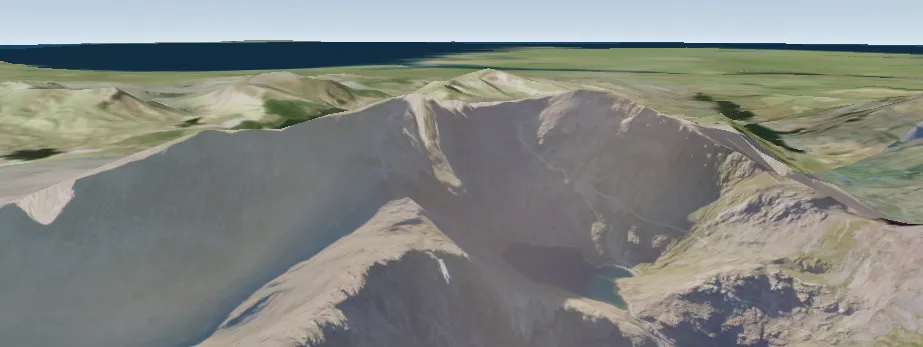
Apply the new camera to the scene view using SceneView::setViewpointCameraAsync(), or animate the transition to it with SceneView::setViewpointCameraAsync(&camera, duration).
m_sceneView->setViewpointCameraAsync(sceneCamera);Move and adjust the camera
After you set a camera, you can update the scene view display by creating and applying a new camera. You can define the new camera with absolute values for location and orientation, or derive it from the current camera using relative values.
For example, using the relative approach, your code can preserve the current camera location, pitch, and roll, but rotate the heading by 45 degrees.
Use the SceneView::currentViewpointCamera() method to get the scene view’s current viewpoint camera. To adjust the viewpoint relative to the camera’s current position or orientation, use the current camera to create a new camera, then apply the new camera with SceneView::setViewpointCameraAsync().