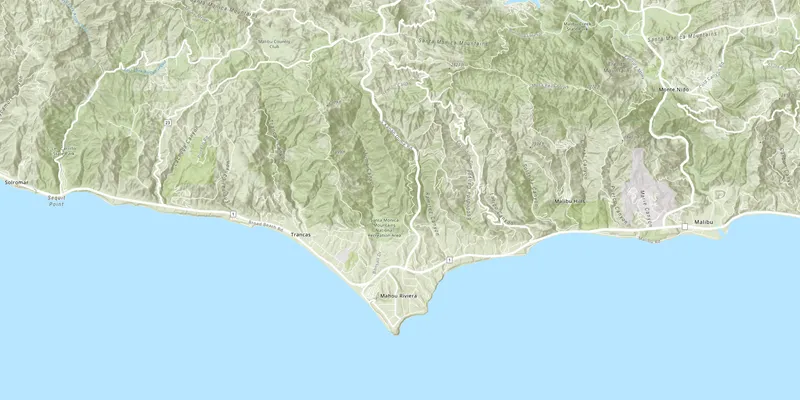
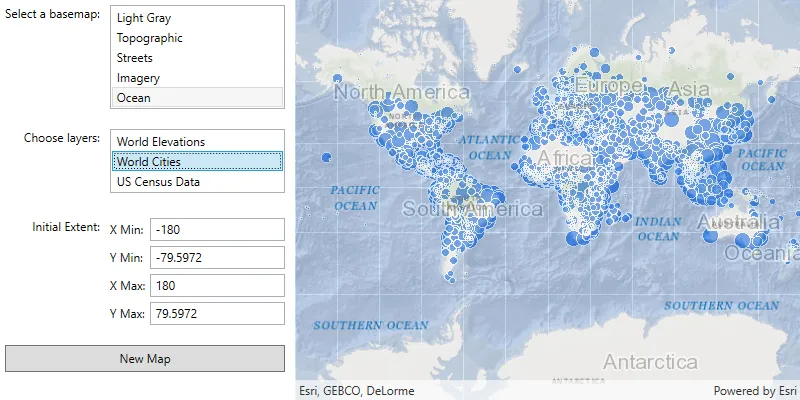
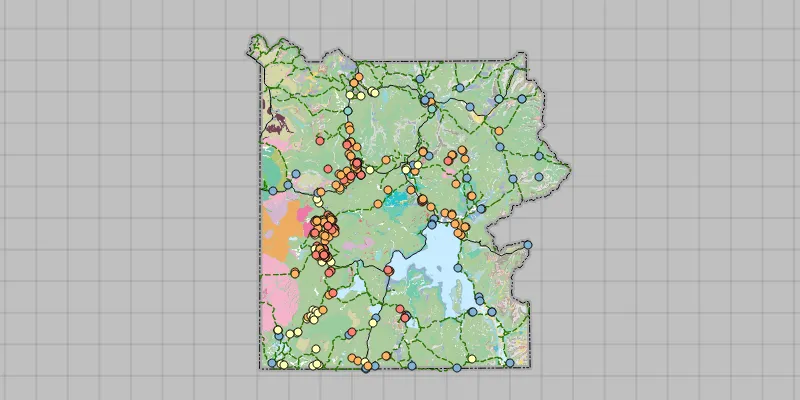
Maps A map is a collection of layers that are displayed in 2D. It is typically composed of a basemap layer and data layers. Learn more and scenes A scene is a collection of layers that are displayed in 3D. It is typically composed of a basemap layer, data layers, and 3D data. Learn more provide interactive displays of geographic data that enable you to visualize and explore patterns, answer questions, and share insight. They can be opened, edited, and shared across the ArcGIS system and beyond. Maps are designed for interaction in two dimensions (2D) and scenes for interaction in three dimensions (3D).

See Scenes (3D) in this guide for more information about working with scenes.

You can use a map to:

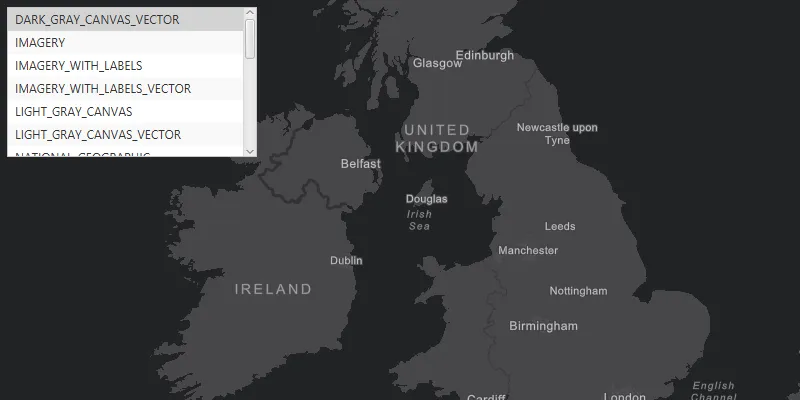
  • Display a basemap layer A basemap layer is the layer in a map or scene that displays basemap data. The data source for a basemap layer is typically a basemap service. Learn more such as streets or satellite imagery.
  • Access and display data layers A data layer is a layer that references geographic data from a file or a service and is used to visualize the data in a map or scene. Learn more based on files or services, including data you have authored.
  • Provide context for temporary points, lines, polygons, or text displayed as graphics A graphic is a visual element composed of a geometry, symbol, and attributes that is displayed on a map or scene. Learn more .
  • Inspect data layers and display information from attributes Attributes are fields and values for a single feature or non-spatial record. They are typically stored in a database or service such as a feature service. Learn more .
  • Measure distance and explore spatial relationships between geometries A geometry is a geometric shape, such as a point, polyline, or polygon, that contains one or more coordinates and a spatial reference. Learn more .
  • Save a collection of layers as a web map A web map is a map stored as a JSON object that defines properties such as the basemap layer, data layers, layer styles, and pop-up styles. Its JSON structure is defined by the web map specification. Learn more to be shared across ArcGIS.

How a map works

A map A map is a collection of layers that are displayed in 2D. It is typically composed of a basemap layer and data layers. Learn more works together with a map view A map view is a user interface that displays map layers and graphics in 2D. It controls the area (extent) of the map that is visible and supports user interactions such as pan and zoom. Learn more to display geographic content in two dimensions. A map contains a collection of layers A layer is a reference to a collection of geographic data that is used to access and display data. The data for layers are typically provided by the basemap layer service and data services. Learn more including multiple data layers A data layer is a layer that references geographic data from a file or a service and is used to visualize the data in a map or scene. Learn more from online or local sources, and a basemap layer A basemap layer is the layer in a map or scene that displays basemap data. The data source for a basemap layer is typically a basemap service. Learn more that gives geographic context. A map can also contain datasets that enable searches for addresses or place names, networks for solving routes A route is a polyline that defines the best path between two or more points in a street network. Learn more , utility networks for tracing the flow of services such as water and electricity, and non-spatial tables. Maps can be created, displayed, edited, and saved. Because the format is based on the ArcGIS web map standard, these maps can be shared uniformly across the ArcGIS system.

For offline An offline application, also known as offline app, is an application that runs on a phone, tablet, laptop or desktop device with limited or no network connection. Offline applications are built with ArcGIS Maps SDKs for Native Apps. Learn more workflows (when you don’t have network connectivity), you can open a map stored in a mobile map package. Mobile map packages can be created using ArcGIS Pro, ArcGIS Enterprise, or ArcGIS Online. See Offline maps, scenes, and data for more information about implementing offline workflows in your apps.

Map

A map contains a collection of layers A layer is a reference to a collection of geographic data that is used to access and display data. The data for layers are typically provided by the basemap layer service and data services. Learn more displayed in the order in which they were added, with the most recently added layer being displayed above existing layers. You can use the map to change the display order of layers as well as to control which layers are visible, and expose this functionality with user interface controls such as lists, check boxes, or switches. A map also contains a collection of bookmarks, which, similar to a web browser bookmark, allow you to quickly navigate to a predefined area of the map.

You can open an existing map or create one entirely with code. To create a map, you typically first add a basemap layer A basemap layer is the layer in a map or scene that displays basemap data. The data source for a basemap layer is typically a basemap service. Learn more and then one or more data layers A data layer is a layer that references geographic data from a file or a service and is used to visualize the data in a map or scene. Learn more .

// Set the ArcGIS runtime environment Api Key to your access token.
ArcGISRuntimeEnvironment::setApiKey("YOUR_ACCESS_TOKEN");
// Set the base map for for the map to be the basemap style of ArcGISNavigation.
Map* map = new Map(BasemapStyle::ArcGISNavigation, this);

You can also open a map stored in a portal ArcGIS portal, also known as a portal, is a website with applications and tools that can be used to create, manage, access, and share geospatial content and data. It supports security and authentication, developer credentials, content and data service management, user and group management, and site administration. A portal can be hosted in Esri's infrastructure or your own infrastructure. Learn more (such as ArcGIS Online) using its URL.

// Define the Url for the ArcGIS portal item.
const QUrl portal_url("https://www.arcgis.com/home/item.html?id=41281c51f9de45edaf1c8ed44bb10e30");
// Create a new map from the portal Url.
m_map = new Map(portal_url, this);

Layer

Each layer A layer is a reference to a collection of geographic data that is used to access and display data. The data for layers are typically provided by the basemap layer service and data services. Learn more in a map references geographic data, either from an online service or from a local dataset. There are different types of layers that can be added to a map, each designed to display a particular type of data. Some layers display images, such as satellite imagery or aerial photography, while others are composed of a collection of features A feature is a single record, also known as a row, that represents a real-world entity. It typically contains a geometry (point, multipoint, polyline, or polygon) and attributes but it can also contain just attributes. Learn more to represent real-world entities using point, line, or polygon geometries A geometry is a geometric shape, such as a point, polyline, or polygon, that contains one or more coordinates and a spatial reference. Learn more . In addition to geometry, features have attributes Attributes are fields and values for a single feature or non-spatial record. They are typically stored in a database or service such as a feature service. Learn more that provide details about the entity it represents.

The Layer class is the base class for all types of layers. The type of layer you create depends on the type of data you want to display. For example, to display feature data you can create a FeatureLayer that references an online service (such as a feature service A feature service is a data service that provides access to spatial and non-spatial data in feature layers, feature layer views, and tables. Learn more ) or a supported local dataset.

void Layers::loadMapLayers()
{
// Set the access token.
const QString accessToken = QStringLiteral("YOUR_ACCESS_TOKEN");
// Set the ArcGIS runtime environment Api Key with your access token.
ArcGISRuntimeEnvironment::setApiKey(accessToken);
// Create a new "trail heads" feature layer based on a service feature table (using the Url provided).
FeatureLayer* trailheadsLayer = new FeatureLayer(
new ServiceFeatureTable(QUrl("https://services3.arcgis.com/GVgbJbqm8hXASVYi/arcgis/rest/services/Trailheads_Styled/FeatureServer/0"), this),
this
);
// Create a new "trails" feature layer based on a service feature table (using the Url provided).
FeatureLayer* trailsLayer = new FeatureLayer(
new ServiceFeatureTable(QUrl("https://services3.arcgis.com/GVgbJbqm8hXASVYi/arcgis/rest/services/Trails_Styled/FeatureServer/0"), this),
this
);
// Create a new "open spaces" feature layer based on a service feature table (using the Url provided).
FeatureLayer* openSpacesLayer = new FeatureLayer(
new ServiceFeatureTable(QUrl("https://services3.arcgis.com/GVgbJbqm8hXASVYi/arcgis/rest/services/Parks_and_Open_Space_Styled/FeatureServer/0"), this),
this
);
// Add the three feature layers to the map's operating layers list model collection.
m_map->operationalLayers()->append(trailheadsLayer);
m_map->operationalLayers()->append(trailsLayer);
m_map->operationalLayers()->append(openSpacesLayer);
}

MapView

A map view A map view is a user interface that displays map layers and graphics in 2D. It controls the area (extent) of the map that is visible and supports user interactions such as pan and zoom. Learn more is a user-interface control that displays a single map in your app. It contains built-in functionality that allows the user to explore the map by zooming in and out, recentering the map display, or getting additional information about elements in the map. It also manages graphics A graphic is a visual element composed of a geometry, symbol, and attributes that is displayed on a map or scene. Learn more in one or more collections of graphics overlays A graphics overlay is a client-side, temporary container of graphics to display on a map view or scene view. Learn more . The graphics managed by the map view always display above all layers displayed in the map.

A map view A map view is a user interface that displays map layers and graphics in 2D. It controls the area (extent) of the map that is visible and supports user interactions such as pan and zoom. Learn more control also allows you to:

  • Access data for data layers and graphics.
  • Display the current location as a point on the map.
  • Identify and select features at a specified location.
  • Export an image of the current display.
  • Rotate the map display.
  • Apply a time extent to filter the display of features.
  • Filter layer data using attribute and spatial criteria.
  • Display image overlays on the map view.

Display a map A map is a collection of layers that are displayed in 2D. It is typically composed of a basemap layer and data layers. Learn more by adding it to a MapView control. Changes you make to the map, such as adding, removing, or reordering layers, will immediately be reflected in the map view display. The Map::initialViewpoint() property will determine the area of the map shown when the map loads. You can also use MapView::setViewpointAsync() and MapView::setViewpointRotation() to programmatically change the map area or orientation shown in the display.

// Create a new map view with a map
MapQuickView* mapView = new MapQuickView(map);
// Define a point using lat/long values and a spatial reference.
const Point center(-118.805, 34.027, SpatialReference::wgs84());
// Asynchronously animate the map to the viewpoint.
mapView->setViewpointAsync(center, 11);

Examples

Create and display a map

You can display a basic map by creating one with a basemap layer, setting its initial extent, and adding it to a map view. To learn how to add additional data, see the Layers topic.

Steps

  1. Create a new Map, passing a BasemapStyle into the constructor.

    // Template code generated for the Maps2d app.
    Maps2d::Maps2d(QObject* parent /* = nullptr */):
    QObject(parent),
    m_map(new Map(BasemapStyle::ArcGISTopographic, this))
  2. Optionally, add one or more data layers to the map.

  3. Assign the map to a MapView to render the map.

  4. Set the map view Viewpoint to focus on a specified area of the map.

    // Set the map function
    void Maps2d::setupMap()
    {
    // Define a point on the map using lat/long coordinates and a spatial reference.
    const Point center(-118.805, 34.027, SpatialReference::wgs84());
    // Define a view point using the point and a scale.
    const Viewpoint viewpoint(center, 72223.819286);
    // Asynchronously animate the map to the viewpoint.
    m_mapView->setViewpointAsync(viewpoint);
    }
    // Set the view function (created in QML).
    void Maps2d::setMapView(MapQuickView* mapView)
    {
    // Test if the map view has not been previously set
    if (!mapView || mapView == m_mapView)
    return;
    // Set the member variable for the map view to the local scope map view.
    m_mapView = mapView;
    // Set the map on the map view.
    m_mapView->setMap(m_map);
    // Call the setupMap function.
    setupMap();
    // Emit the mapViewChanged signal.
    emit mapViewChanged();
    }

You can also create and save a web map A web map is a map stored as a JSON object that defines properties such as the basemap layer, data layers, layer styles, and pop-up styles. Its JSON structure is defined by the web map specification. Learn more using ArcGIS Pro ArcGIS Pro is a professional desktop GIS application that can explore, visualize, analyze, and manage 2D and 3D data. Learn more or the ArcGIS Online ArcGIS Online is a GIS mapping, analytics, data hosting, and content management software as a service (SaaS) product. It includes applications, tools, APIs, and location services for users and developers. It is subscription-based and requires an ArcGIS Online account. Learn more map viewer and open it in your app.

Display a web map

You can open a web map A web map is a map stored as a JSON object that defines properties such as the basemap layer, data layers, layer styles, and pop-up styles. Its JSON structure is defined by the web map specification. Learn more saved as an item An item, also known as a content item, is a resource stored in a portal such as a web map, hosted layer, style, script tool, file, or notebook. Learn more in a portal ArcGIS portal, also known as a portal, is a website with applications and tools that can be used to create, manage, access, and share geospatial content and data. It supports security and authentication, developer credentials, content and data service management, user and group management, and site administration. A portal can be hosted in Esri's infrastructure or your own infrastructure. Learn more , such as ArcGIS Online, using its item ID An item ID is a unique identifier representing a single item stored, managed, and accessed in a portal, such as a web map, hosted layer, or file. Learn more or URL. A portal item can be secured to only allow access for authorized users, in which case you must provide credentials for access. To learn how to access secured content, see Security and authentication.

Steps

  1. Create a QString and set it to the item ID An item ID is a unique identifier representing a single item stored, managed, and accessed in a portal, such as a web map, hosted layer, or file. Learn more for the item that stores the web map.

  2. Create a QUrl that appends the item ID to the ArcGIS Online base URL.

  3. Create a new map, passing the QUrl to the constructor.

  4. Set the map to a MapView to render the map.

    // Define the Url for the ArcGIS portal item.
    const QUrl portal_url("https://www.arcgis.com/home/item.html?id=41281c51f9de45edaf1c8ed44bb10e30");
    // Create a new map from the portal Url.
    m_map = new Map(portal_url, this);
    // Set the map on the map view.
    m_mapView->setMap(m_map);

Display a mobile map

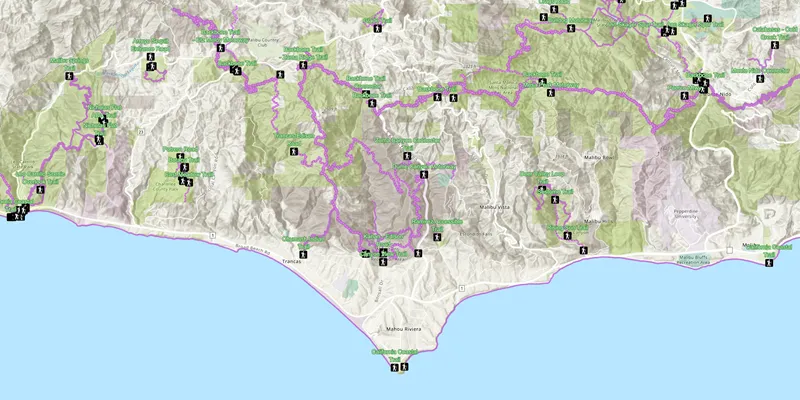
This example displays a map A map is a collection of layers that are displayed in 2D. It is typically composed of a basemap layer and data layers. Learn more from a mobile map package A mobile map package (MMPK) is a standalone file that contains one or more map definitions, including the basemap layers, data layers, layer styles, and pop-up styles for use in offline applications built with ArcGIS Maps SDKs for Native Apps. Learn more . You can create your own mobile map (or scene) packages using ArcGIS Pro, or download existing packages from ArcGIS Online. The Mahou Riviera Trails mobile map package, for example, shows points of interest in Mahou Riviera.

Steps

  1. Create a MobileMapPackage using the path to a local .mmpk file.
  2. Use connect to signal when the package is done loading.
  3. Load the mobile map package.
  4. After the package loads, get the first map from the package using the MobileMapPackage::maps() property.
  5. Display the map in a MapView.
// Create a new mobile map package from the path provided.
MobileMapPackage* m_mobileMapPackage = new MobileMapPackage(QDir::homePath() +
"/ArcGIS/Runtime/Data/mmpk/MahouRivieraTrails.mmpk", this);
// Get the first map (i.e. 0) in the mobile map package and set that as the map in the map view.
connect(m_mobileMapPackage, &MobileMapPackage::doneLoading, this, [this, m_mobileMapPackage](Error)
{
m_mapView->setMap(m_mobileMapPackage->maps().at(0));
});
// Load the mobile map package, which call the doneLoading event.
m_mobileMapPackage->load();

Use API key access tokens

An API key access token An access token is an authorization string that provides access to secure ArcGIS content, data, and services. Its capabilities are determined by the privileges it supports. It is obtained by implementing API key authentication, User authentication, or App authentication. Learn more can be used to authorize access to ArcGIS services A service, also known as an ArcGIS service, is software that supports an ArcGIS REST API and provides geospatial functionality or data. A service can be hosted by Esri or in ArcGIS Enterprise. Learn more and portal items from your app, as well as to monitor access to those services. You can use a single access token An access token is an authorization string that provides access to secure ArcGIS content, data, and services. Its capabilities are determined by the privileges it supports. It is obtained by implementing API key authentication, User authentication, or App authentication. Learn more for all requests made by your app, or assign individual access tokens An access token is an authorization string that provides access to secure ArcGIS content, data, and services. Its capabilities are determined by the privileges it supports. It is obtained by implementing API key authentication, User authentication, or App authentication. Learn more for any classes that implement ApiKeyResource.

Learn more about API key authentication

Tutorials

Samples

Services

Next steps