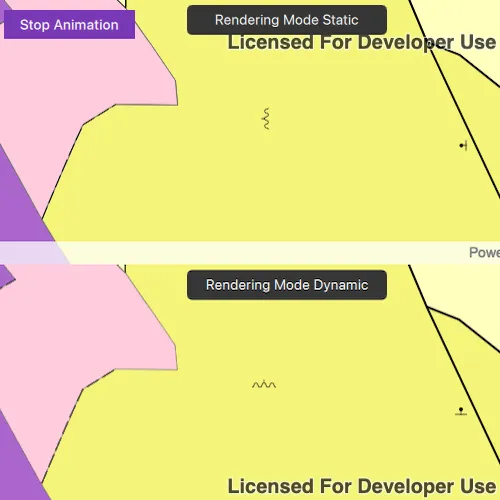
Render features statically or dynamically by setting the feature layer rendering mode.
Use case
In dynamic rendering mode, features and graphics are stored on the GPU. As a result, dynamic rendering mode is good for moving objects and for maintaining graphical fidelity during extent changes, since individual graphic changes can be efficiently applied directly to the GPU state. This gives the map or scene a seamless look and feel when interacting with it. The number of features and graphics has a direct impact on GPU resources, so large numbers of features or graphics can affect the responsiveness of maps or scenes to user interaction. Ultimately, the number and complexity of features and graphics that can be rendered in dynamic rendering mode is dependent on the power and memory of the device’s GPU.
In static rendering mode, features and graphics are rendered only when needed (for example, after an extent change) and offloads a significant portion of the graphical processing onto the CPU. As a result, less work is required by the GPU to draw the graphics, and the GPU can spend its resources on keeping the UI interactive. Use this mode for stationary graphics, complex geometries, and very large numbers of features or graphics. The number of features and graphics has little impact on frame render time, meaning it scales well, and pushes a constant GPU payload. However, rendering updates is CPU and system memory intensive, which can have an impact on device battery life.
How to use the sample
Click ‘Start Animation’ to begin the same zoom animation on both static and dynamically maps.
How it works
- Create a
Mapand callloadSettings()and thensetPreferred[Point/Polyline/Polygon]FeatureRenderingMode(...). - The
RenderingModecan be set toSTATIC,DYNAMICorAUTOMATIC.- In Static rendering mode, the number of features and graphics has little impact on frame render time, meaning it scales well, however points don’t stay screen-aligned and point/polyline/polygon objects are only redrawn once map view navigation is complete.
- In Dynamic rendering mode, large numbers of features or graphics can affect the responsiveness of maps or scenes to user interaction, however points remain screen-aligned and point/polyline/polygon objects are continually redrawn while the map view is navigating.
- When left to automatic rendering, points are drawn dynamically and polylines and polygons statically.
Relevant API
- Map
- FeatureLayer
- FeatureLayer::renderingMode
- LoadSettings
- MapView
Tags
dynamic, feature layer, features, rendering, static
Sample code
// [WriteFile Name=FeatureLayerRenderingModeMap, Category=Layers]// [Legal]// Copyright 2017 Esri.//// Licensed under the Apache License, Version 2.0 (the "License");// you may not use this file except in compliance with the License.// You may obtain a copy of the License at// http://www.apache.org/licenses/LICENSE-2.0//// Unless required by applicable law or agreed to in writing, software// distributed under the License is distributed on an "AS IS" BASIS,// WITHOUT WARRANTIES OR CONDITIONS OF ANY KIND, either express or implied.// See the License for the specific language governing permissions and// limitations under the License.// [Legal]
#ifdef PCH_BUILD#include "pch.hpp"#endif // PCH_BUILD
// sample headers#include "FeatureLayerRenderingModeMap.h"
// ArcGIS Maps SDK headers#include "FeatureLayer.h"#include "LayerListModel.h"#include "LoadSettings.h"#include "Map.h"#include "MapQuickView.h"#include "MapTypes.h"#include "Point.h"#include "ServiceFeatureTable.h"#include "SpatialReference.h"
// Qt headers#include <QFuture>#include <QString>#include <QStringList>#include <QTimer>
using namespace Esri::ArcGISRuntime;
FeatureLayerRenderingModeMap::FeatureLayerRenderingModeMap(QQuickItem* parent /* = nullptr */) :  QQuickItem(parent){}
void FeatureLayerRenderingModeMap::init(){  // Register classes for QML  qmlRegisterType<MapQuickView>("Esri.Samples", 1, 0, "MapView");  qmlRegisterType<FeatureLayerRenderingModeMap>("Esri.Samples", 1, 0, "FeatureLayerRenderingModeMapSample");}
void FeatureLayerRenderingModeMap::componentComplete(){  QQuickItem::componentComplete();
  // Create a map for static rendering  m_topMapView = findChild<MapQuickView*>("topMapView");  Map* topMap = new Map(this);  topMap->loadSettings()->setPreferredPointFeatureRenderingMode(FeatureRenderingMode::Static);  topMap->loadSettings()->setPreferredPolygonFeatureRenderingMode(FeatureRenderingMode::Static);  topMap->loadSettings()->setPreferredPolylineFeatureRenderingMode(FeatureRenderingMode::Static);  addFeatureLayers(topMap);  m_topMapView->setMap(topMap);
  // Create a map for dynamic rendering  m_bottomMapView = findChild<MapQuickView*>("bottomMapView");  Map* bottomMap = new Map(this);  bottomMap->loadSettings()->setPreferredPointFeatureRenderingMode(FeatureRenderingMode::Dynamic);  bottomMap->loadSettings()->setPreferredPolygonFeatureRenderingMode(FeatureRenderingMode::Dynamic);  bottomMap->loadSettings()->setPreferredPolylineFeatureRenderingMode(FeatureRenderingMode::Dynamic);  addFeatureLayers(bottomMap);  m_bottomMapView->setMap(bottomMap);
  // Create Zoom Out Camera Viewpoint  const Point centerPt(-118.37, 34.46, SpatialReference::wgs84());  const double outScale = 650000;  const double outRotation = 0;  m_zoomOutViewpoint = Viewpoint(centerPt, outScale, outRotation);
  // Create Zoom In Camera Viewpoint  const double inScale = 50000;  const double inRotation = 90;  m_zoomInViewpoint = Viewpoint(centerPt, inScale, inRotation);
  // Set initial viewpoint  m_topMapView->setViewpointAndWait(m_zoomOutViewpoint);  m_bottomMapView->setViewpointAndWait(m_zoomOutViewpoint);
  // Create Timer  m_timer = new QTimer(this);  m_timer->setInterval(7000);  connect(m_timer, &QTimer::timeout, this, &FeatureLayerRenderingModeMap::animate);}
void FeatureLayerRenderingModeMap::addFeatureLayers(Map* map){  const QStringList layerIds = {"9", "8", "0"};  for (const QString& layerId : layerIds)  {    QString featureServiceUrl = QString("%1/%2").arg(m_featureServiceUrl, layerId);    ServiceFeatureTable* featureTable = new ServiceFeatureTable(featureServiceUrl, this);    FeatureLayer* featureLayer = new FeatureLayer(featureTable, this);    map->operationalLayers()->append(featureLayer);  }}
// update the Camera when the timer triggersvoid FeatureLayerRenderingModeMap::animate(){  Viewpoint viewpoint;  if (m_isZoomedOut)  {    viewpoint = Viewpoint(m_zoomInViewpoint);  }  else  {    viewpoint = Viewpoint(m_zoomOutViewpoint);  }
  m_bottomMapView->setViewpointAsync(viewpoint, 5.0f);  m_topMapView->setViewpointAsync(viewpoint, 5.0f);  m_isZoomedOut = !m_isZoomedOut;}
void FeatureLayerRenderingModeMap::startAnimation(){  if (!m_timer)  {    return;  }
  animate();  m_timer->start(7000);}
void FeatureLayerRenderingModeMap::stopAnimation(){  if (!m_timer)  {    return;  }
  m_timer->stop();}
// [WriteFile Name=FeatureLayerRenderingModeMap, Category=Layers]// [Legal]// Copyright 2017 Esri.//// Licensed under the Apache License, Version 2.0 (the "License");// you may not use this file except in compliance with the License.// You may obtain a copy of the License at// http://www.apache.org/licenses/LICENSE-2.0//// Unless required by applicable law or agreed to in writing, software// distributed under the License is distributed on an "AS IS" BASIS,// WITHOUT WARRANTIES OR CONDITIONS OF ANY KIND, either express or implied.// See the License for the specific language governing permissions and// limitations under the License.// [Legal]
#ifndef FEATURELAYERRENDERINGMODEMAP_H#define FEATURELAYERRENDERINGMODEMAP_H
// ArcGIS Maps SDK headers#include "Viewpoint.h"
// Qt headers#include <QQuickItem>
namespace Esri::ArcGISRuntime{ class MapQuickView; class Map;} // namespace Esri::ArcGISRuntime
class QTimer;
class FeatureLayerRenderingModeMap : public QQuickItem{ Q_OBJECT
public: explicit FeatureLayerRenderingModeMap(QQuickItem* parent = nullptr); ~FeatureLayerRenderingModeMap() override = default;
void componentComplete() override; static void init();
Q_INVOKABLE void startAnimation(); Q_INVOKABLE void stopAnimation();
private slots: void animate();
private: void addFeatureLayers(Esri::ArcGISRuntime::Map* map);
Esri::ArcGISRuntime::MapQuickView* m_topMapView = nullptr; Esri::ArcGISRuntime::MapQuickView* m_bottomMapView = nullptr; Esri::ArcGISRuntime::Viewpoint m_zoomOutViewpoint; Esri::ArcGISRuntime::Viewpoint m_zoomInViewpoint; QTimer* m_timer = nullptr; const QString m_featureServiceUrl = "https://sampleserver6.arcgisonline.com/arcgis/rest/services/Energy/Geology/FeatureServer"; bool m_isZoomedOut = true;};
#endif // FEATURELAYERRENDERINGMODEMAP_H// [WriteFile Name=FeatureLayerRenderingModeMap, Category=Layers]// [Legal]// Copyright 2017 Esri.//// Licensed under the Apache License, Version 2.0 (the "License");// you may not use this file except in compliance with the License.// You may obtain a copy of the License at// http://www.apache.org/licenses/LICENSE-2.0//// Unless required by applicable law or agreed to in writing, software// distributed under the License is distributed on an "AS IS" BASIS,// WITHOUT WARRANTIES OR CONDITIONS OF ANY KIND, either express or implied.// See the License for the specific language governing permissions and// limitations under the License.// [Legal]
import QtQuickimport QtQuick.Controlsimport Esri.Samples
FeatureLayerRenderingModeMapSample { id: rootRectangle clip: true width: 800 height: 600
MapView { anchors { left: parent.left right: parent.right top: parent.top } height: parent.height / 2 objectName: "topMapView"
Rectangle { anchors { horizontalCenter: parent.horizontalCenter top: parent.top margins: 5 } color: palette.base radius: 5 width: 200 height: 30
Label { anchors.centerIn: parent text: qsTr("Rendering Mode Static") } } }
MapView { anchors { left: parent.left right: parent.right bottom: parent.bottom } height: parent.height / 2 objectName: "bottomMapView"
Rectangle { anchors { horizontalCenter: parent.horizontalCenter top: parent.top margins: 5 } color: palette.base radius: 5 width: 200 height: 30
Label { anchors.centerIn: parent text: qsTr("Rendering Mode Dynamic") } } }
Button { anchors { left: parent.left top: parent.top margins: 10 } readonly property string startText: "Start Animation" readonly property string stopText: "Stop Animation" text: startText onClicked: { if (text === startText) { startAnimation(); text = stopText; } else { stopAnimation(); text = startText; } } }}