List the contents of a KML file.
Use case
KML files can contain a hierarchy of features, including network links to other KML content. A user may wish to traverse through the contents of KML nodes to know what data is contained within each node and, recursively, their children.
How to use the sample
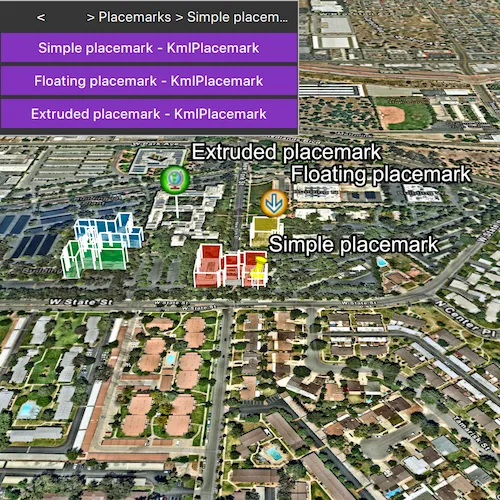
The contents of the KML file are shown in a list of buttons. Select a node to zoom to that node and see its child nodes, if it has any. Not all nodes can be zoomed to (e.g. screen overlays).
How it works
- Add the KML file to the scene as a layer.
- Explore the root nodes of the
KmlDatasetrecursively to create a view model.
- Each node is enabled for display at this step. KML files may include nodes that are turned off by default.
- When a node is selected, use the node’s
KmlViewpointorExtentto determine a viewpoint and set theSceneViewobject’s viewpoint to it.
Relevant API
- KmlContainer
- KmlDataset
- KmlDocument
- KmlFolder
- KmlGroundOverlay
- KmlLayer
- KmlNetworkLink
- KmlNode
- KmlPhotoOverlay
- KmlPlacemark
- KmlScreenOverlay
- KmlViewpoint
Offline data
To set up the sample’s offline data, see the Use offline data in the samples section of the Qt Samples repository overview.
| Link | Local Location |
|---|---|
| Esri KML Sample Data | <userhome>/ArcGIS/Runtime/Data/kml/esri_kml_sample_data.kmz |
About the data
This is an example KML file meant to demonstrate how the ArcGIS Maps SDK for Native Apps supports several common features.
Tags
Keyhole, KML, KMZ, layers, OGC
Sample code
// [WriteFile Name=ListKmlContents, Category=Layers]// [Legal]// Copyright 2020 Esri.//// Licensed under the Apache License, Version 2.0 (the "License");// you may not use this file except in compliance with the License.// You may obtain a copy of the License at// http://www.apache.org/licenses/LICENSE-2.0//// Unless required by applicable law or agreed to in writing, software// distributed under the License is distributed on an "AS IS" BASIS,// WITHOUT WARRANTIES OR CONDITIONS OF ANY KIND, either express or implied.// See the License for the specific language governing permissions and// limitations under the License.// [Legal]
#ifdef PCH_BUILD#include "pch.hpp"#endif // PCH_BUILD
// sample headers#include "ListKmlContents.h"
// ArcGIS Maps SDK headers#include "ArcGISTiledElevationSource.h"#include "Camera.h"#include "ElevationSourceListModel.h"#include "Envelope.h"#include "Error.h"#include "KmlContainer.h"#include "KmlDataset.h"#include "KmlLayer.h"#include "KmlNetworkLink.h"#include "KmlNode.h"#include "KmlNodeListModel.h"#include "KmlViewpoint.h"#include "LayerListModel.h"#include "MapTypes.h"#include "Point.h"#include "Scene.h"#include "SceneQuickView.h"#include "SpatialReference.h"#include "Surface.h"#include "Viewpoint.h"
// Qt headers#include <QFuture>#include <QStandardPaths>#include <QUuid>
// C++ Headers#include <algorithm>#include <utility>
using namespace Esri::ArcGISRuntime;
// helper method to get cross platform data pathnamespace{  QString defaultDataPath()  {    QString dataPath;
#ifdef Q_OS_IOS    dataPath = QStandardPaths::writableLocation(QStandardPaths::DocumentsLocation);#else    dataPath = QStandardPaths::writableLocation(QStandardPaths::HomeLocation);#endif
    return dataPath;  }} // namespace
ListKmlContents::ListKmlContents(QObject* parent /* = nullptr */) :  QObject(parent),  m_scene(new Scene(BasemapStyle::ArcGISImagery, this)){  // create a new elevation source from Terrain3D REST service  ArcGISTiledElevationSource* elevationSource =    new ArcGISTiledElevationSource(QUrl("https://elevation3d.arcgis.com/arcgis/rest/services/WorldElevation3D/Terrain3D/ImageServer"), this);
  // add the elevation source to the scene to display elevation  m_scene->baseSurface()->elevationSources()->append(elevationSource);
  const QString filepath = defaultDataPath() + "/ArcGIS/Runtime/Data/kml/esri_kml_sample_data.kmz";
  // create new KML layer  m_kmlDataset = new KmlDataset(filepath, this);  KmlLayer* kmlLayer = new KmlLayer(m_kmlDataset, this);  m_scene->operationalLayers()->append(kmlLayer);
  connect(m_kmlDataset, &KmlDataset::doneLoading, this, [this](const Error& loadError)  {    if (!loadError.isEmpty())    {      qDebug() << loadError.message() << loadError.additionalMessage();      return;    }
    // recursively build tree to display KML contents    const QList<KmlNode*> nodes = m_kmlDataset->rootNodes();    buildTree(nodes);
    // if at top node, then display children    if (!m_kmlNodesList.isEmpty() && m_kmlNodesList[0]->parentNode() == nullptr)    {      m_currentNode = m_kmlNodesList[0];      emit currentNodeChanged();      emit levelNodeNamesChanged();    }  });}
QString ListKmlContents::getKmlNodeType(KmlNode* node){  if (node == nullptr)  {    return "";  }
  QString type = "";  switch (node->kmlNodeType())  {    case KmlNodeType::KmlDocument:      type = "KmlDocument";      break;    case KmlNodeType::KmlFolder:      type = "KmlFolder";      break;    case KmlNodeType::KmlNetworkLink:      type = "KmlNetworkLink";      break;    case KmlNodeType::KmlPlacemark:      type = "KmlPlacemark";      break;    case KmlNodeType::KmlPhotoOverlay:      type = "KmlPhotoOverlay";      break;    case KmlNodeType::KmlGroundOverlay:      type = "KmlGroundOverlay";      break;    case KmlNodeType::KmlScreenOverlay:      type = "KmlScreenOverlay";      break;    case KmlNodeType::KmlTour:      type = "KmlTour";      break;    default:      return "";  }  return type;}
// recursively build string to indicate node's ancestorsQStringList ListKmlContents::buildPathLabel(KmlNode* node) const{  if (node != nullptr)  {    return buildPathLabel(node->parentNode()) << node->name();  }  return QStringList{};}
void ListKmlContents::displayPreviousLevel(){  KmlNode* parentNode = m_currentNode->parentNode();  if (parentNode == nullptr)  {    return;  }
  KmlNode* grandparentNode = parentNode->parentNode();
  if (grandparentNode != nullptr)  {    m_currentNode = grandparentNode;  }  // if grandparent node is nullptr, then at top of tree  else  {    m_currentNode = parentNode;  }  emit currentNodeChanged();  emit labelTextChanged();  emit levelNodeNamesChanged();}
// display selected node on sceneview and show its childrenvoid ListKmlContents::processSelectedNode(const QString& nodeName){  // extract the node's name from the string, formatted "name - nodeType"  QString extractedNodeName = nodeName;  if (nodeName.contains(" - "))  {    int ind = nodeName.lastIndexOf(" - ");    extractedNodeName = nodeName.left(ind);  }
  // find node in the list  for (KmlNode* node : std::as_const(m_kmlNodesList))  {    if (extractedNodeName == node->name())    {      // update current node      m_currentNode = node;      emit currentNodeChanged();      emit labelTextChanged();      emit levelNodeNamesChanged();
      // if displaying end-nodes, change m_currentNode to first end-node for correct behavior of back button      if (KmlContainer* container = dynamic_cast<KmlContainer*>(m_currentNode))      {        if (!hasGrandchildren(container))        {          m_currentNode = container->childNodesListModel()->at(0);          emit currentNodeChanged();        }      }
      // If node has viewpoint, set view to that viewpoint. Otherwise, create a viewpoint to encompass node's geometry      KmlViewpoint nodeViewpoint = node->viewpoint();
      if (nodeViewpoint.isEmpty())      {        // if no viewpoint, set view to encompass node's geometry        const Envelope nodeExtent = node->extent();        if (nodeExtent.isValid())        {          if (nodeExtent.width() == 0 && nodeExtent.height() == 0)          {            nodeViewpoint = KmlViewpoint::createLookAtViewpoint(nodeExtent.center(), 0, 45, 1000, KmlAltitudeMode::RelativeToGround);          }          else          {            nodeViewpoint = KmlViewpoint::createWithViewpoint(Viewpoint(nodeExtent));          }        }      }      // If nodeViewpoint is still empty, this method is a no-op and will not change the current view      setSceneViewCameraFromKmlViewpoint(nodeViewpoint);      break;    }  }}
void ListKmlContents::setSceneViewCameraFromKmlViewpoint(const KmlViewpoint& viewpoint){  if (viewpoint.isEmpty())  {    return;  }
  const Camera camera = [&viewpoint]() -> Camera  {    switch (viewpoint.type())    {      case KmlViewpointType::LookAt:        return Camera(viewpoint.location(), viewpoint.range(), viewpoint.heading(), viewpoint.pitch(), viewpoint.roll());      case KmlViewpointType::Camera:        return Camera(viewpoint.location(), viewpoint.heading(), viewpoint.pitch(), viewpoint.roll());      default:        qWarning("Unexpected KmlViewpointType");        return Camera();    }  }();
  if (!camera.location().isValid())  {    qWarning() << "Invalid camera location in KML viewpoint";    return;  }
  if (viewpoint.altitudeMode() != KmlAltitudeMode::Absolute)  {    // Get elevation at camera location    m_scene->baseSurface()      ->applyElevationAsync(viewpoint.location())      .then(this, [camera, this](const Geometry& locationOnSurface)    {      const double deltaElevation = Point(locationOnSurface).z();      const Camera raisedCamera = camera.elevate(deltaElevation);      m_sceneView->setViewpointCameraAsync(raisedCamera, 1);    });  }  else  {    m_sceneView->setViewpointCameraAsync(camera, 1);  }}
// recursively build list of all KML nodesvoid ListKmlContents::buildTree(const QList<KmlNode*>& rootNodes){  for (KmlNode* node : std::as_const(rootNodes))  {    // some nodes have default visibility set to false    node->setVisible(true);    m_kmlNodesList << node;
    if (KmlContainer* container = dynamic_cast<KmlContainer*>(node))    {      QList<KmlNode*> childNodes;      for (KmlNode* childNode : *(container->childNodesListModel()))      {        childNodes << childNode;      }      if (!childNodes.isEmpty())      {        buildTree(childNodes);      }    }    else if (KmlNetworkLink* networkLink = dynamic_cast<KmlNetworkLink*>(node))    {      const QList<KmlNode*> childNodes = networkLink->childNodes();      buildTree(childNodes);    }  }}
ListKmlContents::~ListKmlContents() = default;
void ListKmlContents::init(){  // Register classes for QML  qmlRegisterType<SceneQuickView>("Esri.Samples", 1, 0, "SceneView");  qmlRegisterType<ListKmlContents>("Esri.Samples", 1, 0, "ListKmlContentsSample");}
SceneQuickView* ListKmlContents::sceneView() const{  return m_sceneView;}
// Set the view (created in QML)void ListKmlContents::setSceneView(SceneQuickView* sceneView){  if (!sceneView || sceneView == m_sceneView)  {    return;  }
  m_sceneView = sceneView;  m_sceneView->setArcGISScene(m_scene);
  emit sceneViewChanged();}
QStringList ListKmlContents::levelNodeNames(){  if (m_currentNode == nullptr)  {    return {};  }
  QStringList nodeNames = {};
  // if node is not a container, m_levelNodeNames will be unchanged  if (KmlContainer* container = dynamic_cast<KmlContainer*>(m_currentNode))  {    // for current level, get names of child nodes    for (KmlNode* node : *(container->childNodesListModel()))    {      QString str = node->name() + " - " + getKmlNodeType(node);
      // if node has children, add ">" to indicate further levels      if (!node->children().isEmpty())      {        str.append(" >");      }      nodeNames << str;    }    m_levelNodeNames = nodeNames;  }  return m_levelNodeNames;}
bool ListKmlContents::hasGrandchildren(KmlContainer* container) const{  return std::any_of(container->childNodesListModel()->begin(), container->childNodesListModel()->end(), [](KmlNode* node)  {    if (KmlContainer* container = dynamic_cast<KmlContainer*>(node))    {      return !container->children().isEmpty();    }    else if (KmlNetworkLink* networkLink = dynamic_cast<KmlNetworkLink*>(node))    {      return !networkLink->childNodes().isEmpty();    }    return false;  });}
QString ListKmlContents::labelText() const{  return buildPathLabel(m_currentNode).join(" > ");}
bool ListKmlContents::isTopLevel() const{  return (!m_currentNode || !m_currentNode->parentNode());}
// [WriteFile Name=ListKmlContents, Category=Layers]// [Legal]// Copyright 2020 Esri.//// Licensed under the Apache License, Version 2.0 (the "License");// you may not use this file except in compliance with the License.// You may obtain a copy of the License at// http://www.apache.org/licenses/LICENSE-2.0//// Unless required by applicable law or agreed to in writing, software// distributed under the License is distributed on an "AS IS" BASIS,// WITHOUT WARRANTIES OR CONDITIONS OF ANY KIND, either express or implied.// See the License for the specific language governing permissions and// limitations under the License.// [Legal]
#ifndef LISTKMLCONTENTS_H#define LISTKMLCONTENTS_H
// ArcGIS Maps SDK headers#include "KmlViewpoint.h"
// Qt headers#include <QList>#include <QObject>#include <QStringList>
namespace Esri::ArcGISRuntime{ class KmlContainer; class KmlDataset; class KmlNode; class KmlNodeListModel; class Scene; class SceneQuickView;} // namespace Esri::ArcGISRuntime
Q_MOC_INCLUDE("SceneQuickView.h")
class ListKmlContents : public QObject{ Q_OBJECT
Q_PROPERTY(Esri::ArcGISRuntime::SceneQuickView* sceneView READ sceneView WRITE setSceneView NOTIFY sceneViewChanged) Q_PROPERTY(QStringList levelNodeNames READ levelNodeNames NOTIFY levelNodeNamesChanged) Q_PROPERTY(bool isTopLevel READ isTopLevel NOTIFY currentNodeChanged) Q_PROPERTY(QString labelText READ labelText NOTIFY labelTextChanged)
public: explicit ListKmlContents(QObject* parent = nullptr); ~ListKmlContents();
static void init(); Q_INVOKABLE void processSelectedNode(const QString& nodeName); Q_INVOKABLE void displayPreviousLevel();
signals: void sceneViewChanged(); void levelNodeNamesChanged(); void labelTextChanged(); void currentNodeChanged();
private: Esri::ArcGISRuntime::SceneQuickView* sceneView() const; void setSceneView(Esri::ArcGISRuntime::SceneQuickView* sceneView); QStringList levelNodeNames(); QString labelText() const; bool isTopLevel() const;
void buildTree(const QList<Esri::ArcGISRuntime::KmlNode*>& rootNodes); QStringList buildPathLabel(Esri::ArcGISRuntime::KmlNode* node) const; QString getKmlNodeType(Esri::ArcGISRuntime::KmlNode* node); bool hasGrandchildren(Esri::ArcGISRuntime::KmlContainer* container) const; void setSceneViewCameraFromKmlViewpoint(const Esri::ArcGISRuntime::KmlViewpoint& viewpoint);
Esri::ArcGISRuntime::Scene* m_scene = nullptr; Esri::ArcGISRuntime::SceneQuickView* m_sceneView = nullptr; Esri::ArcGISRuntime::KmlDataset* m_kmlDataset = nullptr; QStringList m_levelNodeNames = {}; QList<Esri::ArcGISRuntime::KmlNode*> m_kmlNodesList = {}; Esri::ArcGISRuntime::KmlNode* m_currentNode = nullptr;};
#endif // LISTKMLCONTENTS_H// [WriteFile Name=ListKmlContents, Category=Layers]// [Legal]// Copyright 2020 Esri.//// Licensed under the Apache License, Version 2.0 (the "License");// you may not use this file except in compliance with the License.// You may obtain a copy of the License at// http://www.apache.org/licenses/LICENSE-2.0//// Unless required by applicable law or agreed to in writing, software// distributed under the License is distributed on an "AS IS" BASIS,// WITHOUT WARRANTIES OR CONDITIONS OF ANY KIND, either express or implied.// See the License for the specific language governing permissions and// limitations under the License.// [Legal]
import QtQuickimport QtQuick.Controlsimport QtQuick.Layoutsimport Esri.Samples
Item {
SceneView { id: view anchors.fill: parent
Component.onCompleted: { // Set the focus on SceneView to initially enable keyboard navigation forceActiveFocus(); }
// Create window for displaying the KML contents Control { width: 300 padding: 2 background : Rectangle { color: palette.base border{ color: "darkgray" width: 1 } } contentItem: GridLayout { columns: 2 columnSpacing: 2 rowSpacing: 2 Button { id: backButton text: "<" enabled: !sampleModel.isTopLevel flat: true highlighted: pressed onClicked: { sampleModel.displayPreviousLevel(); }
Binding { target: backButton.contentItem property: "color" value: Qt.styleHints.colorScheme === Qt.Dark ? "white" : "black" } } Label { Layout.fillWidth: true id: textLabel text: sampleModel.labelText elide: Text.ElideRight } ListView { id: myListView Layout.columnSpan: 2 Layout.fillWidth: true model: sampleModel.levelNodeNames Layout.preferredHeight: contentHeight spacing:4 delegate: Button { text: modelData width: myListView.width highlighted: pressed onClicked: { sampleModel.processSelectedNode(text); } } } // Spacer Item { width: parent.fillWidth height: 4 } } } }
// Declare the C++ instance which creates the scene etc. and supply the view ListKmlContentsSample { id: sampleModel sceneView: view }}