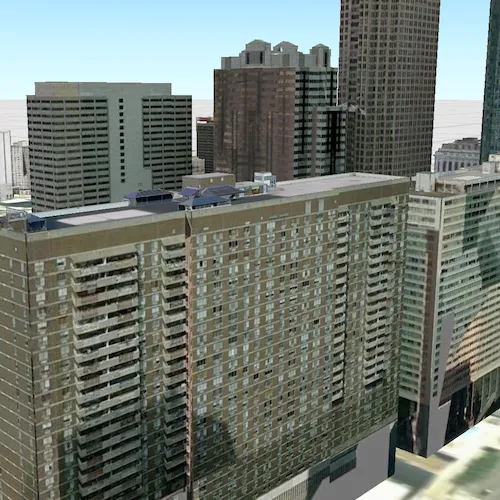
Opens and displays a scene from a Mobile Scene Package (.mspk).
Use case
An .mspk file is an archive containing the data (specifically, basemaps and features), used to display an offline 3D scene.
How to use the sample
When the sample opens, it will automatically display the Scene in the Mobile Map Package.
Since this sample works with a local .mspk, you may need to download the file to your device.
How it works
This sample takes a Mobile Scene Package that was created in ArcGIS Pro, and displays a Scene from within the package in a SceneView.
- Create a
MobileScenePackageusing the path to the local.mspkfile. - Call
MobileScenePackage::loadand check for any errors. - When the
MobileScenePackageis loaded, obtain the firstScenefrom theMobileScenePackage::sceneslist. - Create a
SceneViewand set the scene on the view for display.
Relevant API
- MobileScenePackage
- SceneView
Offline data
Read more about how to set up the sample’s offline data here.
| Link | Local Location |
|---|---|
| Philadelphia MSPK | <userhome>/ArcGIS/Runtime/Data/mspk/philadelphia.mspk |
Additional information
Before loading the MobileScenePackage, it is important to first check if direct read is supported. The MobileScenePackage could contain certain data types that would require the data to be unpacked. For example, Scenes containing raster data will need to be unpacked.
Tags
offline, scene
Sample code
// [WriteFile Name=OpenMobileScenePackage, Category=Scenes]// [Legal]// Copyright 2019 Esri.//// Licensed under the Apache License, Version 2.0 (the "License");// you may not use this file except in compliance with the License.// You may obtain a copy of the License at// http://www.apache.org/licenses/LICENSE-2.0//// Unless required by applicable law or agreed to in writing, software// distributed under the License is distributed on an "AS IS" BASIS,// WITHOUT WARRANTIES OR CONDITIONS OF ANY KIND, either express or implied.// See the License for the specific language governing permissions and// limitations under the License.// [Legal]
#ifdef PCH_BUILD#include "pch.hpp"#endif // PCH_BUILD
// sample headers#include "OpenMobileScenePackage.h"
// ArcGIS Maps SDK headers#include "Error.h"#include "MobileScenePackage.h"#include "Scene.h"#include "SceneQuickView.h"
// Qt headers#include <QStandardPaths>#include <QtCore/qglobal.h>
using namespace Esri::ArcGISRuntime;
// helper method to get cross platform data pathnamespace{  QString defaultDataPath()  {    QString dataPath;
#ifdef Q_OS_IOS    dataPath = QStandardPaths::writableLocation(QStandardPaths::DocumentsLocation);#else    dataPath = QStandardPaths::writableLocation(QStandardPaths::HomeLocation);#endif
    return dataPath;  }} // namespace
OpenMobileScenePackage::OpenMobileScenePackage(QObject* parent /* = nullptr */) :  QObject(parent){  // create the MSPK data path  // data is downloaded automatically by the sample viewer app. Instructions to download  // separately are specified in the readme.  const QString dataPath = defaultDataPath() + "/ArcGIS/Runtime/Data/mspk/philadelphia.mspk";
  // Create the Scene Package  createScenePackage(dataPath);}
OpenMobileScenePackage::~OpenMobileScenePackage() = default;
void OpenMobileScenePackage::init(){  // Register classes for QML  qmlRegisterType<SceneQuickView>("Esri.Samples", 1, 0, "SceneView");  qmlRegisterType<OpenMobileScenePackage>("Esri.Samples", 1, 0, "OpenMobileScenePackageSample");}
SceneQuickView* OpenMobileScenePackage::sceneView() const{  return m_sceneView;}
// Set the view (created in QML)void OpenMobileScenePackage::setSceneView(SceneQuickView* sceneView){  if (!sceneView || sceneView == m_sceneView)  {    return;  }
  m_sceneView = sceneView;
  // set the scene on the scene view to display  if (m_scene && m_sceneView)  {    m_sceneView->setArcGISScene(m_scene);  }
  emit sceneViewChanged();}
// Slot for handling when the package loadsvoid OpenMobileScenePackage::packageLoaded(const Error& e){  if (!e.isEmpty())  {    qDebug() << QString("Package load error: %1 %2").arg(e.message(), e.additionalMessage());    return;  }
  if (m_scenePackage->scenes().isEmpty())  {    return;  }
  // The package contains a list of scenes that could be show in a UI for selection.  // For simplicity, obtain the first scene in the list of scenes  m_scene = m_scenePackage->scenes().at(0);
  // set the scene on the scene view to display  if (m_scene && m_sceneView)  {    m_sceneView->setArcGISScene(m_scene);  }}
// create scene package and connect to signalsvoid OpenMobileScenePackage::createScenePackage(const QString& path){  m_scenePackage = new MobileScenePackage(path, this);
  // connect to the Mobile Scene Package errorOccurred to know when errors occur  connect(m_scenePackage, &MobileScenePackage::errorOccurred, [](const Error& e)  {    if (e.isEmpty())    {      return;    }
    qDebug() << QString("Error: %1 %2").arg(e.message(), e.additionalMessage());  });
  connect(m_scenePackage, &MobileScenePackage::doneLoading, this, &OpenMobileScenePackage::packageLoaded);
  m_scenePackage->load();}
// [WriteFile Name=OpenMobileScenePackage, Category=Scenes]// [Legal]// Copyright 2019 Esri.//// Licensed under the Apache License, Version 2.0 (the "License");// you may not use this file except in compliance with the License.// You may obtain a copy of the License at// http://www.apache.org/licenses/LICENSE-2.0//// Unless required by applicable law or agreed to in writing, software// distributed under the License is distributed on an "AS IS" BASIS,// WITHOUT WARRANTIES OR CONDITIONS OF ANY KIND, either express or implied.// See the License for the specific language governing permissions and// limitations under the License.// [Legal]
#ifndef OPENMOBILESCENEPACKAGE_H#define OPENMOBILESCENEPACKAGE_H
// Qt headers#include <QObject>
namespace Esri::ArcGISRuntime{ class Error; class Scene; class SceneQuickView; class MobileScenePackage;} // namespace Esri::ArcGISRuntime
Q_MOC_INCLUDE("SceneQuickView.h")
class OpenMobileScenePackage : public QObject{ Q_OBJECT
Q_PROPERTY(Esri::ArcGISRuntime::SceneQuickView* sceneView READ sceneView WRITE setSceneView NOTIFY sceneViewChanged)
public: explicit OpenMobileScenePackage(QObject* parent = nullptr); ~OpenMobileScenePackage();
static void init();
private slots: void packageLoaded(const Esri::ArcGISRuntime::Error& e);
signals: void sceneViewChanged();
private: Esri::ArcGISRuntime::SceneQuickView* sceneView() const; void setSceneView(Esri::ArcGISRuntime::SceneQuickView* sceneView); void createScenePackage(const QString& path);
Esri::ArcGISRuntime::Scene* m_scene = nullptr; Esri::ArcGISRuntime::SceneQuickView* m_sceneView = nullptr; Esri::ArcGISRuntime::MobileScenePackage* m_scenePackage = nullptr;};
#endif // OPENMOBILESCENEPACKAGE_H// [WriteFile Name=OpenMobileScenePackage, Category=Scenes]// [Legal]// Copyright 2019 Esri.//// Licensed under the Apache License, Version 2.0 (the "License");// you may not use this file except in compliance with the License.// You may obtain a copy of the License at// http://www.apache.org/licenses/LICENSE-2.0//// Unless required by applicable law or agreed to in writing, software// distributed under the License is distributed on an "AS IS" BASIS,// WITHOUT WARRANTIES OR CONDITIONS OF ANY KIND, either express or implied.// See the License for the specific language governing permissions and// limitations under the License.// [Legal]
import QtQuickimport QtQuick.Controlsimport Esri.Samples
Item {
SceneView { id: view anchors.fill: parent
Component.onCompleted: { // Set the focus on SceneView to initially enable keyboard navigation forceActiveFocus(); } }
// Declare the C++ instance which creates the scene etc. and supply the view OpenMobileScenePackageSample { id: model sceneView: view }}