Add client side feature reduction on a point feature layer that is not pre-configured with clustering.
Use case
Feature clustering can be used to dynamically aggregate groups of points that are within proximity of each other in order to represent each group with a single symbol. Such grouping allows you to see patterns in the data that are difficult to visualize when a layer contains hundreds or thousands of points that overlap and cover each other. Users can add feature clustering to point feature layers. This is useful when the layer does not have the feature reduction defined or when the existing feature reduction properties need to be overridden.
How to use the sample
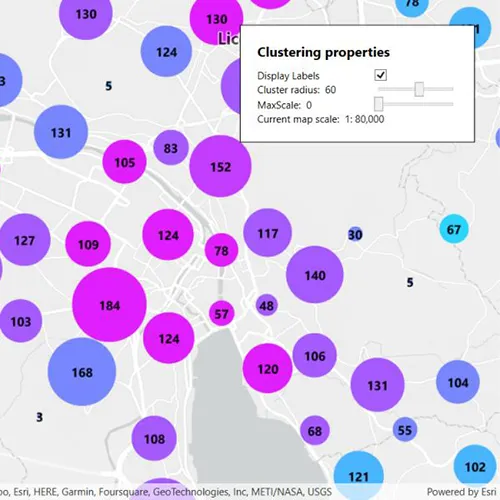
Tap the Draw clusters button to set new feature reduction object on the feature layer. Interact with the controls to customize clustering feature reduction properties. Tap on any clustered aggregate geoelement to see the cluster feature count and aggregate fields in the popup.
How it works
- Create a map from a web map
PortalItem. - Create a
ClassBreaksRendererand define aFieldNameandDefaultSymbol.FieldNamemust be one of the summary fields in theAggregateFieldscollection. - Add
ClassBreakobjects each with an associatedSimpleMarkerSymbolto the renderer. - Create a
ClusteringFeatureReductionusing the renderer. - Add
AggregateFieldobjects to the feature reduction where theFieldNameis the name of the field to aggregate and theStatisticTypeis the type of aggregation to perform. - Define the
MinSymbolSizeandMaxSymbolSizefor the feature reduction. If these are not defined they default to 12 and 70 respectively. - Add the
ClusteringFeatureReductionto theFeatureLayer. - Create a
LabelDefinitionwith aSimpleLabelExpressionandTextSymbolto define the cluster label. - Configure a
GeoViewTappedevent handler on theMapViewto display feature cluster information in aLabel.
Relevant API
- AggregateGeoElement
- ClassBreaksRenderer
- FeatureLayer
- FeatureReduction
- GeoElement
- IdentifyLayerResult
About the data
This sample uses a web map that displays residential data for Zurich, Switzerland.
Tags
aggregate, bin, cluster, group, merge, normalize, popup, reduce, renderer, summarize
Sample code
// [WriteFile Name=ConfigureClusters, Category=Layers]// [Legal]// Copyright 2023 Esri.//// Licensed under the Apache License, Version 2.0 (the "License");// you may not use this file except in compliance with the License.// You may obtain a copy of the License at// http://www.apache.org/licenses/LICENSE-2.0//// Unless required by applicable law or agreed to in writing, software// distributed under the License is distributed on an "AS IS" BASIS,// WITHOUT WARRANTIES OR CONDITIONS OF ANY KIND, either express or implied.// See the License for the specific language governing permissions and// limitations under the License.// [Legal]
#ifdef PCH_BUILD#include "pch.hpp" // IWYU pragma: keep#endif // PCH_BUILD
// sample headers#include "ConfigureClusters.h"
// ArcGIS Maps SDK headers#include "AggregateField.h"#include "AggregateFieldListModel.h"#include "AggregateGeoElement.h"#include "AttributeListModel.h"#include "ClassBreaksRenderer.h"#include "ClusteringFeatureReduction.h"#include "Error.h"#include "FeatureLayer.h"#include "GeoElement.h"#include "IdentifyLayerResult.h"#include "LabelDefinition.h"#include "LabelDefinitionListModel.h"#include "LayerListModel.h"#include "Map.h"#include "MapQuickView.h"#include "Popup.h"#include "PopupDefinition.h"#include "PortalItem.h"#include "ReductionTypes.h"#include "ServiceTypes.h"#include "SimpleLabelExpression.h"#include "SimpleMarkerSymbol.h"#include "SymbolTypes.h"#include "TextPopupElement.h"#include "TextSymbol.h"#include "Viewpoint.h"
// Qt headers#include <QColor>#include <QFuture>
using namespace Esri::ArcGISRuntime;
ConfigureClusters::ConfigureClusters(QObject* parent /* = nullptr */):  QObject(parent){  // Create a map from a web map PortalItem.  m_map = new Map(new PortalItem("aa44e79a4836413c89908e1afdace2ea", this), this);
  // Get the Zurich buildings feature layer once the map has finished loading.  connect(m_map, &Map::doneLoading, this, [this](const Error& error)  {    if (!error.isEmpty())    {      qDebug() << "Map loading error:" << error.message() << error.additionalMessage();      return;    }
    const LayerListModel* operationalLayers = m_map->operationalLayers();    if (operationalLayers->isEmpty())      return;
    m_layer = qobject_cast<FeatureLayer*>(operationalLayers->first());  });}
ConfigureClusters::~ConfigureClusters() = default;
void ConfigureClusters::init(){  // Register the map view for QML  qmlRegisterType<MapQuickView>("Esri.Samples", 1, 0, "MapView");  qmlRegisterType<ConfigureClusters>("Esri.Samples", 1, 0, "ConfigureClustersSample");}
MapQuickView* ConfigureClusters::mapView() const{  return m_mapView;}
// Set the view (created in QML)void ConfigureClusters::setMapView(MapQuickView* mapView){  if (!mapView || mapView == m_mapView)    return;
  m_mapView = mapView;  m_mapView->setMap(m_map);  connect(m_mapView, &MapQuickView::mapScaleChanged, this, &ConfigureClusters::mapScaleChanged);  connect(m_mapView, &MapQuickView::mouseClicked, this, &ConfigureClusters::mouseClicked);
  // Set the initial viewpoint to Zurich, Switzerland.  m_mapView->setViewpointAsync(Viewpoint(47.38, 8.53, 8e4));
  emit mapViewChanged();}
void ConfigureClusters::setClusterRadius(double clusterRadius){  if (!m_clusteringFeatureReduction)    return;
  m_clusteringFeatureReduction->setRadius(clusterRadius);}
void ConfigureClusters::setMaxScale(double maxScale){  if (!m_clusteringFeatureReduction)    return;
  m_clusteringFeatureReduction->setMaxScale(maxScale);}
double ConfigureClusters::mapScale() const{  if (!m_mapView)    return 0.0;
  return m_mapView->mapScale();}
void ConfigureClusters::createCustomFeatureReduction(){  // Add a class break for each intended value range and define a symbol to display for features in that range.  // In this case, the average building height ranges from 0 to 8 stories.  // For each cluster of features with a given average building height, a symbol is defined with a specified color.  const QList<ClassBreak*> classBreaks =  {    new ClassBreak("0", "0", 0.0, 1.0, new SimpleMarkerSymbol(SimpleMarkerSymbolStyle::Circle, QColor(4, 251, 255), 8.0, this), this),    new ClassBreak("1", "1", 1.0, 2.0, new SimpleMarkerSymbol(SimpleMarkerSymbolStyle::Circle, QColor(44, 211, 255), 8.0, this), this),    new ClassBreak("2", "2", 2.0, 3.0, new SimpleMarkerSymbol(SimpleMarkerSymbolStyle::Circle, QColor(74, 181, 255), 8.0, this), this),    new ClassBreak("3", "3", 3.0, 4.0, new SimpleMarkerSymbol(SimpleMarkerSymbolStyle::Circle, QColor(120, 135, 255), 8.0, this), this),    new ClassBreak("4", "4", 4.0, 5.0, new SimpleMarkerSymbol(SimpleMarkerSymbolStyle::Circle, QColor(165, 90, 255), 8.0, this), this),    new ClassBreak("5", "5", 5.0, 6.0, new SimpleMarkerSymbol(SimpleMarkerSymbolStyle::Circle, QColor(194, 61, 255), 8.0, this), this),    new ClassBreak("6", "6", 6.0, 7.0, new SimpleMarkerSymbol(SimpleMarkerSymbolStyle::Circle, QColor(224, 31, 255), 8.0, this), this),    new ClassBreak("7", "7", 7.0, 8.0, new SimpleMarkerSymbol(SimpleMarkerSymbolStyle::Circle, QColor(254, 1, 255), 8.0, this), this)  };
  // Create a class breaks renderer to apply to the custom feature reduction.  // Define the field to use for the class breaks renderer.  // Note that this field name must match the name of an aggregate field contained in the clustering feature reduction's aggregate fields property.  ClassBreaksRenderer* classBreaksRenderer = new ClassBreaksRenderer("Average Building Height", classBreaks, this);
  // Define a default symbol to use for features that do not fall within any of the ranges defined by the class breaks.  classBreaksRenderer->setDefaultSymbol(new SimpleMarkerSymbol(SimpleMarkerSymbolStyle::Circle, QColorConstants::Svg::pink, 8, this));
  // Create a new clustering feature reduction using the class breaks renderer.  m_clusteringFeatureReduction = new ClusteringFeatureReduction(classBreaksRenderer, this);
  // Set the feature reduction's aggregate fields. Note that the field names must match the names of fields in the feature layer's dataset.  // The aggregate fields summarize values based on the defined aggregate statistic type.  m_clusteringFeatureReduction->aggregateFields()->append(      new AggregateField("Total Residential Buildings", "Residential_Buildings", AggregateStatisticType::Sum, this));
  m_clusteringFeatureReduction->aggregateFields()->append(      new AggregateField("Average Building Height", "Most_common_number_of_storeys", AggregateStatisticType::Mode, this));
  // Enable the feature reduction.  m_clusteringFeatureReduction->setEnabled(true);
  // Set the popup definition for the custom feature reduction.  m_clusteringFeatureReduction->setPopupDefinition(new PopupDefinition(m_clusteringFeatureReduction, this));
  // Set values for the feature reduction's cluster minimum and maximum symbol sizes.  // Note that the default values for Max and Min symbol size are 70 and 12 respectively.  m_clusteringFeatureReduction->setMinSymbolSize(5.0);  m_clusteringFeatureReduction->setMaxSymbolSize(90.0);
  // Set the feature reduction for the layer.  m_layer->setFeatureReduction(m_clusteringFeatureReduction);
  // Set initial slider values.  // Note that the default value for cluster radius is 60.  // Increasing the cluster radius increases the number of features that are grouped together into a cluster.  m_clusteringFeatureReduction->setRadius(60.0);
  // Note that the default value for max scale is 0.  // The max scale value is the maximum scale at which clustering is applied.  m_clusteringFeatureReduction->setMaxScale(0.0);}
void ConfigureClusters::drawClusters(){  // If the layer is not yet loaded, do nothing.  if (!m_layer)    return;
  // Create a new clustering feature reduction.  createCustomFeatureReduction();}
void ConfigureClusters::displayLabels(bool checked){  if (!m_clusteringFeatureReduction)    return;
  if (checked)  {    // Create a label definition with a simple label expression.    SimpleLabelExpression* simpleLabelExpression = new SimpleLabelExpression("[cluster_count]", this);    TextSymbol* textSymbol = new TextSymbol("", QColorConstants::Svg::black, 15.0, HorizontalAlignment::Center, VerticalAlignment::Middle, this);    textSymbol->setFontWeight(FontWeight::Bold);    LabelDefinition* labelDefinition = new LabelDefinition(simpleLabelExpression, textSymbol, this);    labelDefinition->setPlacement(LabelingPlacement::PointCenterCenter);
    // Add the label definition to the feature reduction.    m_clusteringFeatureReduction->labelDefinitions()->append(labelDefinition);  }  else  {    m_clusteringFeatureReduction->labelDefinitions()->clear();  }}
void ConfigureClusters::mouseClicked(QMouseEvent& mouseEvent){  if (!m_layer)    return;
  // clear cluster selection  if (m_aggregateGeoElement)    m_aggregateGeoElement->setSelected(false);
  // Clean up any children objects associated with this parent  m_resultParent.reset(new QObject(this));  m_aggregateGeoElement = nullptr;
  // Identify the tapped observation.  m_mapView->identifyLayerAsync(m_layer, mouseEvent.position(), 3.0, true, m_resultParent.get()).then(this, [this](IdentifyLayerResult* result)  {    // clear cluster selection    if (m_aggregateGeoElement)      m_aggregateGeoElement->setSelected(false);    if (!result->popups().isEmpty())    {      Popup* popup = result->popups().at(0);      m_aggregateGeoElement = dynamic_cast<AggregateGeoElement*>(popup->geoElement());      if (m_aggregateGeoElement)        m_aggregateGeoElement->setSelected(true);
      QList<PopupElement*> popupElements;
      const auto attributes = popup->geoElement()->attributes();      for (const QString& attrName : attributes->attributeNames())      {       QString value = attributes->attributeValue(attrName).toString();
       TextPopupElement* textElement = new TextPopupElement(attrName + ": " + value, this);       popupElements.append(textElement);      }      m_popup = new Popup(popup->geoElement(), this);      emit popupChanged();    }    });}
void ConfigureClusters::clearSelection() const{  if (m_aggregateGeoElement)    m_aggregateGeoElement->setSelected(false);}
// [WriteFile Name=ConfigureClusters, Category=Layers]// [Legal]// Copyright 2023 Esri.//// Licensed under the Apache License, Version 2.0 (the "License");// you may not use this file except in compliance with the License.// You may obtain a copy of the License at// http://www.apache.org/licenses/LICENSE-2.0//// Unless required by applicable law or agreed to in writing, software// distributed under the License is distributed on an "AS IS" BASIS,// WITHOUT WARRANTIES OR CONDITIONS OF ANY KIND, either express or implied.// See the License for the specific language governing permissions and// limitations under the License.// [Legal]
#ifndef ConfigureClusters_H#define ConfigureClusters_H
// Qt headers#include <QObject>
namespace Esri::ArcGISRuntime{ class AggregateGeoElement; class ClusteringFeatureReduction; class FeatureLayer; class Map; class MapQuickView; class Popup;}
class QMouseEvent;
Q_MOC_INCLUDE("MapQuickView.h");Q_MOC_INCLUDE("Popup.h")
class ConfigureClusters : public QObject{ Q_OBJECT
Q_PROPERTY(Esri::ArcGISRuntime::MapQuickView* mapView READ mapView WRITE setMapView NOTIFY mapViewChanged) Q_PROPERTY(double mapScale READ mapScale NOTIFY mapScaleChanged) Q_PROPERTY(Esri::ArcGISRuntime::Popup* popup MEMBER m_popup NOTIFY popupChanged)
public: explicit ConfigureClusters(QObject* parent = nullptr); ~ConfigureClusters() override;
static void init();
Q_INVOKABLE void clearSelection() const; Q_INVOKABLE void displayLabels(bool checked); Q_INVOKABLE void drawClusters(); Q_INVOKABLE void setClusterRadius(double clusterRadius); Q_INVOKABLE void setMaxScale(double maxScale);
signals: void mapViewChanged(); void mapScaleChanged(); void popupChanged();
private: Esri::ArcGISRuntime::MapQuickView* mapView() const; void setMapView(Esri::ArcGISRuntime::MapQuickView* mapView);
double mapScale() const;
void createCustomFeatureReduction();
void mouseClicked(QMouseEvent& mouseEvent);
Esri::ArcGISRuntime::Map* m_map = nullptr; Esri::ArcGISRuntime::MapQuickView* m_mapView = nullptr; Esri::ArcGISRuntime::FeatureLayer* m_layer = nullptr; Esri::ArcGISRuntime::ClusteringFeatureReduction* m_clusteringFeatureReduction = nullptr; Esri::ArcGISRuntime::Popup* m_popup = nullptr;
QScopedPointer<QObject> m_resultParent; Esri::ArcGISRuntime::AggregateGeoElement* m_aggregateGeoElement = nullptr;};
#endif // ConfigureClusters_H// [WriteFile Name=ConfigureClusters, Category=Layers]// [Legal]// Copyright 2023 Esri.//// Licensed under the Apache License, Version 2.0 (the "License");// you may not use this file except in compliance with the License.// You may obtain a copy of the License at// http://www.apache.org/licenses/LICENSE-2.0//// Unless required by applicable law or agreed to in writing, software// distributed under the License is distributed on an "AS IS" BASIS,// WITHOUT WARRANTIES OR CONDITIONS OF ANY KIND, either express or implied.// See the License for the specific language governing permissions and// limitations under the License.// [Legal]
import QtQuickimport QtQuick.Controlsimport Esri.Samplesimport QtQuick.Layoutsimport Esri.ArcGISRuntime.Toolkit
Item { // add a mapView component MapView { id: view anchors.fill: parent
Component.onCompleted: { // Set and keep the focus on MapView to enable keyboard navigation forceActiveFocus(); } }
// Declare the C++ instance which creates the map etc. and supply the view ConfigureClustersSample { id: sample mapView: view
onPopupChanged: popupView.visible = true }
// Add a background to the column Rectangle { anchors.fill: dialog radius: 10 border.width: 1 visible: (Qt.platform.os === "android" || Qt.platform.os === "ios") ? !popupView.visible : true }
PopupView { id: popupView anchors { top: parent.top bottom: parent.bottom right: parent.right } popup: sample.popup
visible: false onVisibleChanged: { if (!visible) sample.clearSelection(); } }
Column { id: dialog spacing: 15 padding: 10
Button { id: button visible: !button.checked width: 200 anchors.horizontalCenter: parent.horizontalCenter text: "Draw clusters" checkable: true onClicked: { sample.drawClusters(); sample.displayLabels(true); } }
Label { visible: button.checked text: "Clustering properties" font.pointSize: 14 padding: 5 }
CheckBox { visible: button.checked text: "Display Labels" checked: true onCheckedChanged: sample.displayLabels(checked); }
Label { visible: button.checked text: "Cluster radius: " + Math.round(clusterRadiusSlider.value); font.pointSize: 14 padding: 5 }
Slider { id: clusterRadiusSlider visible: button.checked from: 30 to: 85 value: 60 onValueChanged: sample.setClusterRadius(value); }
Label { visible: button.checked text: "MaxScale: " + Math.round(maxScaleSlider.value) font.pointSize: 14 padding: 5 }
Slider { id: maxScaleSlider visible: button.checked from: 0 to: 150000 value: 0 onValueChanged: sample.setMaxScale(value); }
Label { visible: button.checked text: "Current map scale: " + Math.round(sample.mapScale); font.pointSize: 14 padding: 5 } visible: (Qt.platform.os === "android" || Qt.platform.os === "ios") ? !popupView.visible : true }}